Titled: Where Teachers Meet
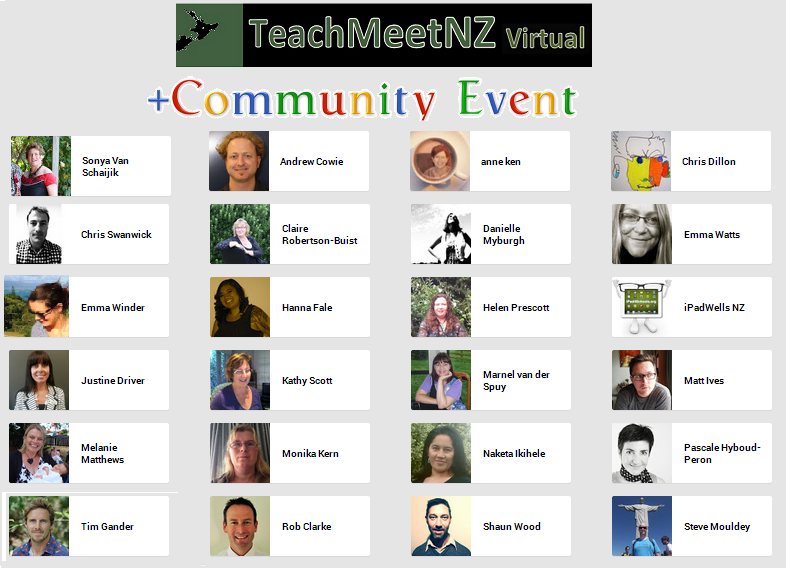
(Educators involved in TeachMeetNZ in 2013)
This post is an update of that article.
In 2013, I launched TeachMeetNZ as part of my TeachNZ Sabbatical. A TeachMeet is an organised but informal meeting (in the style of an unconference) for teachers to share good practice, practical innovations and personal insights in teaching with technology. TeachMeet originated with three Scottish educators – Ewan McIntosh, David Noble and John Johnston. Currently all over the world there are hundreds of TeachMeets that take place regularly in a variety of venues. As Ewan Macintosh commented, TeachMeet was never about technology 100%, it was about the Teach first of all, and the tech was instrumental to achieving what we wanted to achieve pedagogically and never the other way around.” Ewan Macintosh.
This article will describe how I developed TeachMeetNZ, the process of the on-line organised collaboration using Google Hangout, the relevance to teaching and conclude with future development for TeachMeetNZ.
TeachMeetNZ
I developed TeachMeetNZ after two years of research, investigation, then the trialling of a variety of online products, with Google Hangout being selected as the preferred platform.
A small team of willing educators agreed to join with me to learn how to use Google Hangout as a way of presenting, demonstrating good practise, sharing and celebrating teaching with technology. Each term, a group of inspirational New Zealand educators develop and deliver a series of presentations. These sessions are live streamed, and are attended virtually by educators from around New Zealand and globaIly. In addition a TeachMeetNZ wiki was developed for participants to communicate and share their presentations with a virtual audience.
Collaboration and participation
TeachMeetNZ is about New Zealand teachers connecting online. They collaborate and problem solve using online tools. These educators support and mentor each other before and during the practise Google Hangout sessions. To take part, teachers prepare 12 slides that auto cue every 15 seconds so their presentation is three minutes long. The slides are hosted on Google Presentation or Slideshare and must be live before the session. We learnt that the most viewed YouTube clips are just under three minutes long so this is the preferred length. A three minute video is created of their presentation and may become a resource for use at a later time.
After the live event, discussion usually follows via twitter using the hashtag #TeachMeetNZ. Many teachers go on to blog a reflection of their session, and they can embed the YouTube clip into their blog. A TeachMeetNZ presenters badge is awarded to those educators who present on TeachMeetNZ.. Participants and viewers willingly give feedback and regularly give their time to support and help others.
Relevance to teaching
Online spaces are useful for portfolio development and fostering interaction and collaboration. Google Hangout is a tool that can be used to collate and present resources, to support community interaction and contributions, and as a platform for personal expression. Google Hangout is an ideal tool for teachers combined with a YouTube account.
From creating and hosting TeachMeetNZ sessions I have learnt that teachers appreciate recognition and acknowledgement for what they do. Hosting TeachmeetNZ has pushed my knowledge of making connections with ideas and with people. Hosting the sessions has encouraged me to give better feedback to teachers who take part. The sessions have allowed me to be more focussed on my feedback with teachers and not to rush this important process. After each session I play the clip back and reflect on how I can carry out the task better next time. I make notes and begin with these notes at the next session. I have also learnt to go through the presentations before the live streaming so that I can better prepare my questions. I do this by asking for presentations to be live before the session and I usually run practise sessions for people new to using Google Hangout.
Where to next?
In the future I plan to host more discussion sessions with panels of educators. Last year I had an educator host a specialist session based on PE and this year I have planned to include similar sessions. In addition I have planned to have single themed discussions and to have educators and practitioners who can contribute to themes at a deeper level. Some of the feedback that I have had from participants is that they enjoy the opportunity to ask questions and discuss ideas in greater depth. A session, that I hosted at the Festival of Education in Auckland, featured a group of inspirational educators who shared and discussed their passions both online and with a live audience.
The TeachMeetNZ site has grown rapidly and I have now become the site’s curator. Currently the site contains nearly thirty nano presentations. This number increases each term as teachers share and celebrate their learning on TeachMeetNZ. Global visitors and viewers can watch the presentations in their own time and place.
For my own learning.
The SOLO Taxonomy practitioner in me realises that my current sessions take me back to being multistructural in my thinking. In order to achieve depth in what I do online I need to continue to take a leadership role in other online communities. As frightening as this sounds I think that my first goal is to move from participating and running TeachMeetNZ sessions in online communities to being involved at administration level with online global projects. I would also like to continue with mentoring and developing others to host sessions. The popularity of the digital badge concept may also mean that I further develop this system for levels of participation.
If you have been a presenter or have watched a session on TeachMeetNZ, please add your comments below.
For further information
Visit the wiki
Teacher from Newmarket School
Auckland New Zealand


 Sonya @VanSchaijik