October-spring is here

 
October is usually a crazy busy month for me.


It is my mum and dad’s birthday. In addition it is my youngest son’s birthday and also my birthday.


This October I have probably taken on far too much but because I have been in the world of education for 30 years, I know that sometimes it just gets like that and helps with the sprint to the end of the year for our New Zealand summer holidays. Plus it is the learning that ignites my education fire and I find it exciting and stimulating. I am passionate about teachers and their learning too. To help give you a bit of an overview, here is what my October looks like for me, without those important four family dates and all the practises in between.


Dates
Title
Links
30 Sept
Minecraft Hangout
Google Hangout
1st Oct
Launching CENZ
Webinaire
4th Oct
TeachMeetNZ google Hangout
Google Hangout
9 Oct
Present Ulearn with Wendy
Presentation
10 Oct
Present Ulearn with Ginnie
Presentation
TBC
Eduignite Citizenship
Presentation
20 Oct
Complete my chapter on educator
Blog Post
28 Oct
TeachMeetNZ /TMsydney
Google Hangout
31st Oct
EdbookNZ
Publish a book


I am also aiming to complete my Flat Connections Global Educator Certificate with Julie Lindsay. Already I have learnt that I do not give enough opportunities for my teams to get to know each other with a handshake. I have immediately remedied that by setting up a padlet for my #TeachMeetNZ project.

In addition set up systems to support our RTLB with the next roll out of iPads for their teaching and learning with students. Currently I am reading around minecraft as I believe we need to explore this programme further.

Sometimes I am asked why do I take on the extra outside of my school life, however those of you in my PLN who read this, you will fully understand when I say all the extra benefits me, my learning and therefore benefits my school. How else do I know how to help our teachers create videos, help them with reflective blog posts, help them with their inquiries and presentations and know who to ask for help or call in to skype with our children and share their expertise. Ultimately this helps them  This is because I am right in the middle of it all.


PS: I aim to visit Eden Gardens too these holidays and I hope to get my garden planted for the summer.

The tool for the job.

I have an interest in boys writing and have been fascinated by some of the stories our children write around Minecraft.
I was first introduced to Minecraft a few years back in 2010 via Natasha Walden @MissNWalden a teacher at our school. She told me that this game, Minecraft, was taking the gaming world by storm. However I had no idea what she was talking about except to feel quite scared when we were in Minecraft. Then nighttime arrived and I was not ready in and for this Minecraft world. I now realise we had entered Survival Mode.
So I learnt there was a difference between Survival Mode and Creative Mode. Survival Mode has the monsters come out at night and Creative Mode is when you can fly around and see the world that you have made. I think that if I had seen Creative Mode I might have been persuaded to take part. Natasha is one of those teachers that drags me along in her online gaming world. Through her I had seen the inside of WOW and Minecraft before they were even spoken about in lay education circles.
Fast forward to 2013 and I watched my nephew create cheat videos to access pathways on his server. He showed me a Minecraft map that he had created and has had a massive download. Normally a quiet and shy fellow, his eyes lit up passionately as he explained what he was doing and why. But again I was not quite ready with my understanding. I was still a lurker and observer.
Then Shaun Wood @mrwoodnz presented on TeachMeetNZ and I was intrigued again with the Minecraft World.
I started to learn about servers, and about the Minecraft Edu version. I began asking questions about the logistics of bringing Minecraft into our school. I spoke with our technical people about setting up our own server. This year however I have been consumed with Google Apps for Education as we established our domain name, learnt how to use GAFE at school, set up the architecture for teacher use and learnt how to set up and use Hapara. This is still a time consuming journey. So Minecraft sat in the back and simmered.
As is with all fabulous professional learning, I spotted this #educampminecraft event via twitter. This year when Annemarie Hyde put the call out to attend I could not resist finding out more of what other educators in New Zealand were doing with Minecraft.
So on Friday night, straight after school I drove down to Rotorua and joined several other educators for #educampminecraft at Mokoia Intermediate School.
You can find out more about the event here on the educamp wiki.
Annemarie created a collaborative presentation using Google slides and different people added their ideas before the day http://bit.ly/1r7vnXQ
During the day, Monika Kern kept the conversation broadcasting to the rest of New Zealand via twitter and challenged us to complete a blog post about our experience of the day. By doing this I can grab a digital badge for my portfolio. I am always open to a challenge and this keeps me motivated to reflect on what I learn.
I contributed by creating a twitter list of all the teachers talking about Minecraft in New Zealand and that can be accessed here.
Here is a folder that I created and added photos that I took during the day.
Straight after the event Reid Walker created a Google+ Community for teachers using Minecraft group and that can be accessed here.
During the day it was particularly powerful to have some students there sharing their expertise with Minecraft. How often do we see students at education events? So I thought this was forward thinking of the organisers.
However I do think that the students would have probably run the session in a totally different way. I loved the way they showcased their work.
I loved how Kassey Downward  had her students share their learning and then guided us in ours. I learnt about griefing, when you destroy creations. One student said to me that is what I was doing when I left clicked the mouse and had great fun pulling down buildings that others had created. She said, “In Minecraft we practise citizenship and do not destroy other people’s creations.”
She taught me how to right click and put the blocks back. However I probably had already created quite a bit of havoc. We got to hear too from Natalie Dodd and her students about how they used Minecraft. 
My learning from all this is to go down the Minecraft Edu pathway because of time. According to Shaun who came in via skype and shared how he had set up a server, a lot of time and technical know how is required to set up a server for the children. You can read more about this on the slides.
I had my questions answered and more. I saw how Steven Katene mapped using Minecraft against SOLOtaxonomy. I say how his students crafted their Minecraft planning using Inspiration. I saw how they shared their creations with family via hidden youtube URL. His school has a 1:1 ipad programme. I can’t wait to have further dialogue with this amazing educator.
I had gone to Rotorua specifically to find out how to set up a server and the logistics in running Minecraft at our school. There would be legalities involved in hosting a server separate from Minecraft Edu where children take part and learn. In addition, the space would require adult supervision because our children are under the age of 14. I still observe what happens in Skoodle and know from experience that the most active online time for our children is straight after school. Some can work quite late at night. Yes we can lock it down to certain hours but also know from experience is that the children will move to other social media sites to communicate with their friends when we lock down their sites. I had been mulling over the idea of buying our own space because I initially thought the Edu licence seemed quite expensive and I am always looking for a cheaper way of doing things. However because we are dealing with student safety Minecraft Edu would be the preferred option. 
Another idea that I found out is that Minecraft requires a hard drive therefore striking our chrome books out. I don’t know why I had not thought about that. I thought Minecraft was an online game and did not realise that we would need plugins to download.
https://minecraft.net/store A singe computer licence costs $33.16 and this can be downloaded. 
The Minecraft Edu Version costs $22.15NZ per single licence and a single server licence is $50.45 NZ. However with the Microsoft school’s agreement deal I wonder if this would change because of the recent takeover.  At Newmarket School, we would require 1x server licence and $22.15 x each senior syndicate student and a netbook per student. So that cuts out what I had planned for the senior team because our senior classes have chrome books and Minecraft cannot go on a chrome book.
I also see that there is also an iPad  licence that costs $8.99. However this does not work with the Edu version. I have not yet investigated if this can be bought on the VPP store. But think that this could be an answer for us. I need to speak more to Steve about this and I have heaps more questions for him. Michael Fawcett confirmed that the pocket versions could talk together. So the Androids can talk to the iPads.
Our middle school use ipad and netbooks so at this stage they are the best place to put in a copy of  Minecraft. My recommendation to school would be to purchase 30 iPad licences and aim Minecraft for the middle school. But I would only do that if a teacher is willing to take the time to trial it with her class as part of teaching and learning. Like with everything on the iPad, Minecraft would go have to go through Configurator. Because we do not have 1:1 devices we would have the challenges of saving games and a shared central location of creations to deal with.
So where to for us.


When I think ahead for us as a school I recall the weekend conversation I had with Annemarie regarding the tool for the job. As a school we are conscious about sinking too much money into one platform as things change so quickly.  The ideal tool for Minecraft appears to be a netbook, with a mouse. To make full use of the collaborative and community aspect we would require a server licence and individual licences for the students involved. We would need someone to set it up and have a teacher dedicated to be an online moderator.  The alternative is to have it set up on the ipads but like with everything on an iPad, there are challenges for sharing because of the ages of our children and because they do not have 1:1 ipads.
If someone can talk me through a workaround, I would love to discuss this more. I am @vanschaijik on twitter.


Teachers at Newmarket School, if you have any further ideas, do let me know. My thinking around Minecraft for learning is how absolutely fabulous. We all know that learning is a social activity and what better way can we hook in our children with learning then with connecting, collaborating, creating and sharing in a community environment using a space that they love and several already know so well.


Reid, you were looking for a further challenge after completing your Code challenges. How about if we go in together as educators into the Minecraft world and create something for our own learning. Maybe we could create our ideal school. I would put my hand up for that.


Annemarie, Monika, Kassey, Steve thanks heaps for organising an amazing day of learning for us. Unfortunately I have come away with more questions that fortunately I can ask on the new Minecraft community.
To find out more about Mincraft in New Zealand Schools, Visit the site created.To find out more about #educampminecraft, Visit the slides created.

To find out more about education licences, Visit the Minecraft Edu Wiki space.
The big news of the weekend was that  Minecraft has just been sold to Microsoft. Delving a little into the Minecraft history brings up two names.

Markus Persson @NotchAlexej Creator of Minecraft. @jeb_ Lead developer for Minecraft


Goundhog Day at Newmarket School

In 1877, Newmarket School in Auckland New Zealand was established on the site where 277 is today.
On the weekend I was excited to have our current principal Dr Wendy Kofoed take part in an online discussion about learning with educators from around New Zealand.
This discussion will continue throughout October as part of #CENZ14.
After the discussion I put a call out to Pam Hook to read what we have so far accomplished as I wanted to ensure that the project is framed by SOLO Taxonomy. 
Pam flicked me a link to a sceptics log she and a team of creators had made in 2006 and the discussion was the same. In addition she linked me up to Chris Bigum who had been part of that original discussion and he started feeding me readings and video links via twitter.
The outcome of all that weekend learning is this reflection.
One particular idea that I had read about and awoke with was groundhog day. 
We are such an old school. I thought of our first school leader, Captain Charles Ross Cholmondely Smith.
in his single classroom with his room full of children.
The stories I have read about how the children learnt is hilarious. 
But if we revisit those early days of education, we know that the teacher was basically a coach.
They used the older children to teach the younger children who in turn taught the younger ones than themselves. In addition he would have had a team of children leaders who took care of various activities to help with the running of the school, kind of like our student leadership programme.
If a child needed extra help they would know who to ask for support.
They would only go to the teacher when absolutely necessary because he ruled his classroom in true military style of the time. 
Newmarket School on current 277 site of today
As the years passed and the school grew and new teachers came in, the process continued with teachers using each other as support. There was no professional development in those days only personal learning.
They relied totally on the community for everything because there was no local $2.00 shops to stock up or colour photocopying for the walls. They used local resources in their programme kind of like the glocalisation concept. (No, not a spelling mistake.)
The children would have continued to support each other and most had a job to do to help keep the school clean and tidy because there would have been no school cleaners in those days. This is like how we structure our enviro programme.
I was thinking about our current situation with the discussion centred around learning and thought we are moving back to those times not because of circumstances but because it just worked.
Teachers are reminded about the pool of learning amongst their peers. Our current head teacher continues to lead by example in her own learning. She in turn guides and coaches her team in their learning, who guide and coach the teachers in their teams with their learning who guide and coach the children in their classes and between classes as we move back to ”it takes a whole school to teach a child,’ and we move back to the notion of a single building on the site where there are no walls and we learn with and from each other. 
We have a variety of interesting developments happening in our school and this is raising teachers to the surface with their learning. Even more exciting is that they are sharing their learning with each other and several have begun the journey of reflecting in a visible way for our global school community via  a blog that you can read on the right hand side. If I have missed anyone, please do send me your link.
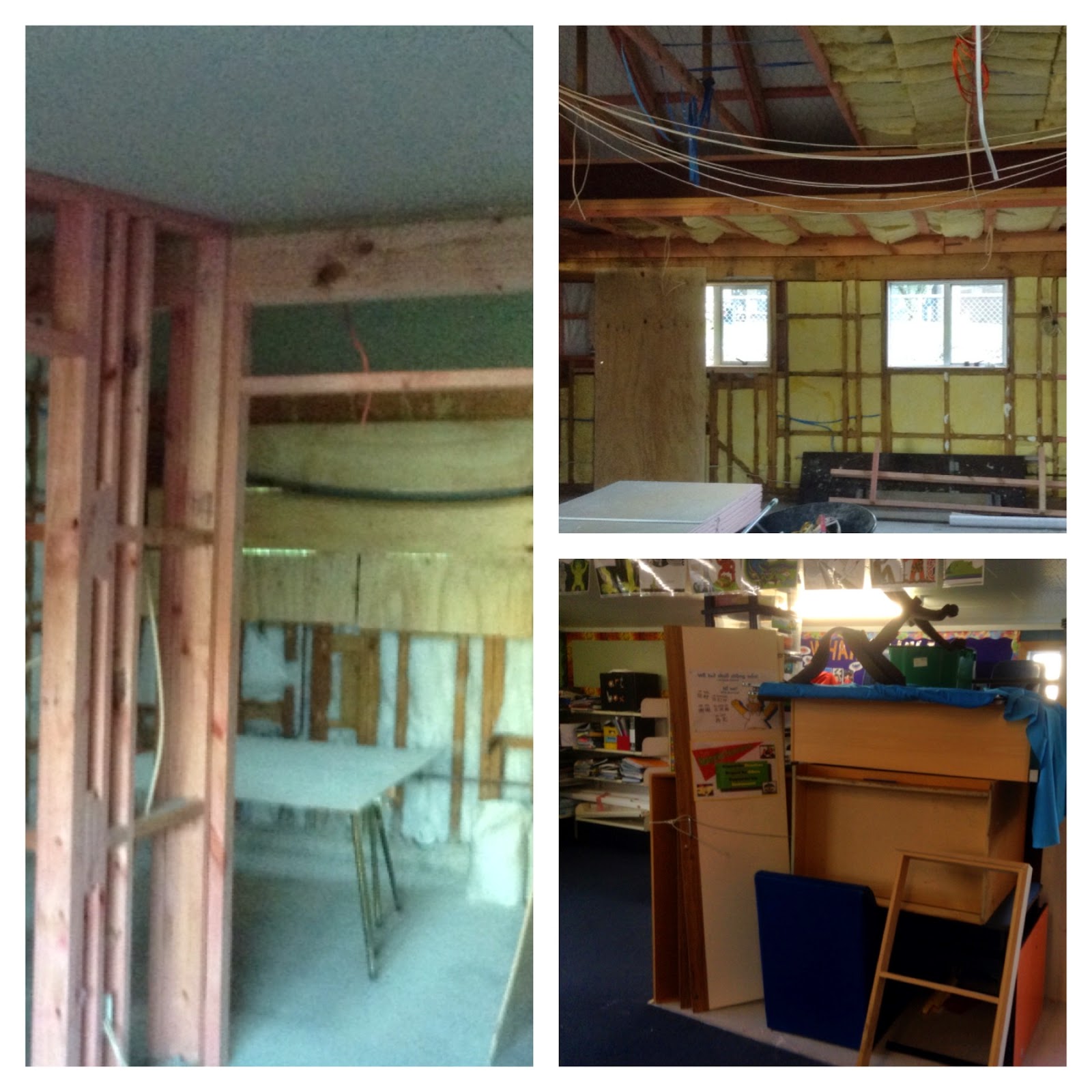
So in our old grounds, in our old buildings that are being demolished and rebuilt I can hear our head teacher, teachers and children ancestors giggling and watching from the ruins saying, here we go again. And you know what, so what. This teacher with 30 years experience finds it exciting to watch the cycle of education life go around again. Just like I love watching our 100 year old tree go through its cycle of life on a yearly basis, change and grow bigger and better, Just like I love talking with teachers and hearing their learning stories and sharing their learning stories. Even more exciting is the change happening. 
Children ancestors of Newmarket School

Eduignite

This post is a reflection of all the times I have taken part in Eduigite sessions.

I guess it is thanks to Veni Jamieson whose feedback to me after one of my led staff meetings was ‘Find out how not to blush so much when you present.’

I do, I get really red because I am not a public speaker and the nerves are just there.

So the first thing I did was research and some steps I read include, drink cold water before going into a session, locate the room and survey before you begin, make connections with your audience, and just get in front and do it. The more you present the better you will be.

The steps are simple enough except for ‘practice speaking out loud as often as you can to a room full of people’. Hence Eduignite. Where else could I find a better group of people to practice on than my own peers?

My first eduignite, I attended was Term 3 2012.
The second time I was unwell, but went along anyway and presented. I was really nervous as you can see and hear.

To present in 5 minutes, a lot of time is involved in preparation just for 5 minutes.
The format is 20 slides in 5 minutes. Each slide auto runs at 15 sec intervals.
You have to know your topic really well.

I rely on cue cards as I speak, because I just do. I have also used an ipad as cue cards and learnt to create PDFs that could be downloaded in advance using iBooks. That was before schools had easier access to wifi. Now I usually use them because it is just one less technology I am organising.

As each session progressed, I am not as nervous at the thought. I have now given 5x mini presentations and yes my confidence has certainly grown in this area. I do not feel as nervous as the earlier days and I am getting better. Every so often I get feedback that makes me pause and think. Like last presentation night when Emma Winder said Sonya you always share some great ideas. Because for me the real purpose is practicing with  a room full of peers to overcome nerves. The bonus is I also get to listen to other stunning presentations and hear teachers sharing their stories.

I also like to see the videos of my own performance and the earlier ones I cringe at but learning can’t happen without a few lessons.

Last night, I did not blush. Where to next for me. The next eduignite is held at the National library in week 1-2 of Term 4. Andrew Cowie is orgainisng that one as part of Connected Educators Month #CENZ14 and I will present again because this year I set myself a goal of sharing a three part journey.
Part one: My personal tattoo, Part two: My digital tattoo, Part three: Citizenship. You can check out the slides on my slideshare account.

I have had Reubina Irshad come along to one session and Wendy Kofoed my principal attend another. Eduignite stipulates that the first time you attend, the second you either present or bring a mate. Having peers attending from school only added to the stress of presenting because again, presenting to people you know has both positives and negatives.

This time too I have set further goals, invite the rest of Newmarket Staff to join me in the third presentation of  the three part series, get some more feedback from Veni to see if he thinks I have improved and EKK not use cue cards. There I have written it down.

This would be extra fabulous for me because I have been working with our Newmarket Staff on making connections with each other using social media. Eduignite would be a great way of connecting with other educators F2F outside of Newmarket School, use twitter during the session and maybe this might higlight too the importance of making their own learning visible.

The great thing about Eduignite is that the entertainment learning is free and there is always wine and food. The evenings are fun and you get to meet some great people.

So I do hope you all join me in Term 4 at the National Library.

Finally, just a shout out for Torbay school who hosted the last session. They are selling cook books as a fund raiser. I loved the way Johanna Chambers kept reminding us and she did all she could to support her school in their fundraiser. Oh and I caught the tail end of their children’s Trash to Fash sharing. It was absolutely brilliant.

Torbay School Cookbook. Developed by students. Awesome Christmas gifts @vanschaijik pic.twitter.com/oYxLoTmWLC
— Johanna Chambers (@ChambersJohannaSeptember 11, 2014

Connected Educator


The Connected Educator at Newmarket School.
Very soon Dr Wendy Kofoed and myself are presenting at Ulearn14. Our presentation centres around our teachers. The title of our presentation is ‘Before collaboration teachers need to make connections.’ Do join us at Ulearn. We are Breakout Four A on 09 Oct 2014 at 13.45-14.15. This post has developed as part of my teacher inquiry around ‘Connected Educators at Newmarket School.’
In our school’s revised strategic plan, one of our guiding principles is Whangaungatanga or connectedness. As Wendy and staff have been working at crafting our strategic plan I have been revisiting my own understanding of whangaungatanga. For me as an efellow that is about my understanding of hyperconnectivity which is all about the relationships we build and how we build them. The Samoan word for connectedness is Va Fealofani and in Maori it is Whanaungatanga.
So some of my own questions include:
·                What does a Connected Educator at Newmarket School look like?
·                What tools do they use and why?
·                How do they share what they are learning?
As I have been thinking and reflecting on connectedness Wendy has been looking at the big picture. Her own inquiry centres around ‘Challenging Learning Design.’ I look forward to her sharing her own inquiry.
At Newmarket one concept we have is whakatauki which is sharing our stories. On our boundaries and dotted within our school we have Harakeke growing. In the springtime when the Harakeke flowers we have Tui come and drink the nectar. So I begin my post with the following proverb and have changed the word kōmako for Tui because we do not have bellbirds.
Hutia te rito o te harakeke
Kei whea te Tui e kō?
Kī mai ki ahau;
He aha te mea nui o te Ao?
Māku e kī atu
he tāngata, he tāngata, he tāngata
If the heart of the harakeke was removed,
Where would the Tui sing?
If I was asked,
What is the most important thing in the world”?
I would say
It is people, it is people, it is people
If I frame this post around the current three school values I am already confident about our presentation focus. Our three values are whanaungatanga, manaakitanga, kaitiakitanga.
I use these concepts and their definition to frame my current thinking around Connected Educators.
What is a Connected Educator at Newmarket School?
Whanaungatanga – Connectedness
Being connected requires learners to develop a secure sense of their own identity and agency to think and work towards where their potential might lie.
Newmarket School is already a strong learning community that collaboratively constructs knowledge to form a foundation for learning. In order to achieve this we aim for all our teachers to be connected educators. A Connected educator at Newmarket School understands the concept of whanaungatanga. They are someone who focuses on building relationships with each other, our community and our children.
A connected educator at Newmarket School knows how to use the managed online tools to find people and how to connect with them. They think carefully about the dynamics of interactions. They actively use Facebook, Twitter, Skype, Google+, LinkedIn, and other media tools to make connections and to build their own personal learning network. Because we are in New Zealand a connected educator at Newmarket School’s learning kete includes some New Zealand managed tools such as Pond, Virtual Learning Network, Myportfolio and the School Google+ community to find other New Zealand educators and to actively connect with them and build learning relationships.

What tools do they use and why?
Manaakitanga  – Generosity of spirit
Developing the ability to walk in others’ shoes which includes seeing issues from others’ perspectives and thinking carefully about the dynamics of interactions.
A connected educator at Newmarket school knows how to use and take the tools from their kete to move their practice forward. They know how to get the learning needed to improve the craft of teaching. A connected educator at Newmarket School knows how to use Google Apps for Education to crowdsource and share ideas. They are participants in online learning communities that can be found on the Virtual Learning Network and via Google Apps for Education. They take part in twitter chats such as #edchatnz to connect nationally with other New Zealand educators. They know which chats connect them with educators globally. They use a wiki, blog and or google sites as a sandbox to test their learning with online tools and show what has been learnt. They attend online New Zealand webinar such as the Virtual Learning Network monthly sessions. They curate their own learning using Pond and make connections with other New Zealand educators to share what has been found and learnt online. They know how to bring back what they have found and learnt online and share it with their school community via a reflective educator blog. Personal learning is transparent, visible and accessible by all.

How do they share what they are learning?

Kaitiakitanga – Guardianship
Ensuring sensitivity and thoughtfulness of actions in environments both local and distant.
A connected educator at Newmarket school knows how to build their community of practise that has active participants like guest speakers and where everyone co constructs knowledge. A great example of this is #TeachMeetNZ that takes place each term.  They know how to reflects on what they have learnt and make this available for all via a blog, Google Doc, wiki and or a site.  

I began this post with a whakatauki and I end with a whakatauki.
·                Ka rongo, ka wareware
·                Ka kite, ka mahara
·                Engari, mā te mahi ka mōhio.
·                I hear and I forget, I see and I remember, but through doing, I know.
Overall a connected educator at Newmarket School knows how to grow as a professional and to empower each other and their students to build their own personal learning networks to learn using the technologies that are available. Much is learnt from each other, with each other, and with the children that they teach.

As an update, a few hours after writing this, I revisited some of the education terms that have been popular in recent times. I realised that I have been doing the same thing and that is highlighting a key education term. What the originators have done is take a key word and added a descriptor to it to make it sound different. However the key word it self is fine if we view it through an extended abstract lens. Those of you who are SOLO Taxonomy educators will know what I am talking about. I created a visual to better describe what I mean.
So returning to Connected Educator and the whole point of this blog post, I finish with ‘ A Connected Educator at Newmarket School is a Newmarket School Educator.’ 

(When I write I create a rubric from Pam Hook’s site using the SOLO Taxonomy Rubric Creator. 
I use SOLO Taxonomy to frame my thinking and clarify the direction of my inquiry by asking clearer questions. Here is my Connected Educator rubric.)



Travelwise

Today was our  Travelwise Lead Teacher day held at the Trust Stadium in Henderson.
One of the most important aspects of these days is the opportunity to network with other Lead teachers from around Auckland and curate ideas that we can use back at Newmarket School.

A real highlight for me was seeing Christine Allen and Veronica Verschuur from Marist School. I worked with them many years ago.

Russell French designed the introductory session so that the information was front loaded using a QR code activity. We moved around the room scanning QR codes in order to locate correct information of facts asked. We could have also googled this information but the opportunity to try a digital activity was fun. Russell then shared with us the rest of the information via his presentation.
He then continued and introduced us to the work of Robert Cialdini and how to link this to our days learning.
Cialdini’s 6x principles of persuasion and apply it to Travelwise

  1. Reciprocity
  2. Commitment (and Consistency)
  3. Social Proof
  4. Liking
  5. Authority
  6. Scarcity

We moved around the stations of activities set up by the CTCs and we covered a lot of information in a variety of ways. 


    WOW www.atwowcalendar.co.nz . I was interested in seeing the WOW calendar set up as a way of children taking responsibility for data entry using the new online system.
    The day was fabulous as it reminded me of what I still need to do at our school.
    So here are my goals until the end of the year.
    • Complete our time zone map and photograph hazards.
    • Revisit our Walking School bus idea. Particularly as we are going through a rebuild and we don’t just have a hazard at the gate we have a Tsunami.
    • Set up a Travelwise display board. At this stage I have no idea where to place it as we are going through a rebuild. Maybe I will create a digital display and resurrect our Travelwise pages on our school Enviro wiki and revamp that.
    • I really liked the idea about surveying our parents and identify where they drop our children off so will create a google form for that.

    After lunch, I presented our school’s trial with the Tracksafe resource framed using SOLO Taxonomy. My pechakucha ended up being presented eight times so by the end of the afternoon I was hoarse. However I was excited as I could see where Virginia Kung and I need to improve on for our Ulearn presentation when we share how we have used the resource at Newmarket School.


    @vanschaijik Reflection

    Thanks to @chasingalyx @boonman who tagged me.

    I want to keep the connections going and make more connections. So maybe a blogging meme will work.” Reid Walker @ReidHns1
    If you get included in the blogging meme: copy/paste the questions and instructions into your own blog then fill out your own answers. Share on twitter tagging 5 friends.


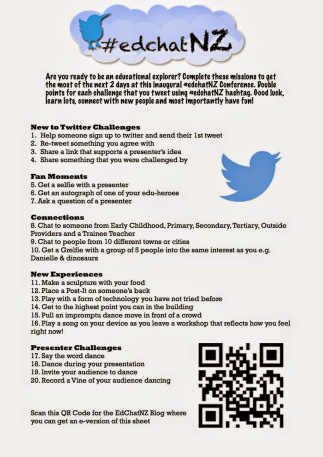
    1. How did you attend the #Edchatnz Conference? (Face 2 Face, followed online or didn’t)
    I was there in person and online and had the privilege of being part of the organising committee.
    We planned the #edchatnz conference in 18 weeks totally digitally.
    edchatnzjpg.jpg


    2. How many others attended from your school or organisation?
    I had two others attending from @newmarket school and they were Anna Speir @MissSpeir  and Renee Hogg @MissRHogg.


    3.How many #Edchatnz challenges did you complete?

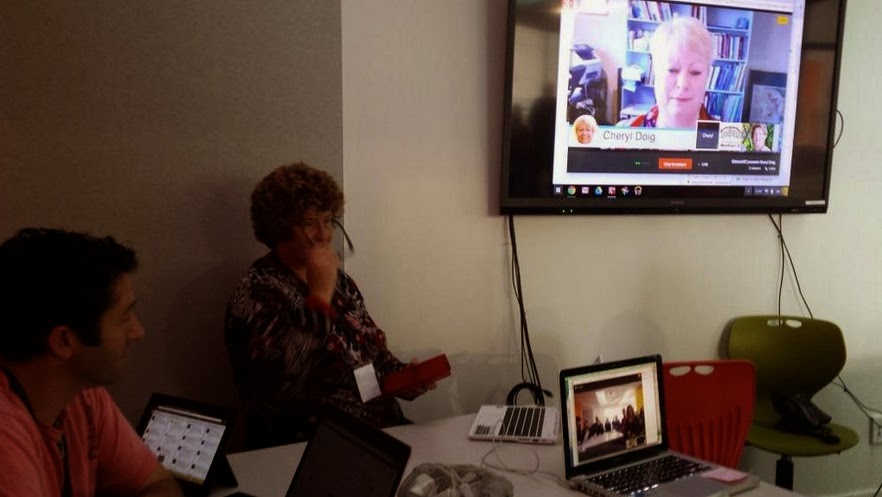
    I achieved 10 of them and that is another blog post. I made it a point of talking to lots from preservice because I was so happy that they could join us. In addition I was the vehicle for Dr Cheryl Doig’s virtual session.
    She and I practised the session virtually until she was comfortable with using the tools. On the day she ran her session through me virtually using virtual tools.
    4. Who are 3 people that you connected with and what did you learn from them?
    @arti_choke  @BridgetCasse @mattynicoll It was just fabulous to catch up with SOLO taxonomy educators who’s work I have read and who inspire me to shift deeper in my thinking and practice.
    solo.jpg

    I also connected with @beechEdesignz who shared about design thinking and with @fFreemansbayScho who shared her principal’s journey into school design.


    5. What session are you gutted that you missed?
    I would have liked to see some of the coding and 3d printing session and the gaming. But generally, I am happy with what I attended. I did miss out of getting my image lazer printer.
    6. Who is one person that you would like to have taken to Edchatnz and what key thing would they have learned?
    I would liked to have brought @ginnynz01 but due to circumstances that was not possible. However because she is now on twitter I know she was following virtually.
    7. Is there a person you didn’t get to meet/chat with (F2F/online) that you wished you had? Why
    I love science and missed meeting and hearing Nanogirl  @medickinson.
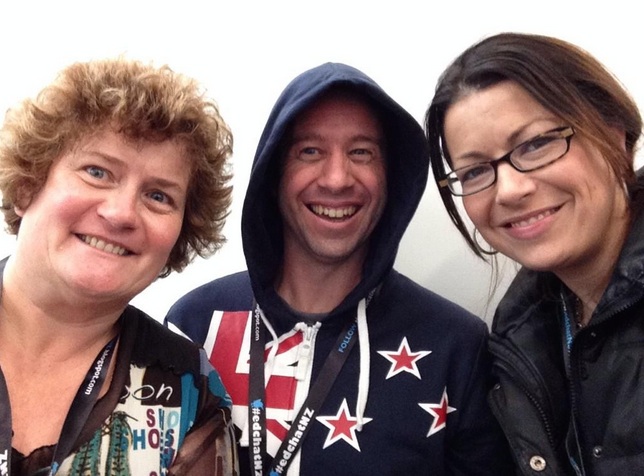
    I love photos as memories. So I will say I missed out on a photo opportunity with my TeachMeetNZ team. The TeachMeetNZ teachers have put in a lot of effort and time to share their teacher stories and it would have been great to have that as a memory.  I also would have liked a #grelfie with Pam Hook aka @arti_choke. She is my eduhero.
    8. What is the next book you are going to read and why?
    I want to read SOLO Taxonomy in Physical Education written by Nicola Richards and Pam Hook. I want to see how SOLO is used in PE.
    9. What is one thing you plan to do to continue the Education Revolution you learnt about at #EdchatNZ?

    I will continue on my journey of learning more about how I can support  ‘The greatest source of variance that can make a difference to student learning–the teacher and how they share their learning.’ My principal Dr Wendy Kofoed @newmarketschool and I will be sharing this at Ulearn so do join us in our session. Breakout Four A on Thursday 09 Oct 2014 at 13:45 to 14:15.

    10. Will you take a risk and hand your students a blank canvas?
    I am willing to take a risk and handing our teachers a blank canvas and coaching them as they take the risk with our students.


    Who do will I tag with this meme:
    Having been involved with a meme before and knowing how it works, I am tagging
    Anna Speir @MissSpeir   
    Renee Hogg @MissRHogg
    Terry Beech @beechEdesignz
    Bridget Casse @BridgetCasse


    I am adding one more task to this meme. Using my SOLO taxonomy lens I know that this meme is at relational level because we are making connections with each other. However to push my meme to extended abstract I need to make my meme visible in a sharing way. So I have added mine to the #edchatnz Listly and I challenge anyone reading and who are tagged in the meme to do the same.

    Clesol Day 2

    Saturday
    Keynote Speaker: Deborah Short, TESOL International
    Using Sheltered Instruction to Develop Essential Academic Language Skills

    http://www.victoria.ac.nz/lals/resources/academicwordlist/
    Averil Coxhead 

    Give the children something interesting to talk about.
    Give verabal scaffolds for elaboration
    SOLO Taxonomy at relational by highlighting key vobabulary.

    Using word wall to make signal words explicit.

    I was fortunate to sit in on Rosa Kalauni session where she spoke about
    Secondary  Success
    At her school they choose Pasifika Teachers and put the median band children together.
    These same children attended the same classes with a Pasifika chosen teacher or a literacy class with a Pasifika chosen teacher. Rosa spoke with passion for the Tama Toa Project. Her session was well thought through and put together and I came away motivated to implement even more focussed projects at out school for our learners.

    Today was the day I shared my #TeachNZ project
    http://teachmeetnz.wikispaces.com/TeachMeetNZ_2014_3
    If you go to this link you will find my slides and also all the 3 minute presenters slides.

    Over the next few days, I will take the video and cut it down in three minute slots that the presenters can add to their digital footprints. I am excited to see the reflections begin to come in because I know that here is where the real learning takes place.

    The exciting part of running a TeachMeetNZ session is watching the confidence and interactions develop between the educators who take part. The challenge with running a virtual session face to face with a live audience is ensuring a a balance between presenters sharing their stories and having time for the face to face audience.

    After a break we moved into ‘In conversation with – Janet Holmes’, Victoria University of Wellington
    Janet gave a great presentation and I really liked the way she incorporated photos and video to break up the just listening to Death By Powerpoints that seems to be the focus of a lot of presentations I have seen at the CLESOL conference.

    I left the day early to have  rest. Then walked to the evening dinner.

    Clesol2014

    Clesol Day 1

    http://www.clesol.org.nz/index.html is in Wellington and runs for three days.

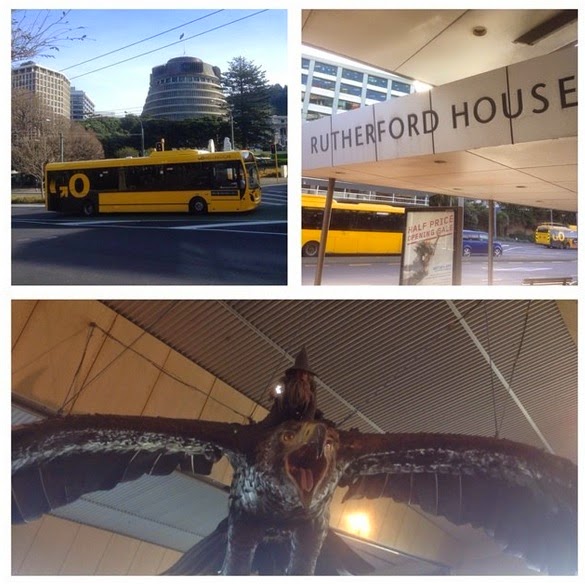
    This year Clesol is hosted at Victoria University. This is my first visit to Rutherford house.
    Using #Clesol on twitter I could only locate 6x other educators attending the conference.

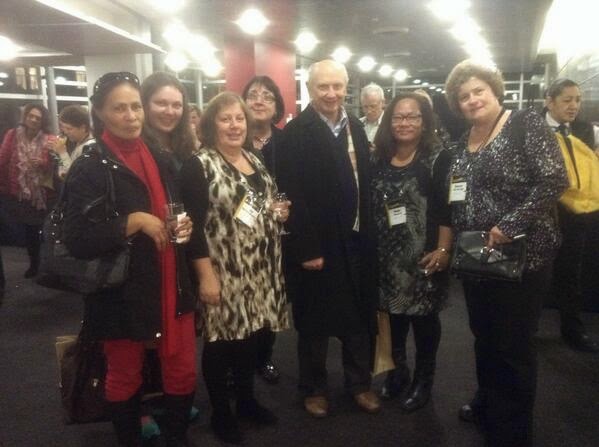
    The conference launched with a welcome function sponsored by IELTS. I was excited to see a few familiar faces so as Paul Nation walked by I grabbed him for a group photo.

    The first plenary began the following day and as I sat in that first session and looked around, I  saw maybe 6 educators using a device. The challenge is most teachers have been given a TELA since 1996 so why were most educators here still using pen and paper.

    William Grabe

    Powerpoint available via email.
    william.grabe@nau.ed
    Foundation for L2 Reading development.
    William highlighted essential aspects of reading comprehension. He spoke about instructional applications as well as a few specific practices that are not commonly considered in many reading instruction curricula. I was listening to him share about building a reading curriculum.

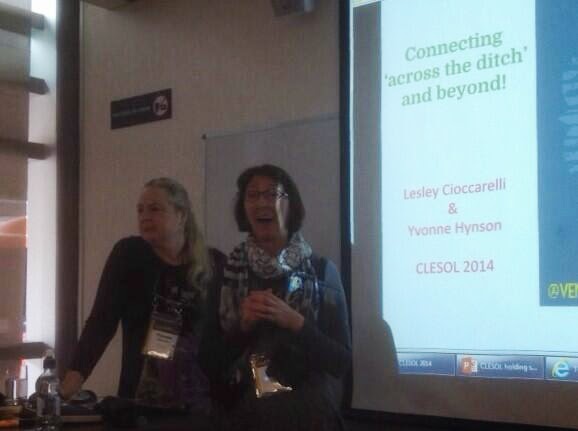
    I attended   collaborative workshop ‘Connecting across the ditch and beyond.’ The session was well rehearsed, ran to time and was inclusive of all attendees. Both Lesley and Yvonne covered a range of social media and how they used them in their work. I was particularly interested in the collaboration and to hear that yesterday was the first time these educators had met f2f.
    Lesley highlighted for the group a few of her global connections from her personal learning network. 
    The following session was from John Read who covered 

    ‘Coming to grips with quality in language assessment’. John spoke about an ongoing concern in language teaching is how to assess learner abilities through good-quality assessments that are suitable for their intended purpose. He stressed the importance of moderation and expertise amongst teachers in their own subject area. Again the slides are incredibly text heavy and for a learner like me, I like my pictures.  I give a quiet chuckle when he spoke about computer familiarity. I was not sure if this included mobile devices but probably not.  

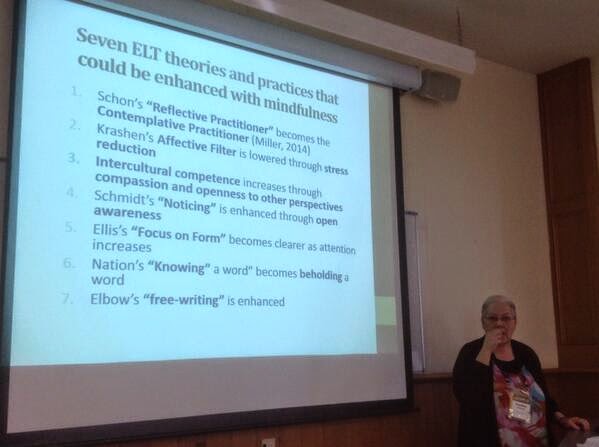
    In the afternoon session I attended Heather Thomas session on Mindfulness practice and pedagogy that could enhance English Language Teaching (ELT) by increasing attention, emotional 

    The session was not what I expected but is actually what I needed to hear. We often rush from one thing to the next but never take time to stop and smell the roses. 
    She shared with us the following documentary. ‘Room to breath’.


    Heather’s session was on Mindfulness meaning about being in the moment, being present, being in the now.

    Probably the best part of the day was the discussion that happens between the sessions.

    TeachMeetNZ Interface

    Titled: Where Teachers Meet
    TMNZ.png
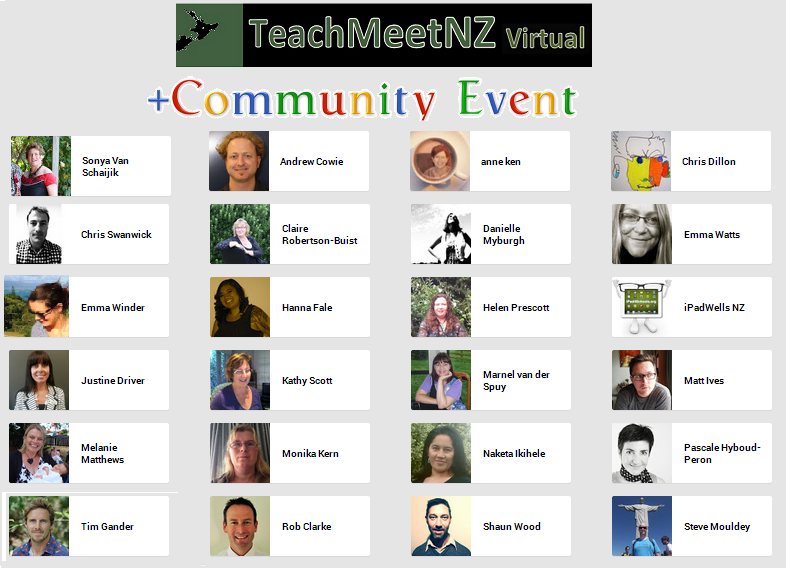
    (Educators involved in TeachMeetNZ in 2013)
    This post is an update of that article.


    In 2013, I launched TeachMeetNZ as part of my TeachNZ Sabbatical. A TeachMeet is an organised but informal meeting (in the style of an unconference) for teachers to share good practice, practical innovations and personal insights in teaching with technology. TeachMeet originated with three Scottish educators – Ewan McIntosh, David Noble and John Johnston. Currently all over the world there are hundreds of TeachMeets that take place regularly in a variety of venues. As Ewan Macintosh commented, TeachMeet was never about technology 100%, it was about the Teach first of all, and the tech was instrumental to achieving what we wanted to achieve pedagogically and never the other way around.” Ewan Macintosh.
    This article will describe how I developed TeachMeetNZ, the process of the on-line organised collaboration using Google Hangout, the relevance to teaching and conclude with future development for TeachMeetNZ.


    TeachMeetNZ
    I developed TeachMeetNZ after two years of research, investigation, then the trialling of a variety of online products, with Google Hangout being selected as the preferred platform.  
    A small team of willing educators agreed to join with me to learn how to use Google Hangout as a way of presenting, demonstrating good practise, sharing and celebrating teaching with technology. Each term, a group of inspirational New Zealand educators develop and deliver a series of presentations. These sessions are live streamed, and are attended virtually by educators from around New Zealand and globaIly. In addition a TeachMeetNZ wiki was  developed for participants to communicate and share their presentations with a virtual audience.


    Collaboration and participation
    TeachMeetNZ is about New Zealand teachers connecting online. They collaborate and problem solve using online tools. These educators support and mentor each other before and during the practise Google Hangout sessions. To take part, teachers prepare 12 slides that auto cue every 15 seconds so their presentation is three minutes long. The slides are hosted on Google Presentation or Slideshare and must be live before the session. We learnt that the most viewed YouTube clips are just under three minutes long so this is the preferred length. A three minute video is created of their presentation and may become a resource for use at a later time.
    After the live event, discussion usually follows via twitter using the hashtag #TeachMeetNZ. Many teachers go on to blog a reflection of their session, and they can embed the YouTube clip into their blog.  A TeachMeetNZ presenters badge is awarded to those educators who present on TeachMeetNZ..  Participants and viewers willingly give feedback and regularly give their time to support and help others.


    Relevance to teaching
    Online spaces are useful for portfolio development and fostering interaction and collaboration. Google Hangout is a tool that can be used to collate and present resources, to support community interaction and contributions, and as a platform for personal expression. Google Hangout is an ideal tool for teachers combined with a YouTube account.


    From creating and hosting TeachMeetNZ sessions I have learnt that teachers appreciate recognition and acknowledgement for what they do. Hosting TeachmeetNZ has pushed my knowledge of making connections with ideas and with people. Hosting the sessions has encouraged me to give better feedback to teachers who take part. The sessions have allowed me to be more focussed on my feedback with teachers and not to rush this important process. After each session I play the clip back and reflect on how I can carry out the task better next time. I make notes and begin with these notes at the next session. I have also learnt to go through the presentations before the live streaming so that I can better prepare my questions. I do this by asking for presentations to be live before the session and I usually run practise sessions for people new to using Google Hangout.


    Where to next?
    In the future I plan to host more discussion sessions with panels of educators. Last year I had an educator host a specialist session based on PE and this year I have planned to include similar sessions.  In addition I have planned to have single themed discussions and to have educators and practitioners who can contribute to themes at a deeper level. Some of the feedback that I have had from participants is that they enjoy the opportunity to ask questions and discuss ideas in greater depth. A session, that I hosted at the Festival of Education in Auckland, featured a group of inspirational educators who shared and discussed their passions both online and with a live audience.


    The TeachMeetNZ site has grown rapidly and I have now become the site’s curator. Currently the site contains nearly thirty nano presentations. This number increases each term as teachers share and celebrate their learning on TeachMeetNZ. Global visitors and viewers can watch the presentations in their own time and place.


    For my own learning.
    The SOLO Taxonomy practitioner in me realises that my current sessions take me back to being multistructural in my thinking.  In order to achieve depth in what I do online I need to continue to take a leadership role in other online communities. As frightening as this sounds I think that my first goal is to move from participating and running TeachMeetNZ sessions in online communities to being involved at administration level with online global projects. I would also like to continue with mentoring and developing others to host sessions. The popularity of the digital badge concept may also mean that I further develop this system for levels of participation.  


    If you have been a presenter or have watched a session on TeachMeetNZ, please add your comments below.


    For further information
    Visit the wiki
    #TeachMeetNZ on twitter


    Teacher from Newmarket School
    Auckland New Zealand