#eTwion

etwion.png

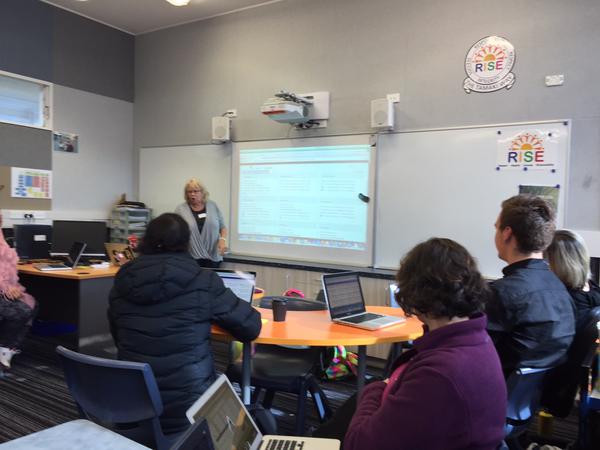
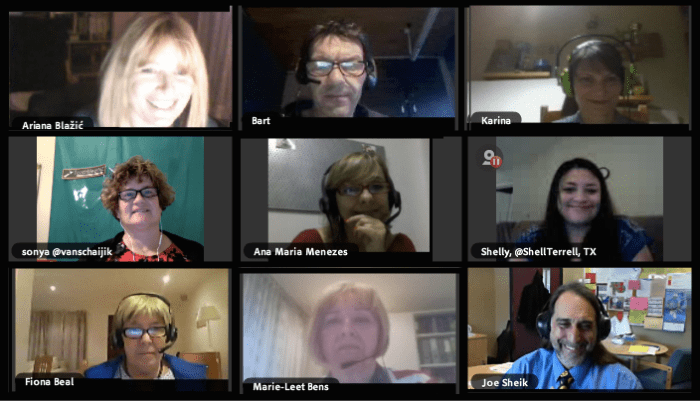
My ongoing personal inquiry is teachers and how they share their learning. I was really excited to  join Arjana and Bart @abfromz @BartVerswijvel and six other global educators on Tuesday 26th of April for a global networking seminar as part of their programme for European teachers called The Networked Teacher. When Shelly opened the session, we had both Arjana and Bart on screen and I was reminded about our history of connections through the TeachMeetINT virtual sessions that we took part in a few years ago. Bart had this cow bell that he used as a timer. That bell was an awesome timekeeper and we tried hard not to hear it.

I shared parts of my ongoing personal inquiry but from my perspective of how I built my professional learning network. I was asked to focus on my New Zealand connections so was extra excited to share about our part of the world to European educators in the eTwinning programme. The hashtag they use is #etwion. The session took place at 5.00am in our New Zealand time zone. You can check out the hashtag and see what the attendees are learning.

I built the slides over a few days. An event like this allows me to reflect on where I am as a learner and from listening to other global educator stories inspires me to set new digital learning goals. I was interested in hearing their stories from their parts of the world. Happening in the chat window was a lot of questions. I am not the best at multitasking so quickly captured the questions asked of me so I could respond to them later. The ones that caught my attention involved teachers of heritage languages wanting to make contact with our Te Reo teachers. So I suggested contacting me via social media and I hope to help them make connections here. I learnt the splot trick from @MissSpeir. So sprinkled purple splots as hyperlinked breadcrumbs throughout my presentation.

I have to mention here how Arjana was an inspiration for the #TeachMeetNZ project which is where New Zealand teachers share their passions and learning in 3 minute video clips. In a way too she plays a part in #Edblognz because it was by tagging me in a #Meme that the list of New Zealand educator blogs was curated by @HelenOfTroy01. I took that over and expanded that to include all other New Zealand blogs which was then added to the #EdblogNZ curated site of New Zealand educator blogs which I now help curate with @nlouwrens and @ariaporo22.

Thank you Arjana and Bart for inviting me to share our New Zealand teachers learning. To Joe from Canada @Joe_Sheik, Fiona from South Africa @fibeal, Shelly from Texas, USA  @ShellTerrell, Karina from Israel @karinam60, Marie-Leet from Belgium @BensBel, and Annamaria from Brazil @anamariacult, fabulous to meet you all. Hearing your stories was inspirational. To all the attendees of the webinair great to meet you all and I look forward to adding you on twitter.
Agentic Teacher

On Thursday evening I took part in the fortnightly #EdChatNZ Learner Agency led by Philippa N Antipas.

The topic was, ‘Schools seek to nurture learner agency. What does learner agency look like for teachers, and how do we develop it ourselves to model it for others?’

Last year Claire Amos wrote a brilliant piece explaining  Learner Agency – more than just a buzzword! That she kindly allowed to be used in the EdBookNZ 2015 project unpacking latest buzz words.

I am continually amazed at how connections made online come together in fabulous way.

On Thursday Phillipa was moderator for #EdChatNZ and this was her first time leading this New Zealand Educator chat. I know she would have really enjoyed moderating the chat because she is a passionate educator and really know how to make connections with those that she works with.

I pulled together a storify of the chat because I am always interested in numbers.

I counted 719 entries on the storify over the hour. I deleted anything past that time and also past the next day. However I think it would have also been interesting to include the ongoing discussion because the chat continued for most of Friday too.

When I shared the storify, there were 34 tweeps who took part. You can see them all from the discussion. I have not counted the other educators who continued to contribute to the discussion on Friday. 

The hour long #EdChatNZ conversation was fast and furious. I am always interested in questions asked. I was particularly interested in Thursday night’s topic because teachers as learners is a topic very close to my heart. I have previously blogged about this recently in Children do not come first. Those of you who follow the work I do will know about the spaces and places I have created for teachers to share their learning such as TeachMeetNZ where teachers connect and share their learning in 3 minutes, EdBookNZ  where teachers collaborate and co-construct their own learning and more recently EdBlogNZ where teachers reflect on their learning, a site which I help collate.

Using storify to make connections and to unpack the discussion around teacher agency I churned over several of the quotes and as I further unpacked the discussion I had the feeling of Déjà vu. You can see what I mean because I have written about this before but under a different labeller of ‘ Connected Teacher.

Using the questions fired at us, I searched for some references. The third reference was given to us.

1)What does professional or teacher agency look like?

I found this great article written by Jackie Gerstein that tells us a little more, titled  Teacher Agency: Self-Directed Professional Development

2)Define Teacher Agency

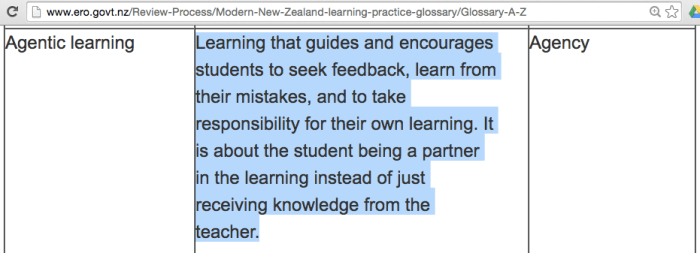
This one has a fabulous video of a teacher sharing practice and explains what a teacher does. John’s story – Agentic positioning. But still couldn’t really find a true definition except for what Clare wrote. Also via the chat a definition for Learner Agency surfaced from ERO site.

agentic

Together under Philippa’s guidance we hogged twitter with our ideas to define Agentic Teacher.

Defining Agentic Teacher

(Totally ninjed from the 34 kiwi educators taking part and rehashed.)

Teacher agency is about service to our learners and our community through communication, making connections and seeking collaboration. An agentic teacher has the power to make a difference by becoming involved and owning their own learning through figuring the known and the unknown. An agentic teacher shows mutual respect for collaborative partners through actions with a focus on learning. Current practices are challenged and alternatives ideas are suggested where appropriate. The learning journey of an agentic teacher is lifelong. The ongoing goal is to be the best as you can be by actively and continuously challenging own assumptions, knowledge and practice regarding learning.

Personally, I should have also added Whānaungatanga. An agentic teacher lives and practices Whānaungatanga. Here you can read my personal description of Whānaungatanga. 

3)What kinds of environment or culture would teachers need to develop agency?

This article was referenced in the chat. Swimming out of our depth.

4)Teaching as inquiry has been mentioned. It’s in the NZC. Has this led to agentic teachers? If not, why not?

Agentic Teachers is a way of being.

Q5: What if schools co-constructed professional learning with their teachers? Would that encourage agency?

Q6.What might it look like if everyone in the staff was agentic? Chaos?

So what do you think?

Have I defined Agentic Teacher or is agency a quality and mindset that we develop as is suggested by Jackie. Do all teachers need agency? Or will we just exhaust our teachers?

If you write about the chat, please do use #EdBlogNZ and I will curate them all together.

Philippa has asked to be tagged too so do remember that as she will be reflecting on her session and seeking feedback.

ALLiS

Know thy Impact.

I often hear this phrase espoused by John Hattie and I thought about it after this week’s personal experience. I had a hilarious experience this week with the 5 years olds which I must share.

IMG_2696

ALLiS

I am lead teacher for the ALLiS project at Newmarket School. As a school Newmarket has joined the ALLiS Cluster (Asian Language Learning in Schools). According to the MOE, the ALLiS Contract is funding available for schools or groups of schools, with particular emphasis on those that establish language learning pathways from primary through to secondary. The fund will encourage greater collaboration amongst schools in partnership with external Asian language and cultural organisations. Programmes must be self-sustaining once funding ends. The aim of the funding is to increase the number of students learning Asian languages to support our growing trade and international relationships. There are also bilingual benefits of learning a second language.


Our ALLiS Group of Schools.

Our group is the Epsom/Remuera group with Meadowbank School as our lead school. We are fortunate to have Deb Ward as our ALLiS Lead Teacher and she is based at Epsom Girls’ Grammar School. I have included a list of the school lead teachers in our group and we will be working together to increase the number of students learning Asian languages in our schools.


Deborah Ward ALLiS Lead Teacher
Stephanie Lin Parnell School
Maria Blanco Blanco Epsom Girls Grammar
Lisa Rolle Cornwall Park School
Joanne McNeil Remuera Intermediate
Jane Cameron Victoria Ave
Amy Ko Meadowbank
Sonya Van Schaijik Newmarket
Mary Fallwell Remuera Primary


This week at Newmarket School we began our Mandarin language and cultural programme for our school. We are fortunate to have access to our parent community who are Mandarin speakers and we were extra fortunate to have two parents agreed to teach Mandarin language and Culture further up in our school.IMG_2639

I have agreed to teach Mandarin and have been accepted into the Teacher Professional Development Languages Programme. (TPDL). The programme equips teachers to teach language effectively. Part of that is learning and teaching Mandarin for a whole year. I have registered and have paid for Chinese (Mandarin) Level 1A to begin soon at Unitec.


Polyglot

Those of you who know me know I am already quite a polyglot.

My first language is Samoan and I learnt English academically when we shifted here to New Zealand. I led a Samoan bilingual unit for two years and this strengthened my Samoan literacy. I learnt high school French and used this learning when I visited France. I also hosted a Tahitian student for a short period of time and this reactivated my schoolgirl French.

I learnt Maori at teacher’s college for three years and regularly led the Kapa Haka group. Now I can kind of get by with support. In my married life I learnt Dutch and when I visited Holland with my children’s father I was able to converse in Dutch with very little support.


When I first moved to Auckland I was thrown in at the deep end into a predominantly Tongan speaking class and learnt to survive on basic Tongan. I had a grandmother who often would teach me phrases which I used as part of classroom control.


I hosted Japanese teachers for three years and during that time I learnt Japanese at night school. I was able to use this learning when I visited Japan or when we have new English learners from Japan.

I also can say hello in all the languages of our children at Newmarket School.


Why?

So why am I now learning Mandarin, you may ask?


Well I have always maintained that I would never ask staff to do something that I was not prepared to do myself. So part of the ALLiS goal is learning an Asian language. It is about school sustainability with the Mandarin language. Our teachers have had access to a Mandarin Language Assistant who came to us as part of Confucius  and taught whole class Mandarin.


I chose Mandarin because I have hosted a Chinese student and absolutely adore her. In addition a large percentage of our school population are Chinese speakers. I live in Newmarket and know that out of all the local languages, Mandarin is the one I am most likely to have others to communicate with. This is because historically Newmarket has large numbers of Chinese migrants living here. I have visited China twice to visit my host daughter and I know I will return. I attend the Chinese lantern festival hosted each year in Auckland as part of making connections with the children I teach. I am also involved with the Flat Connections China Project as a teacher observer. I am fascinated with the way teachers are making connection across the locked down ‘Great Fire Wall of China’.


My level of Mandarin

If I use SOLO Taxonomy I know I am unistructural with Mandarin language.

I can count to 5, with support. My support are the children because they have been teaching me forever during my lunchtime duty. However I still need them to start me off. I can say hello, my name is Sonya and Goodbye. That is basically the sum of all I know in Mandarin. This week I have been practicing like mad to say Happy New Year, but still have to consult my card.

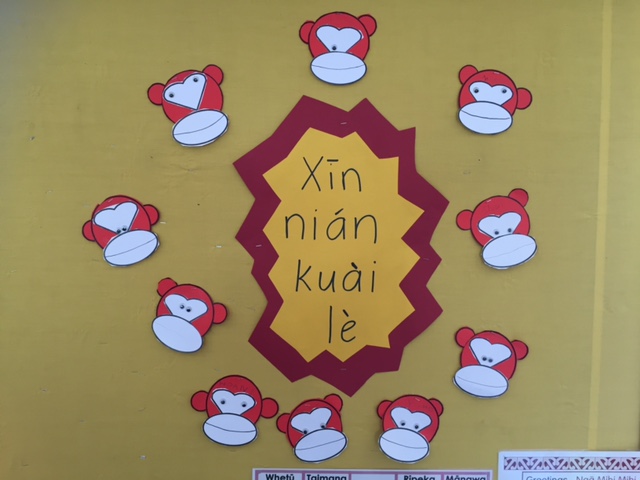
I also consciously learnt a new work. My new word was monkey. I thought about this and tried hard to remember the single sound of ‘hou’. This is because 2016 is the year of the Monkey and I wanted to share a little bit about the year of the monkey.


My first Lesson

I have agreed to teach the 5 year olds because I know from personal experience that if I am not prepared they will eat me alive. So I went into my lesson reasonably clear about the sequence of the lesson and my learning intention.


Everything was going really well. My first group were fabulous and I had support in the students with my pronunciation. They all made their monkeys and they all learnt basic sentences and could say this with support.


My next group involved two classes together and their two teachers. The lesson was a little more challenging because of the larger number. But that is OK because I know I will adjust from my peers feedback. I also know that the teachers are further along in Mandarin than me because they have had access to weekly lesson with the Mandarin Language Assistant so I am relying on them to support the lessons.


In the second class I have identified 7 fluent speakers who need much more than what I can deliver but that is OK too because I will use this piece of information to challenge my pedagogy. I do not want to teach whole class but want to structure the learning so my lessons caters for all levels of the language. Being a linguist I really want the children to be speaking in phrases rather than in single words as has been the previous few years learning.


I kept my eye on the short time and packed the children up. As they were leaving one little poppet, who was not a mandarin speaker called back to me,

再见猴子 Zàijiàn hóuzi. I responded with Zàijiàn. When he started giggling I realised what he had said and my first thought was, ‘just you wait until tomorrow.’


But then I thought about the linguistic implications. He had made a connection with two words, and he had made a joke. I know that to crack a joke in your second language takes quite a bit of thinking.


So do I feel pride or should I feel indignation? I will catch up with him about respect but will do so in a positive way. Unfortunately with 5 year olds, yesterday was a lifetime ago.


Personally, the parting comment made my afternoon and I was going around the staff telling anyone who would listen. However in this post I won’t respond what one staff member said. But it was really funny and you can probably make a smart guess.


My next steps

When I use SOLO to map my learning, extended abstract seems a lifetime away. But that is OK too. I have identified my starting level and I know what my next steps are.

My next steps will be carried out with Unitec with learning Mandarin and in the university paper on second language acquisition. I am looking forward to stretching my thinking by doing something new totally outside my comfort zone. I am really interested to learn about acquisition from a personal perspective and to apply it to a different way of learning.


Next week our group of schools will begin the ALLiS contract officially with an inauguration ceremony held at Epsom Girls Grammar. All of our staff will be present as we are committed to making this contract work.


For those of you wanting to know more about ALLiS you can join the online ALLiS Google+ community discussion group that has been set up.

But for now


再见

Zàijiàn


My personal Inquiry

Personal Inquiry

This year my personal inquiry focussed on the following statement.

Changing pupil outcomes depends on changing practice. What we have always done is no longer good enough.  Do teachers participating in virtual learning networks, reflective blogging, using social media  make a difference to student learning outcomes?

The challenge I have is how do I measure the results of teachers participation? I know that often it is not just one intervention that makes a difference to student learning outcomes but a range of strategies.

I know from Hattie’s research that teachers are one of the factors that does make a difference to student achievement. It is what teachers do.

So again how do I measure the results?

As the year roller coasts towards the final term I thought I would reflect on some of the online work I do that is over and above what I do in school.

The reason I take this on, is the immense satisfaction of seeing teachers come together to share their learning. I also wonder about the impact that this has on student learning. Being a teacher with over thirty years experience I am aware that what happens in class is no longer enough. Teachers must make connections with educators outside their domain to lift their own practice. They must see what others are doing and use this knowledge to lift their pedagogy. They must be part of active collaboration in order to bring about this same change to the content that they have their students create. I think about them collaborating together with sufficient magnitude and question how much of a difference this makes to their student’s learning.

This year is no different.

I set goals that by the end of this year, every teacher at Newmarket School would have a blog and be connected on twitter. That goal is at 99%.

I found from my involvement in the edblognz project that the blogging goal I set for our Newmarket School teachers is very high as I have identified very few edubloggers in our New Zealand system in comparison to the number of registered teachers there are. As for our principals who blog,  At the same time I know from experience that edubloggers are a certain type of educator. If I use the 1% of content creating rule I guess that applies to most schools. I have been tracking our teachers involvement through their contribution to the education community. I regular remind them that it is not enough to just take part in professional learning but to leave some kind of legacy that is easily seen. If I cannot see what they are doing? Does this mean that it did not happen?

So this year again, I know that before I push something at my school I have to be actively doing the same activity that I would ask of teachers. So it is seen that I would never ask them to do something that I was not willing to do myself.

Blogging

This year I have written 36 entries on my reflective blog. I have actively given feedback where I am able to and responded to feedback on my own blog. I have used twitter to celebrate what teachers do. I have just passed 18,000 tweets.

Know my impact

I have coordinated and run three TeachMeetNZ for New Zealand educators with two more still to go.

So far this year that involves 23 educator stories. In that group I had 2 teachers from my school share their stories. If I think of the impact on the number of students that these teachers are involved with say approximately 25 x 23 would guestimate an impact on 575 students. How this affects student learning outcomes, I am unable to clarify.

In April I encouraged 3x teachers to present at Google Summit and because I presented twice I was able to bring in a 4th teacher. You can read my reflection here. I had two teachers join me in an Educamp held at Tamaki college. You can read my reflection here. I work hard at getting our teachers to actively share their learning. I know I can be insistent but again, I remind teachers that they expect their students to do this but where is their evidence that they are prepared to do the same.

In April I was fortunate to attend the WELLs Conference with my principal and Assistant principal. It was great to have them write their reflections of the experience. My ultimate is to co-create a piece of writing with some of our teachers. I will get there using baby steps.

We have developed our #NPSfab twitter hash tag and that is being used more and more as more of our staff see the relevance of making connections with educators outside their immediate learning bubble.

I have presented twice this year at Eduignite and have left a legacy on my Slideshare account. I have presented my student inquiry to our Board of Trustees and have made this visible on our staff site.

So where to next.

Teachers Collaborating. I believe that before teachers can collaborate with each other successfully, first they must make a connection. I have set up a large collaborative initiative using google+ communities. I have approximately 28 educators involved in the EdbookNZ collaborative project. Again, how do I measure the impact of something like this? I have some idea. I can do this via active involvement. As for measuring effect on student learning outcomes I believe the area is still quite grey.

The teachers are working together to create an artifact for the education community. But for me the real goal is seeing if teachers can work collaboratively outside of their own school environment. The measure would be in seeing the product and in seeing the blog reflections that take place. I also aim for teachers to ask me lots of questions as this would clarify my thinking too as part of my own ongoing inquiry.

Overall I think that teachers working together will enable them to see what other teachers are using and what tools they are using as part of their own learning. This will raise their own benchmark of what is possible.

At the same time I am learning from others. For example, I created the google+ community after experiencing what it was like to be actively involved in one. This enabled me to see what is possible with the tools that are available to us as educators.

In the past I have struggled a bit with creating communities. I struggle too with being part of communities but I now realise that virtual communities ebb and flow. I go in and out of them when I am learning just as I am aware that the educators who have joined the current one are doing the same. They want to see how an active community operates. I hope to see them go on and create their own communities or use the skills that they learn with me to finetune communities that they currently lead. How do I measure the effect of this you might ask? Again I have no idea. I am always gathering data on involvement and use the data to create something better next time. But I am not sure how to use the data to measure affect on student achievement.  

Relevance to teaching and learning

By creating a virtual community, I can see how I am able to engage and motivate the students I work with in a virtual community. The teachers in the Edbooknz project do not need to be there so I have to be experimental, motivated and inspirational to enable them to participate willingly and most importantly actively. I am leading my moderators so that they will actively give feedback to the teachers that they work with.

In addition I am part of two global communities and I am also learning from the best. I have brought on board three of our Newmarket School teachers so that they can begin to take part in communities outside of school and learn how to inspire and engage the children that they are responsible for in the Flat Connection project. I am also moderating in an educator’s group using very different tools to connect, collaborate and create with.

As I move around our school I observe our teachers and I can see the teachers active online in a variety of ways. They are the ones creating content with their students. Their lessons are engaging and they teach their students to be persistent in their learning.  The ones who are not so active are consumers of content. I believe that being active online contributes to teachers creating content with their students. How do I measure this against student learning outcomes? Maybe I am focusing too much on student achievement and should be focusing on students creating content and students engagement in their own learning. Maybe I should be identifying the teachers who persistently encourage their students to reflect on the learning process.

Maybe my question should be, is there a relationship between teachers creating collaborative content and their students creating content? This I could measure using our involvement with Hapara. This is what has given me an incentive to have teachers collaborating because I still see very individualised content in our students folders. I would like to see much more collaborative content and much more teacher and student reflections on the learning process.

Ah well blogging is about clarifying one’s thoughts. But at this stage I think I am more muddled than ever.

EducampAkl

EducampAkl is amazing professional learning for teachers. This years session was coordinated by Fiona Grant and team. The hosting school was Tamaki college so we got the chance to see inside a different school.

The incredible part is that it is free and you have the opportunity to find out more about a burning question or issue that has been a little difficult to answer. You spend a day on your own professional learning and learn about edu stuff that you want to know more about. Technically the day is about you as a learner. You say what you want to learn and someone helps you learn it. I was really excited to have Belinda and Waveney join me from Newmarket School so they could see what I rave on about every year.

nps

Saturday 25th of July was fabulous and I got to meet and make connections with lots of new people and reconnect with many virtual acquaintances. One reason I attend #educampakl sessions is to put the face behind the twitter handle.

SmackDown

During the SmackDown educators are given the opportunity to share. You can access the slides from here with link,

edcamp

Photo by Fiona

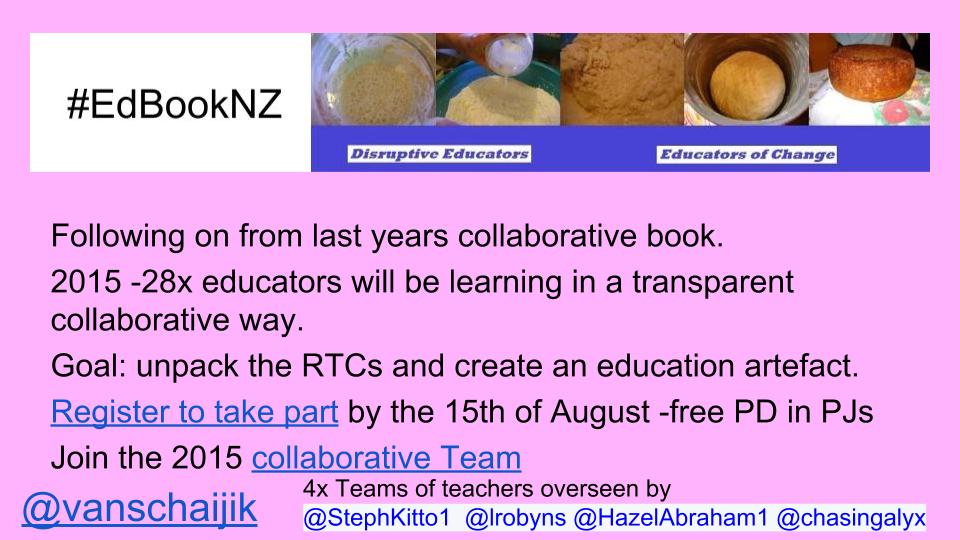
I shared the upcoming #edchatnz project that I created to bring teachers together for virtual collaboration. Therefore free PD in your PJ’s.

#EduCampAKL Smackdown 2015 (1)

I shared about a twitter app called Periscope that has the facility to live stream. I have added a summary to my slide and embedded the short demonstration clip I took during Fiona Grant’s introduction.

#EduCampAKL Smackdown 2015

Today I attended sessions by @lenva @tanya @gmacmanus @codingpoet.

Pond

gerard

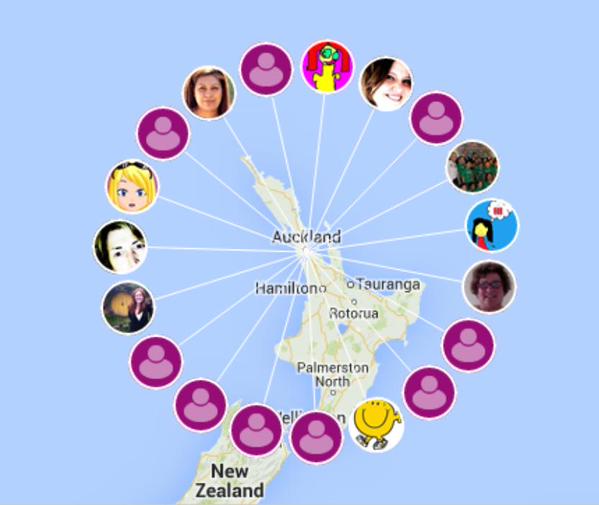
Gerard spent time with me and a few other visiting Pond. One of my burning questions was how easy would it be to set up a Newmarket School group in the POND. He showed us how to activate the Geo map and see our teachers and I really like this image that was generated in regards to Newmarket School.

pond

I had another lesson in curating and sharing content.  He was patient and awesome but I still had the feeling that our teachers have when they work with me and tell me you are going too fast. POND as a tool is amazing and I will continue to put in some hours to learn it because it is worth it.

Hapara Workspace

lenva

Lenva from Hapara covered Hapara Workspace. The workspace comes live on Monday.

I believe we should upgrade our package to include Hapara interact. This costs a little extra on the package and is something I will recommend we do for when we renew our license as this will allows us to help keep our students safer. We already love Hapara and the extra facility will support teachers in their work too. Anything that helps our children and teachers is worth a little extra.

TeachMeetNZ

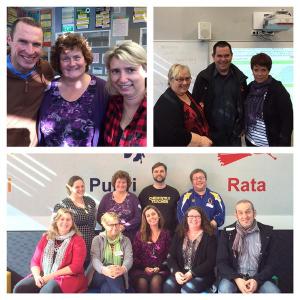
I called together any presenters who have been on TeachMeetNZ to come for an obligatory photo, the task was like trying to herd puppies, so in the end I created a montage. Even then I still missed James. The exciting part of Educamps is meeting up again and having a bit of a catch up. I pulled in Fiona too to this one because she is presenting on the TMSydney combined with TeachMeetNZ in October. Here they all are so do follow them on twitter.


CKvGyJcUYAAzW-1

Photos by Waveney and Justine

I give a shoutout here for the upcoming Virtual Learning Network Webinair ‘Personalising PLD using social networks’. So pop along and register. I will be sharing TeachMeetNZ and Danielle Myburgh is sharing Edchatnz.

When: 15:45 – 16:45, 12 Aug 2015

Venue: Adobe Connect

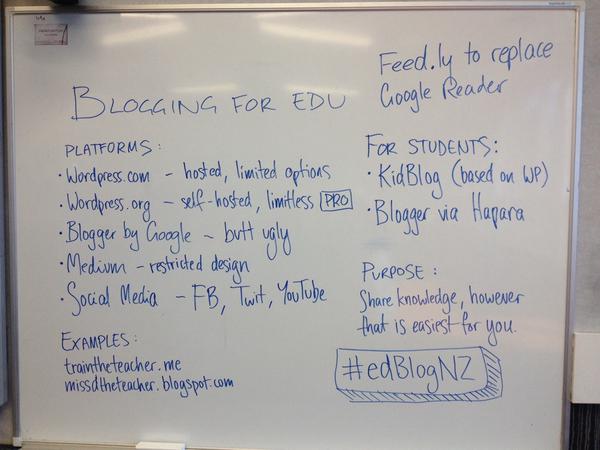
Blogging for Educators

Tanya was running a session so I popped in and had a listen. I ninjaed her notes.

tanya

Image by Tanya

You can also find a fabulous list of New Zealand educator blogs here. You can also add yours if it is not there.

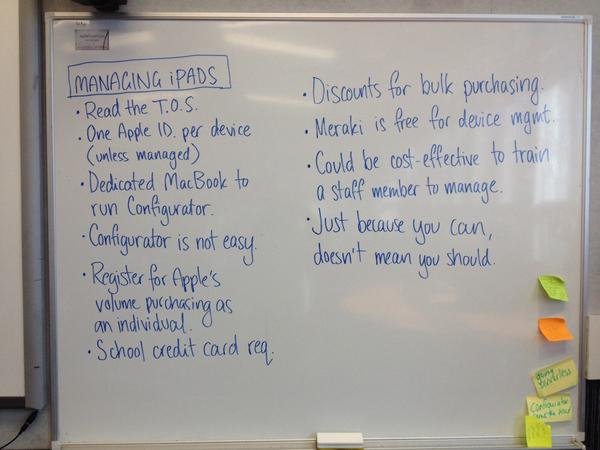
Configurator and Meraki.

codingpoet

Image by Tanya

After Tanya, I listened to Clinton sharing about Configurator and Meraki. I really like the way he speaks, as in the practicalities and how to save school money. I have found configurator a real challenge especially with purchased apps. When a teacher asks me about adding new apps to the system I now totally ignore them. However from now one I will put across to them to trial the app first on their teacher iPad using their class budget to buy the app, test it with a group of students and then write me a proposal of the value of purchasing the app for the ipads. If they can be bothered to do all that, then I can be bothered to spend hours fighting configurator to install it.   The last holidays I just could not face spending another full week updating the system. There must be a better way. I wonder if there are schools who could do with a refresher and together we fly him up for a day’s training. Clinton said that he would create self help videos so I look forward to those. Again notes are from Tanya. I also found out that iPad 2 system charges for apple apps but these are given with later models.  Clinton also cautioned against giving children printing rights on a chrome. I agree with him. I still cannot understand teachers who want children to be able to print from the chrome. As we move more and more digital, are they not aware that the doc can be shared?

Highlights

  • Learning with teachers from Newmarket School.
  • Catching up with TeachMeetNZ presenters.
  • Connecting with others watching the twitterstream.
  • Building my own learning.
  • Finishing off with pizzas and drinks from Network4Learning.

Reading other attendee reflections such as 

TeachMeetNZ 2015 Session 2

Another fabulous session of TeachMeetNZ has passed. On the live hangout we had eight presenters from around New Zealand.

Session Host: Sonya Van Schaijik

TimeKeeper: Virginia Kung 

Broadcaster and Storify: Monika Kern tuning in from Melbourne.

Screen Shot 2015-07-15 at 10.37.41 pm

Country Presenters Name Topic Twitter Google+
1 NZ Stuart Kelly #NCEADigitalEnglish @stuartkellynz +StuartKelly
2 NZ Natasha Walden My Experience as a Gamer @MissnWalden +MissNWalden
3 NZ Steven de Bruin Developing agency in the early years @Steven_de_Bruin +SteveDeBruin
4 NZ Terry Beech Design Collaboration @beechEdesignz +TerryBeech
5 NZ Adam Baker Star Wars,the comic strikes back @AdamBaker31 +AdamBaker
6 NZ Kerri Thompson #NZreadaloud @kerriattamatea +KerriThompson
7 NZ Shona Poppe Creating an inclusive classroom @shonapoppe +ShonaPoppe
8 NZ Rachel Chisnall ‘Bravery’ in your teaching @ibpossum +RachelChisnall

The celebration is over and I now look forward to the educators reflections about the process.

I know that this is when the real learning happens. There is also an evaluation form to complete and this helps drives the next session.

Presenters can add digital badges and a digital certificate to add to their reflection.

Now that the session is over I still need to clip videos and add them to the wikipages. Then I will add the pages to the Pinterest list. If you were a presenter and are visiting thank you again for taking part.

I give a shout out here to Monika Kern who did a fabulous job with broadcasting. We trended on twitter so that was really exciting and I give a shout out here to all the teachers who joined in on the session virtually. Thank you because having an active audience really helps make the session. Monika created a storify of the session.

I also acknowledge Virginia Kung from Newmarket School. She is our assistant principal and for this session she agreed to be timekeeper. She gave feedback and covered for me when I stepped away at the start of the session to collect the team.

Where to next for TeachMeetNZ, well we will be steaming live from Ulearn and I will have Matt Esterman from TMSydney with me as co-host. We will run a combined Australia and New Zealand TeachMeet virtually.

Finally, I was not all nervous this time. The changes I have made included creating slides and broadcasting them before each practice session. We also had questions happening on the  Hangout and I will push this more next time.

Now if you are interested in taking part, please do not hesitate to contact me on twitter. If there is space I do bring in educators from outside New Zealand however the time difference for you does suck.

Language and learning

http---makeagif.com--media-1-23-2015-64zMJV

At my school we have children and staff from all over the world.

Combined together we speak a total of 23 languages including English and Maori.

As a trained second language teacher with a National Diploma of TESSOL and have a specialist Bilingual Certificate, I have a fascination with linguistics. Myself Samoan is my first language and I learnt English at school. I can get by in basic French and Dutch. At teachers college I specialised in Maori language and  later on I learnt Japanese for two years in order to empathise with children from Asia learning a different literacy script. In addition I learnt a little Tongan when I was immersed in a Tongan speaking class for one year. This year, I hope to learn some Mandarin too.

First Language Maintenance

I love hearing our children speak in their first language and encourage them to share with others in their own language if they are developing understanding of concepts. My bilingual training allows me to trust this strategy because of the work of educators who have come before me and have tested the theory of BICs and CALPs from the research of Jim Cummins. At my school we offer Chinese after school for our children and each year we see more and more mainstream children join these classes. In addition we are part of the Mandarin Language Teacher programme and we have a mandarin teacher work with our children teaching language and culture. We also teach Maori within our classes and have an itinerant teacher of Maori who works with us whenever we can.

Data

I spent a few terms as an ESOL verifier and began to learn how to analyse data. However my fascination with data has been as a second language teacher for twenty years and as a Bilingual Team Leader for two. I have worked alongside staff continuously and alongside bilingual educators during this time.

When I run English Language Learning professional development with staff I remind them of the graph from Collier and Thomas that charts how long it takes to learn a second language for academic proficiency. I remind them of how fragile language is and that it takes two generations for a language to die in a family. This is accelerated by children learning only in English at school. The language that children learn at school is the language that their children will grow up with. I am a living example of this. My own children speak English as their first language. They have a small bank of words in Samoan but nothing to survive with.

If we do not foster first language maintenance in our schools, our children will loose their home language within two years. We can see this by year three. You ask your children to say something in their home language, you can see them struggling to find the word. If English second language children are drowning in an English medium setting and not encouraged to think in their language they loose a 100 words of their first language a week. The faster they loose their language the slower they will be academically in English.  As children learn English they require a proficiency of 100 new words each week to reach the 5000 word yearly target to catch the moving target of the first language learner. In order for children to respond to your questions in a sentence they must have a 10,000 word vocabulary bank. This is the number that an average 5 year old English speaker begins school with. It takes an accelerated second language learner two years to match this number.

Therefore those of you who say your year 3 and 4 second language children who are at benchmark on our National Standards, I applaud your teacher judgement because you far out perform the thousands of bilingual educators who aim for 6 years at school to reach standards.

I am continually amazed at educators who place their students at national standard after being in New Zealand for 2 to 3 years at school. I monitor our data and I regularly see the year 4 drop in data. Two things cause this. The first is that often junior school teachers over score the children because they take the ‘surface’ data at face value. When cognitively applied language proficiency hits the learner and the data shifts to depth in literacy and knowledge across all numeracy strands teachers can no longer justify the surface gathering of data.

Educators who work with large numbers of second language learners know exactly what I am writing about because they are the ones who have to justify the drop in data. There is often the feeling of failure as a teacher because of this drop and questions are raised as to what kind of teachers are in the year 3 and 4 areas because the fabulous earlier school data has been allowed to drop. I often hear school principals ask, ‘What is going on? There should not be a change in data at years 3 & 4.’ However again I reiterate, this drop happens because at the earlier years the data gathering gathering is at surface level and teachers are going by what they can see at surface levels of learning to make their overall teacher judgements (OTJs) and are not taking into consideration that their children are learners of English as a second language before making that OTJ. Therefore that initial early data will NOT hold when the children hit academic levels of proficiency. From personal experience of continually working with data and from the ongoing research I have learnt from expert bilinguals,  this drop will continue to happen until a school understands how long it takes for a second language learner to meet national standards in English. I repeat myself that the data begins to even out by year 6. If only we followed the learning from Finland who do carry out data gathering and benchmarking of their children until their children have been at school for 6 years. Pasi Sahlberg calls what we do GERM or Global Education Reform Movement.

The next time I usually see a drop in data is at year 5. This happens as greater cognitive academic proficiency is expected from the children. Often I look at the year 4 expectation and I know from teaching this year level that they are expected to make an 18 month progress in one year. This is particularly noticeable in mathematics.

I also sometimes see children who have maintained progress for a few years suddenly hit year six and their data takes an accelerated jump to out perform average data that I would expect to see from intermediate aged children. Again, this is because their learning data has levelled out. However their teacher become so excited that they overscore the children. Again this happens when class teachers have been working for a few years with large numbers of second language learners. They become so excited when they see the acceleration of language learning happening. Again the work of Thomas and Collier shares that the acceleration happens then when a school has all its thinking correct around second language learning. However a reminder again that second language learners overtakes mainstream learners at intermediate because the acceleration takes off at year 6. Teachers begin to see this and suddenly place their children above national standard data.

Did you know?

From the conventions on the rights of the child, article 30, that children have the right to communicate in their language when other speakers are around?

children

If a child is literate in their first language then you can expect to see an 18  month gain in their learning each year at school? This is why I particularly love working with new migrant children at year 5 and 6. I literally watch their progress using graphs.

The younger the children are, the less academic exposure they would have had to literacy in their first language and this slows down their academic progress in English. This can be seen by the year 3 and 4 data. They appear to learn English very quickly and this is know as basic interpersonal communication skills or playground English. Therefore just because they appear strong orally in English, does not mean they yet have the academic proficiency in English.

From school wide data I would expect to see the data even out by year 6 if the school and teachers understand how to benchmark the children accurately against National Standards. If the data is too high in the junior school then expect to see the drop in year 3 & 4 data.

Mathematics generally moves first, then reading and then writing. If the children’s writing data is higher than reading, I ask our teachers to look again. Either they have misinterpreted the reading data or have over scored the writing data.

I also check historical data and if I see a shift of 2 or more sub levels in a semester that alerts me to an accelerated push and I ask to see in class evidence. This is usually something that takes place in the second gathering of data. This means, has the previous teachers got their data wrong or is something else going on here.

So as you return to school for this second term, I give a shout out to the year 3 and 4 teachers who are looking at the data. particularly when your class settles and your reading groups need reshuffling because the previous data does not match what you see in your class. Last year our teachers of year 2 and 3 children produced a realistic gathering of data so I know that the children’s new teachers will not have this problem.

In class support versus withdrawal

As I group our funded children for support, I always aim for as much in class support as I can give them. Research shows that children who have been identified as needing extra learning support do not need to fall even further behind their peers by being withdrawn. Colliers and Thomas research shows that withdrawal is the least effective form of second language acquisition. If I do withdraw children then I come in as an additional teacher to the team that has the most needs. Whatever they do in class I do that with the withdrawn children. Sometimes teachers think the ESOL teacher only teaches reading and writing. ESOL teachers are first and foremost trained teachers and can teach anything. We have have had additional training in second language acquisition. Sometime I teach maths to my withdrawn group.  I do feel anxious when my withdrawn children tell me that they are missing physical activities, science or art. I know from experience that often our second language leaners shine in these areas and the one chance they can get to shine in class is taken off them because ‘they need more English learning.‘  As much as I can I target teams during their literacy and numeracy times.

If I am working in class alongside a teacher, the teachers who have the mindset will sometimes have me take an accelerated group in their class while they work with the ESOL children.

At my school, I am conscious of always having my time in a classroom as a classroom teacher and I ask that part of my programme involves classroom teacher release or beginning teacher release. I like to do this as it gives me a sense of data normality. So when I am working with groups, I am clear about how hard to push my children in their learning.

Questions

  • What do you do as a school to ensure first language maintenance is happening?
  • Have you had experience with the year 3 and 4 data drop?
  • What are your views on allowing your students to discuss curriculum concepts in their first language?
  • Do you allow your children some opportunities to write in their first language?
  • Have you carried out personal research to identify where your children come from and would you be able to greet them in their language?
  • Does your school teach an additional language that is one of your children’s home language?

Educampwelly

Yesterday I attended #educampwelly at St Mary’s college in Wellington.

I took time out from a hectic schedule to show my support for Philippa who I knew was one of the organisers.

IMG_0286

Teachmeetnz : @Juliet_Revell @timoslimo @hunch_box @AKeenReader @vanschaijik @heymrshay @taratj

Philippa is one amazing educator who is moving fast in ‘edusphere’. Last year she presented with me on a TeachMeetNZ session and later on we were both on the steering committee for edchatnz, then she was was selected to be a Coreefellow 2015 intake. Now she is part of the Mindlab team and is sharing her passion about Design thinking and learning. That is her in the middle of the #TeachMeetNZ photo that I always try and gather at events.

However as an experienced teacher sometimes we attend events to offer support but can come away with so much more. That was me.

First of all I was able to visit St Mary’s College and having been a Director of Religious studies for most of my teaching career, I was able to see the visual evidence of the special character of the school. I loved the way that the main organiser Paula opened the session for the day as all catholic schools open special events with a prayer. I especially loved that she proudly did so in Te Reo. She delegated the blessing of the meal to another delegate.

The second highlight was catching up with the fabulous #TeachMeetNZ educators. I always watch how they are getting on and have a real sense of pride in seeing them. I was able to chat with the upcoming presenters such as @Jackbillie35 and @steve_katene and find out more about them and their interests and tag a new presenter for an upcoming session.

The third highlight was having a chat with Tim about the Pond developments and hear him mentor a new ICT Lead teacher in ensuring that systems are in place before purchasing devices. This reminded me how much I still need to mentor staff at my school about pedagogy before the tool and continue to encourage them to share their practice outside of our school bubble.

A further highlight was leading a SOLOtaxonomy session. Totally off the cuff and totally exciting because we had recently had Pam Hook work at our school and we revisited the why and the how of SOLOtaxonomy. Therefore I was able to share with the interested delegates some of what I had recently heard from Pam. I think that my mentor Ginny would have been proud because I even showed them how to create a rubric using the generator from Pam’s site. However on reflection, I did not start with a rubric. I did use the hand signals to indicate a shift in thinking. I also used the hand signals to identify teachers whose thinking was strong and encouraged them to lead a discussion at their tables because the group was so big.

IMG_0289

I attended other sessions too and took away much in the discussion. I was able to make connections with heaps of new educators, introduced a couple onto twitter, and unfortunately could not attend everything. So I do look forward to reading other blogs about the educampwelly event. For example here is Leanne’s reflection. @fivefoot3

Finally you have no idea how excited I was to meet Drew @phatnesian and Victoria @vtofilau. They are other Samoan educators who also attended on the day. We chatted in Samoan and generally basked in the glow of finding each other as I know from research how few and far we are in the education system.

IMG_0285

To finish up with I love freebies. As educators we often spend on our own professional development and it was such a fabulous gesture of Coreeducation Wellington team to sponsor our lanyards. This helped us put a twitter handle to a face. They were there too and helped with registration and helped problem solve the WIFI.

To the N4L team who put on the pizzas for us hungry people. This enabled us to stay back and chat because during the packed day there were so many exciting sessions that just having the opportunity to chat and catch up with each other is also such an important part of educamps. Thank you too for this. You remember what it is like as teachers to attend events and knew exactly what you would do if you had the chance to support.

Now Fiona, educamp mama you were not here physically but you were here on our lips, in our minds and in the odd tweet you were tagged in and responded to.

So for all of the delegates who attended, have you fulfilled the criteria for earning your digital badge? To help you, here is the twitter list from the day. Have you joined the educamp group on google +? Here is the link.

Have you taken time out to say thanks to the amazing welly_ed team who put together this fabulous event for us? What are your plans regards running your own collaborative event? eg: I have one coming up #TeachMeetNZ meets #Science hosted by Cath.

Lastly have you recorded your reflection of the day and have shared it in a public way?

Around the World in 80 Days (well almost)


(Cross Posted from TESOLANZ Newsletter December 2013 Vol 22 #3)

A collaborative effort using google Docs by Sonya Van Shaijik, with Margaret Kitchen and Maree Jeurissen

Anytime, anywhere connectivity can change the face of learning. Just look at the Hole in the Wall Project below. Learning is about collaboration and co-creating, and E-Learning enables this. This article reports on Sonya Van Shaijik’s (E-learning Lead teacher and ESOL teacher from Newmarket School) Ministry of Education TeachNZ sabbatical which was to investigate the relationship between pedagogy and student learning using ICT. A long-time advocate of bilingual learning, Sonya visited Asia to enrich her understanding of the children she teaches.

India: The Hole in the Wall Project

http://www.hole-in-the-wall.com/Publications.html

img_3337

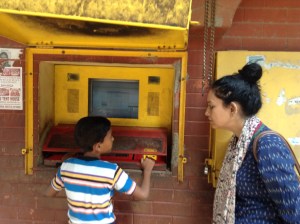
Sonya’s visit to one cell of The Hole in the Wall Project illustrates the changing face of learning.  In 1999 a team from NIIT (an Indian company specialising in educational learning  solutions, information technology and much more) carved a “hole in the wall” that separated the NIIT premises from the adjoining slum in Kalkaji, New Delhi. Through this hole, a freely accessible computer was put up for use. This computer proved to be an instant hit among the community, especially the children. With no prior experience or teacher intervention, the children learnt to use the computer on their own. Sonya was taken to meet three of the earliest users at one cell by Dr Ritu Dangwal, a researcher in the project. One of these first users is now a shop owner, another is in the second year of teacher training and one is training to be a lawyer. Sonya also watched the children step up to use the computer. One boy comes every morning to talk to his grandfather in another city, the grandfather also using a “hole in the wall” computer. The project’s instigator Dr. Sugata Mitra hypothesises that: The acquisition of basic computing skills by any set of children can be achieved through incidental learning provided the learners are given access to a suitable computing facility, with entertaining and motivating content and some minimal (human) guidance.

Suneeta

Sonya also was able to virtually meet Dr Suneeta Kalkarni the face behind the Granny cloud project (http://solesandsomes.wikispaces.com/Home) which is the next stage of Sugata’s work. This is when learners do not need supervision but that does not mean that they do not need ‘benign mentors’. Indeed, is it not the role of grandparents, uncles, aunts, [and sometimes parents and teachers too!] to be benign and friendly mentors instead of just ‘supervisors’?

Flat classroom conference

http://fclive2013.flatclassroomproject.org/

Sonya participated in a flat classroom conference in Hawai’i, a unique event that included 200 students and 40 educators from 9 countries working together in teams. Flat classrooms are about educators and students being part of learning communities using leading technology tools such as wikis, blogs, social networking and digital storytelling.


https://sonyavanschaijik.com/2013/08/01/flat-classroom-conference-2013/

FCGE Ryan
Hui Mei Chang, Sonya Van Schaijik

Anita Chen, Bill Brady, Ryan Fujii

  Sonya reconnected with Ryan in Japan  later on in her journey

Pedagogy and Student Learning

Sonya used her TeachNZ sabbatical to establish connections with educators around the world. Schools in Europe and then in Asia were visited and different learning environments observed. The educators who allowed access to their domain were educators who have a history of sharing professional practice and responding to children’s learning by using Technology in Transformative Ways. Whilst on her journey Sonya was able to observe how schools in Europe learn a second and even a third language. Many schools visited begin learning a second language by about 9 years old and the language is kept separate by teacher or by subject. Language and content learning are fully integrated and two or three languages are learned concurrently by all students – food for thought for the NZ context.

While away on her TeachNZ Sabbatical, Sonya used the following tools to communicate with educators both in New Zealand and globally.

https://twitter.com/vanschaijik

http://instagram.com/vanschaijik

http://www.sonyavanschaijik.com

More Information on Sabbatical Teacher Awards

http://www.teachnz.govt.nz/teacher-awards/directory/primary-teachers-sabbatical/

http://www.teachnz.govt.nz/teacher-awards/directory/secondary-teachers-sabbatical/


Jiao


Scan 3

Jiao

Mandarin Language Assistant.
In 2011 Newmarket School joined the Confucius Mandarin Language Assistant Programme, through Auckland University. This means we have a Chinese Language Teacher who teaches language and culture at our school. Our school is dominantly Asian and as such we believe in the importance of first language maintenance for our Chinese students and that our other students  can benefit from learning another language in addition to Te Reo and English.
In 2011 we had Mengmeng and then last year I agreed to host Jiao.
The first time I saw her I thought, whoa she is tall and skinny as, like about a size O,
However after the first few weeks, I mentioned to my principal that I was a fairly large eater and yet she could match me and then some. She was always hungry. My principal advised me to purchase a rice cooker and that was an excellent suggestion.
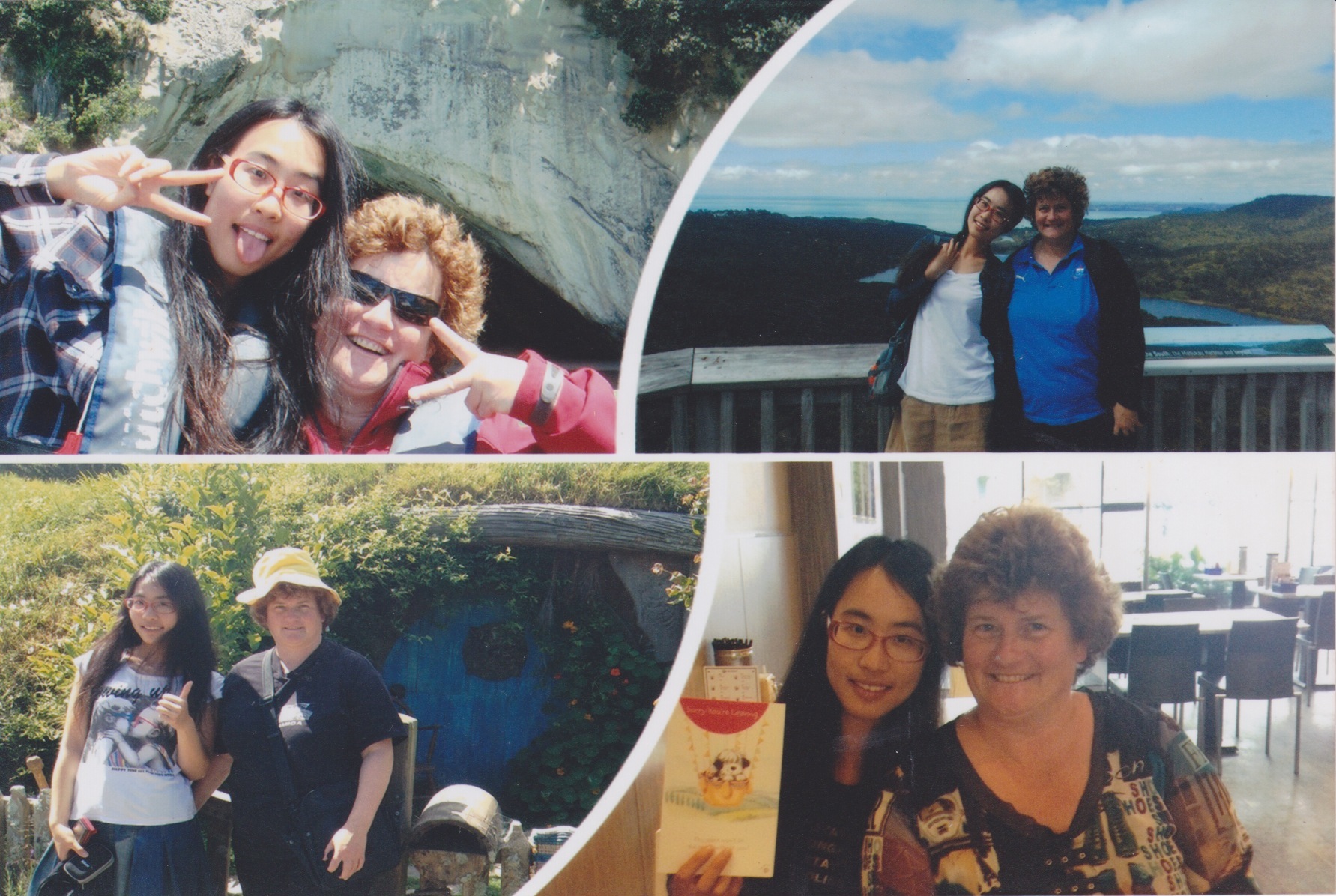
Jiao was only supposed to stay with me for a few weeks. However because we were such a good fit, she ended staying with me for the whole year and I am so glad that she did. I am a mother of grown up sons and never had a daughter, so Jiao is like my adopted daughter.
I have so many memories of her
EG: like within the first month, I asked her to clean the bathroom, which was a task that she would do each week.
After her first time, doing the task unaided without me,
She said to me. “Do you know what the day is?”
I replied that it was Saturday and that it was the day for cleaning the bath room.
She said, “I know that but it is also my birthday. This is the year of the dragon and I am a dragon baby so this year is as significant as a 21st birthday.”
I think this major event broke the ice between us because I laughed and said, “Oh my, you will never forget this birthday. You have no cake, no special event, and I made you clean the bathroom. Come on I will take you to the movies.”
And so we attended the first of many.
However, she proceeded to hold me accountable to this event by telling my parents the next day, my sisters and then at school the following week, how I had made her clean the bathroom on her special dragon birthday. So my parents and sisters teased me about what a dreadful host mother I was.
Jiao taught me heaps, like how to make dumpling, introduce myself in Mandarin and the Game of Thrones.
Me I introduced her to bacon and taught her how to cook and bake.
She took to baking like duck to water and made many muffins and cakes to fill up the lunchbox and to share with friends.
Once a week, she would hurry home from school to prepare the evening meal. She used the internet to search out recipes and experimented continuously.
Her favourite meal of the week was Sunday cooked breakfast. She got to sleep in and rose later for the event.
We had a lot in common. A love of science fiction, to a love of our communication devices. She introduced me to the Chinese Social media that she used to keep in contact such as QQ and wechat. I haven’t yet understood QQ but definitely know wechat.
I watched this quite shy quiet, young girl blossom into a confident and organising young woman.
Her first major task was introducing herself in front of Confucius and later on in the year she also gave her experience of being hosted. Both major events made my heart swell with motherly pride.
She organised her travels around New Zealand each holidays and I loved the fact that she did not rely on me to entertain her. She sometimes had friends over to stay.
She had no hesitation at letting me know how she was feeling and her dry sense of humour continuous to have me in stitches.
When she was told that as part of her teaching programme that she would be teaching Chinese dance, I think this was one of the major challenges that she had. She said to me, “I can’t dance Sonya, how on earth am I supposed to teach a Chinese dance.”
I told her, “You must think in patterns and it is easy. Anyway, you have access to youtube so do your  research and you will be fine. “
 
The fan dance she taught our children was stunning.
Jiao ended up thinking that she was quite an expert and that the dance she picked out for the next MLA was so advanced and intricate that I still laugh at the memory.
In 2013 I was selected as a TeachNZ Sabbatical and I toured the world. I told Jiao that I would come and visit her in Shanghai.
This I did. By then she had a boyfriend and was excited for us to meet.
When I arrived in Shanghai I could not believe how beautiful she had become. Her confidence had continued and she had developed into a lovely young woman.
Gone were the trousers and replaced with skirts and pretty sandals.
IMG_3521
She introduced me to her young man Chao and I observed how her treated her. She had chosen well. He was delightful and obviously adored her. He was clever like her and could match her for intelligent conversation. He was very kind to me too. They spoilt me rotten with their time.
profli
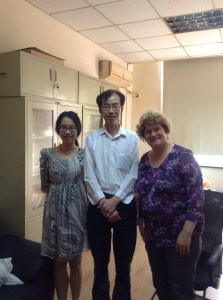
Jiao was very proud of the univeristy she attended and she took me especially to meet Professsor Li and a chance to tour the university. She organised for me to catch up with Mengmeng and I was able to meet her husband to be.
One fabulous memory I have is when they took me to visit the ancient town of Xitang in Jiashang county, Zhejiang Province.
Because of the vastness of China, I got to meet her mum and his parents via Skype. They were wanting to meet me in person but because I had a short time, I said I would come back for the wedding.