Agentic Teacher

On Thursday evening I took part in the fortnightly #EdChatNZ Learner Agency led by Philippa N Antipas.

The topic was, ‘Schools seek to nurture learner agency. What does learner agency look like for teachers, and how do we develop it ourselves to model it for others?’

Last year Claire Amos wrote a brilliant piece explaining  Learner Agency – more than just a buzzword! That she kindly allowed to be used in the EdBookNZ 2015 project unpacking latest buzz words.

I am continually amazed at how connections made online come together in fabulous way.

On Thursday Phillipa was moderator for #EdChatNZ and this was her first time leading this New Zealand Educator chat. I know she would have really enjoyed moderating the chat because she is a passionate educator and really know how to make connections with those that she works with.

I pulled together a storify of the chat because I am always interested in numbers.

I counted 719 entries on the storify over the hour. I deleted anything past that time and also past the next day. However I think it would have also been interesting to include the ongoing discussion because the chat continued for most of Friday too.

When I shared the storify, there were 34 tweeps who took part. You can see them all from the discussion. I have not counted the other educators who continued to contribute to the discussion on Friday. 

The hour long #EdChatNZ conversation was fast and furious. I am always interested in questions asked. I was particularly interested in Thursday night’s topic because teachers as learners is a topic very close to my heart. I have previously blogged about this recently in Children do not come first. Those of you who follow the work I do will know about the spaces and places I have created for teachers to share their learning such as TeachMeetNZ where teachers connect and share their learning in 3 minutes, EdBookNZ  where teachers collaborate and co-construct their own learning and more recently EdBlogNZ where teachers reflect on their learning, a site which I help collate.

Using storify to make connections and to unpack the discussion around teacher agency I churned over several of the quotes and as I further unpacked the discussion I had the feeling of Déjà vu. You can see what I mean because I have written about this before but under a different labeller of ‘ Connected Teacher.

Using the questions fired at us, I searched for some references. The third reference was given to us.

1)What does professional or teacher agency look like?

I found this great article written by Jackie Gerstein that tells us a little more, titled  Teacher Agency: Self-Directed Professional Development

2)Define Teacher Agency

This one has a fabulous video of a teacher sharing practice and explains what a teacher does. John’s story – Agentic positioning. But still couldn’t really find a true definition except for what Clare wrote. Also via the chat a definition for Learner Agency surfaced from ERO site.
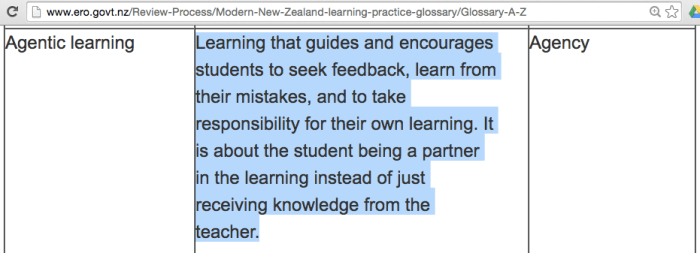
agentic

Together under Philippa’s guidance we hogged twitter with our ideas to define Agentic Teacher.

Defining Agentic Teacher

(Totally ninjed from the 34 kiwi educators taking part and rehashed.)

Teacher agency is about service to our learners and our community through communication, making connections and seeking collaboration. An agentic teacher has the power to make a difference by becoming involved and owning their own learning through figuring the known and the unknown. An agentic teacher shows mutual respect for collaborative partners through actions with a focus on learning. Current practices are challenged and alternatives ideas are suggested where appropriate. The learning journey of an agentic teacher is lifelong. The ongoing goal is to be the best as you can be by actively and continuously challenging own assumptions, knowledge and practice regarding learning.

Personally, I should have also added Whānaungatanga. An agentic teacher lives and practices Whānaungatanga. Here you can read my personal description of Whānaungatanga. 

3)What kinds of environment or culture would teachers need to develop agency?

This article was referenced in the chat. Swimming out of our depth.

4)Teaching as inquiry has been mentioned. It’s in the NZC. Has this led to agentic teachers? If not, why not?

Agentic Teachers is a way of being.

Q5: What if schools co-constructed professional learning with their teachers? Would that encourage agency?

Q6.What might it look like if everyone in the staff was agentic? Chaos?

So what do you think?

Have I defined Agentic Teacher or is agency a quality and mindset that we develop as is suggested by Jackie. Do all teachers need agency? Or will we just exhaust our teachers?

If you write about the chat, please do use #EdBlogNZ and I will curate them all together.

Philippa has asked to be tagged too so do remember that as she will be reflecting on her session and seeking feedback.
How I use SOLO

Definition and background

What is SOLO Taxonomy? SOLO is the Sustained Observation of Learning Outcomes. I was first introduced to this learning framework during my TESSOL diploma in 1997. I selected to present the work of Biggs and Collier during one of my earliest assignments. We had to present our learning in 5 minutes. A decade later I joined Newmarket School and the school was in the second year of an ICTPD contract with Pam Hook. I was incredibly lucky in my second year to oversee the contract therefore was able to have extra learning time with Pam. My understanding of SOLO was reactivated as we learnt how to use the HOT frames and rubrics.

I used the HookEd maps from Pam to identify where I was on my learning with using ICT with my students. Those who know me know that I am a technology geek and pride myself on getting fabulous work when I am working with children. When I used the frames to self asses where I was and what my next steps would be, I was shocked to learn that my outcomes were multistructural. In focusing on the product and what could be seen, I totally missed the process and reflection from my learners. So I made it a mission to plug this gap in my learning. Over the next year, I read around SOLO. I cyber stalked the work of Pam Hook. I reread the theory behind SOLO. I reread John Biggs and even talked to him via email. On twitter I started to identify teachers who were using SOLO and devouring everything I could. As I followed teachers particularly from overseas I could see the HookED SOLO Taxonomy maps and symbols in all that they were doing and all this led back to the work of Pam.

The rubrics

In gathering the overview for our school about SOLO I quickly identified who the strong teacher users were and one was Virginia Kung. I targeted Ginny for discussion and kept hounding her for feedback. Some of my best outcomes from children were framed using SOLO. Ginny would come in and observe and give me feedback. At the beginning of every session her first question was, ” Show me your rubric.” In my earlier teaching sessions I did not understand the importance of using the rubrics. Ginny still observes me and still has discussions with me and she still says at the beginning of every session, “Show me your rubric.” What the rubric does is clarify what you are looking for with your learners. It allows you to see the progression of your teaching. It highlights key words that jump out and if the children highlight these in their process and reflections and this helps drive identifying next steps and reflecting about what went went well. That learning has finally sunk in. I now always start with the rubric. In addition, if I am writing with the children, I have learnt to have a go first at writing out what I want to see from them. A good example of this is explaining what whānaungatanga is. First I would define whānaungatanga, then describe what it looks like at Newmarket School and make a list of school events that highlight the concept of whānaungatanga. Next I would explain what whānaungatanga means and then if we had an event that brought our school community together, I would evaluate if whānaungatanga was present and maybe identify what we needed to do next time to make the event even better at bringing people together to collaborate, share and celebrate. 

HOT maps and rubrics

In the earlier days I was hooked on using the HookED Hot maps. I pulled them all out, and displayed them on one wall of my teaching space. I aligned all the rubrics underneath them, stood back and tried to make sense of it all. Often early users get stuck on the defining and even the describing maps and cannot see past this part of SOLO. But by targeting a new map each term and learning how it works with the rubric, this drove my learning. For example I targeted the compare and contrast HOT map and used this to frame speech writing, Then I targeted analogy maps for creating new monsters that visited our school. I targeted the sequence map to frame a unit on electricity. Each time I pushed for reflections using teacher generated Rubrics. I then carried out a writing session using paddle crabs and I used describe maps and sequencing together and this is when I began to highlight the key words.

Reflections and extended abstract thinking.

Each time I targeted a new map I kept up the dialogue with Ginny. Over time whenever I saw Pam, I would share with her what I was doing and she would also stretch my thinking by asking probing questions about what I was doing. I looked forward to her visits because it was like self talk. As I reflected more on the process and I clarified my thinking, I could motivate my learners to do the same. I used an explanation map to deepen my own understanding of Matariki. When I worked with the children I pushed for an overall statement. But at that time I still did not see the triangulation of a statement reflecting on the process and sharing where to next.

My inquiry.

Last year I had Virginia as my appraiser. I deliberately asked for her for two reasons. Ginny can drive my thinking deeper and she always asks for visible evidence. That visible evidence is something I also drive with our teachers. This is my ongoing personal teacher inquiry.  ‘If I cannot see what you do, it doesn’t exist.‘ I have been pushing our teachers in curating their own learning via presentations, blog reflections, photo curation via Instagram, google and and micro blogging via twitter. As their skills develop, I also aim to see more learning happening using video. Our teachers’ own learning must be visible for a shift in pedagogy to happen. It is no longer enough to just have learning visible on classroom walls or sitting inside an appraisal folder.

My student inquiry

My own student inquiry centred around SOLO taxonomy and my TESSOL training.

Ginny being who she is asked me to prove the following statement and of course by now I knew to begin with the rubric. 

I wonder if what I know using SOLO taxonomy and the prior knowledge and training I have been through the best best practice for second language learners?

Some of what I have did was:

  • gathered student data before and after each team,
  • collated all that was happening in my students books,
  • took heaps of photos and scanned countless pieces of student evidence,
  • displayed the process on the wall with tags and allow the walls to be my think aloud,
  • microblogged some of what I have did via twitter,
  • wrote several blog posts reflecting on where I was up to and also to clarify some of my thinking,
  • published a piece about SOLO Taxonomy and how SOLO frames learning,
  • presented my inquiry to our Board of Trustees.
  • kept up the dialogue with Ginny.

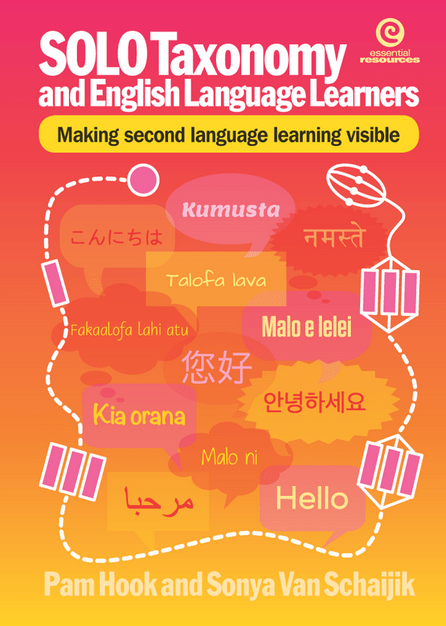
SOLO Taxonomy and English Language Learners

I planned and co-wrote a book with Pam Hook. The initial idea freaked me out because those of you who know me well know how incredibly challenging I find writing and I am the first one to admit that I cannot spell. However I am always up for a challenge. I have never let my spelling skills hold me back. I always find a person with an eye for detail to help me by proof reading what I write. 

Pam framed up the book and I brought in our Newmarket School samples. Doing something on this scale allowed me to continually reflect on my pedagogy and to test ideas using research. Over the year I read what Pam framed up and I added statements, quotes and some references. We used Google Docs to work collaboratively. As I checked our Doc’s history I could see Pam beaver away continuously in the background. She did an amazing work on research and I am truly thankful at how special the writing has turned out. I can hear my voice as I continually stressed to her that everything I did with our children was not at the expense of their first language. We met once a term face to face over scrambled eggs and bacon and kind of debriefed. Those sessions helped motivate me to plan what I would do in the following term with our learners. During the final few months I gave Ginny and Wendy, our principal access to the doc and asked them for feedback. Even during the final edit we were all still making modifications.

My learning

During the process it was incredible exciting. Writing a book is like studying. Some of my best teaching happened when I was a TESSOL student. I liken this to research and practice all wrapped up together. So it is like addressing the why and the how of learning. I also knew the importance of gaining my principal Dr Wendy Kofoed and our Board of Trustees approval before undertaking something that involved our school, our teachers and our children. Wendy is so infectious when she says yes. Getting her approval helped spur me into action. As for our BoT, they asked me heaps of questions about my learning when I presented to them. Both gave approval.  I especially knew the importance of copyright and gained written parent permission to use their children’s image and work in the book. I had the letter translated into the three main home languages of our school. I learned that something like this is not a one person wonder but involves so many people. Even the product itself had a team of proofreaders, editors, designers and our publisher, Essential Resources. Personally I adore the cover and wished I could have had all our languages on it. But I am quietly happy to see our Pacific greetings take pride of place amongst the other dominant languages that are ESOL funded by our Ministry of Education.

Finally the thanks

I am cautious to thank anyone publicly by name and the important ones are already in the book. But I cannot finish without again thanking the amazing children that I teach and who teach me everyday. However I do have to finish by mentioning my two sisters. Kathie Phipps and Astrid Grobben. You know why and you know what you do for me. Your blunt honesty keeps me on track. In this post I want to thank Pam Hook too for giving me this amazing opportunity to share my practice in such a public way. 

Where to next

On Friday Pam and I have our book launch and this happens at our #NPSFab Newmarket School. We have not bought in any books to sell because the afternoon is really a celebration for us. However if you do want a copy, then here is the link on Essential Resources. You have the chance of purchasing both a print copy and an electronic copy. The electronic copy is totally in colour so looks especially amazing. The paper copy is in black and white and that smells and feels amazing. This year my inquiry centres more around my pedagogy and what exactly do I do that makes a difference. Of course SOLO Taxonomy is in there guiding me and of course Ginny is there prodding me. Pam is there too to hold a mirror to my practice.

Screenshot 2015-11-08 at 20.38.13


Holes in the bucket

I wonder if there are holes in the bucket?

Phonological Awareness.

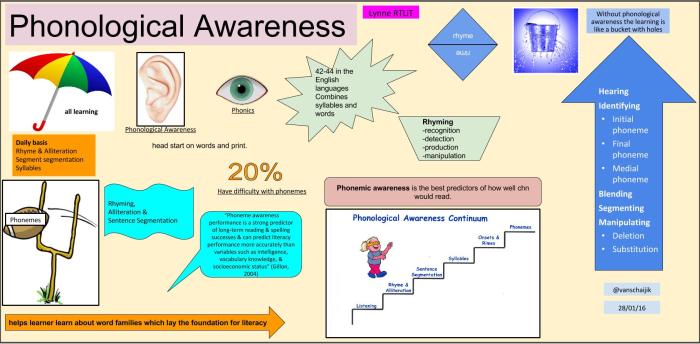
Phonological awareness is the ability to hear and consciously break words into syllables, rhyme, onset and rime, and individual sounds or phonemes.TKI 2016

Phonological awareness refers to an individual’s awareness of the phonological structure, or sound structure, of words.

Phonemic Awareness

TKI defines phonemic awareness as the ability to hear, differentiate, and attend to the individual sounds or phonemes within words and is part of phonological awareness. Alcock further states that ‘Phonemic awareness is a category of phonological awareness and is the ability to hear, identify and manipulate individual sounds in words. Phonemic awareness is necessary for understanding and using phonics knowledge.’ Alcock, 2010.  Gillon (2004), stresses that, “Phoneme awareness performance is a strong predictor of long-term reading and spelling success and can predict literacy performance more accurately than variables such as intelligence, vocabulary knowledge, and socioeconomic status” (p. 57).

Many people do not understand the difference between phonological awareness, phonemic awareness, and phonics. Others are uncertain about the relationship between phonological awareness and early reading. I created the following diagram from our teacher only day to help clarify my thinking. You can see that phonics are visual and phonological awareness is all about listening. Phonemes are a subset of phonological awareness.

phonological awareness

phonological awareness (PDF)

Phonological awareness is an important and reliable predictor of later reading ability. Some of the most exciting findings from research on phonological awareness is that critical levels of phonological awareness can be developed through carefully planned instruction therefore having major influence on children’s reading and spelling achievement.

This week we had our team meeting with Andrea our fabulous team leader who had asked Lynne one of our RTLiTs to come in and do a follow up session of Phonological awareness that she had run for staff on our teacher only day. Andrea had been so inspired by the concept of checking the foundation of literacy using the phonological awareness assessment that she had run the phase one test with her 5 year old class.  She had been motivated by the patterns she had identified. She thought phonological awareness is something we should all seriously look at. After our team session I totally agree with her.

I reflected on my inquiry regarding 3 level guides and wondered if I was working with leaking buckets of knowledge. So I asked Lynne if she could carry out a phonological awareness test with one of my students whose data did not make sense. I wanted to observe how she carried out the test so I could continue when I had similar doubts with some of the data I gathered. I also wondered about using it to gather further data before I began my writing intervention.

Lynne used the Plymouth Phonological Awareness Assessment Phase One. One of my target students is a year 6 second language learner. He has been with us since he was nearly 7 and I know he did not achieve literacy in his first language. Those of you who work with bilingual students know about the phenomena that happens when children are literate in their first language and how fast they can accelerate when learning their second language.

This student is at level 17 for reading. He is well below for writing. He was recently tested using Steps and identified as achieving well below his chronological age.

Sure enough the Phonological Awareness Assessment identified gaps in his literacy. Lynne often states in her discussion that, “If we do not address that basic foundation then all we are doing is pouring in time and resources into a bucket with holes.

She shared with me the information from our ‘Switched onto Spelling’ programme that indicates the importance of carrying out a Phonological Awareness Assessment before undertaking the programme. Alcock, 2010

I reflected on our overall school literacy programmes. For example, I run an ESOL programme and intervene with children who need accelerated work to catch up to the moving target of peers that they are chasing. We run a ‘Steps’ programme that works with children who appear to have gaps in literacy building blocks. We gather data for the Mutukaroa cluster project that we are part of. We have reading recovery for children identified at 6 years old observation survey who do not appear to make the required progress. Often the programme spaces are taken up with our second language learners.  

In addition we sometimes run an accelerated literacy programme for our gifted and talented children.

Writing

This year as a school we have targeted writing and especially targeted SOLO Taxonomy as the framework for writing because this has been identified as helping children to deepen their literacy. We have put more of staff resourcing to support learning in class because international research has identified that withdrawal is the least effective form of literacy development. Our teams are currently trialling grouping students according to needs as teachers experiment with their own learning pedagogies. This is a cautious approach because we are also aware of the research around grouping children.  

Data

As a school we are really good now at gathering data. Teams are beginning to develop an awareness that our children’s data is all of our responsibility. Data is an ethical issue. As a school we are all responsible if our children are not making the required progress.

Therefore I believe that along with making connections with the child and their families we also should check the bucket of literacy learning. When children are literate in their first language we should see accelerated progress. If they are not literate in their first language, then we should endeavor to ensure language maintenance continues. Before we pour in the learning, check that the foundation of literacy is in place.  The Phonological Awareness Assessment is simple to administer and yet can quickly identify gaps that need addressing.

Where to next for me

I begin a new writing group this week. Before I do anything, I have looked at their data and identified where they are reading at. I have looked at their e_asTTle writing data from last year. I have looked at their historic data and found out as much as I can about the children. I will now carry out a Phonological Awareness Assessment and check their foundation and feed this back to their teachers. This week our children are sitting an e-asTTle test and I will mark and collate my group’s data. I will be part of our team moderation and then our school wide moderation. Taking part in moderation ensures that my own teacher judgements remain current with national standards.

Overall

As a teacher of children learning English I believe it is important to find out as much as I can about the children I teach. I believe it is important to address the urgency of second language learners catching a moving target of learners. But not at the expense of maintaining their first language. I believe it is especially important to make connections with the children that I teach. One way of doing this is just getting to know the children personally. I do this by targeting them in the playground and saying hello in their first language. I often make links with them via a common interest. At the moment a big interest with children is Minecraft. With some of the older girls, it is drawing using the Manga style- (Big Eyes).

I also believe in the importance of reflective teachers and this year I aim to reflect in a visible written format.  Finally it is especially important to have ongoing dialogue with colleagues about what they are doing in their inquiry and for me to make links with that information to my own inquiry. I especially like it when colleagues send me links to what they are reading and become even more excited when they tag me with something reflective that they have written. So Andrea thanks for giving me a prompt to reflect on my practice and for alerting me to revisit what Lynne had shared with all staff on teacher only day. The follow up session allowed me to dig deeper into my pedagogy and to think about the words of John Hattie, ‘Know thy impact.’

My last question for anyone reading this is….

How do you ensure that your buckets of practice do not have holes?’


References

Alcock, J. (2010). http://www.spelling.co.nz/Downloads/Practitioner’s%20guide.pdf

Gillon, G. (2004). Phonological awareness: from research to practice. New York: Guilford Press.

Gillon, G. (2013).  http://www.education.canterbury.ac.nz/people/gillon/Workshop_handout_2013Sept.pdf

Plymouth Council. (2016) http://www.plymouth.gov.uk/phonics_assessments.pdf


Term 1 Observation

Visit 1 focus: Baseline data of teacher and student use of target language.

My Reflection.

wendy

This week I had the pleasure of meeting Wendy Thomson Director of TPDL. Wendy has been Project director since its inception as a pilot programme in 2005. She is an experienced language teacher and speaks several languages herself. Currently like me she is also learning Mandarin. For this first observation, she was my ISSF, In-School Support Facilitator.

What is TPDL?

Teacher Professional Development Languages (TPDL) is a programme that provides professional development and accreditation for languages teachers throughout New Zealand in order to improve their pedagogy and language fluency in ways that impact positively on student achievement. I have written about TPDL before when I reflected on my first Mandarin lesson.

Reason for the visit.

Wendy had come to Newmarket School to observe me teaching Mandarin and to gather baseline data about me and my student’s use use of Mandarin throughout my lesson. She used scaffolded observation criteria and structured observation and reflection tools that enabled me to see the extent to which my classroom practice supports effective language learning. Those of you who have been following this story will be nodding your heads about me as the learner. Gathering data and supporting me to identify my next steps. I have been teaching for over 30 years and am always excited at learning something new. My knowledge of Mandarin language is currently growing and in order to make the 2000 basic interpersonal skills in a year I need to be learning 25 new vocabulary a week. So far this week I have made that. I have learnt to count to ten and I know all the primary colours. I know that I would not have learnt these words if I had not been teaching them.  The experience is a reminder to us all about the power of teaching to clarify thinking when learning something new. How often do we give students the experience of teaching? I know I need to do much more think, pair, share activities in my practice.

Wendy shared with me the work of Rod Ellis and I am already familiar with Rod’s work because of my recent published book with Pam Hook, SOLO Taxonomy and English Language Learners. However what she did was to map my lesson against the Ten principles of Successful Language Instruction, Ellis 2005.

Wendy literally transcribed everything I said. I was interested in seeing those highlighters being used because I tested that out last year with my student’s writing and used highlighters as visible evidence of their writing. Always with my elearning lens on, I questioned her use of paper copies as I said I could have given her WiFi Access. When we looked over my transcript I could identify the number of times I used Mandarin, the number of times the children used Mandarin and more importantly the number of times I could have used Mandarin. With her support  I was able to identify my next steps based on evidence of me and my students’ use of the language. For me my next step was using Mandarin for classroom use.

She gave me hard copies of examples I can use in my lessons for classroom language and for social interactions. Again I would have loved the sheets in soft copy because now I need to spend time recreating them so I can have a set of small spiral cards with me during my lessons. I spent ages online with a translator but could not find the exact script, so I will have to remake them. Again how often do we give students worksheets rather than a soft copy that they can add to. That is the beauty of Hapara for sharing soft copies with our learners rather than giving them paper copies that they cannot edit.

She also gave me a paper folder and to be honest I asked her ‘Why.’ Again I am the student who would have preferred soft copies of everything. I know I can say this to her because if students keep accepting paper copies and ring bind folders and do not question the reason behind this, then our tertiary providers will keep thinking that this is OK. In my given kit was a memory stick of audio and again I thought, why are our tertiary providers not using online storage of sound for this purpose? Particularly in this current ease of WiFi. I believe access to the internet is like having access to roads. It just is. Do we really still have adult teacher learners who do not have WiFi access in this day and age? Have I been so spoilt with school access that I have forgotten reality? How many schools are still waiting to be snupped and are still waiting for N4L? My receiving a USB is like receiving a floppy disc. I am the student who will always ask for soft copies or who will turn up to an event with a mobile device and expect to be given the Wifi password.

Wendy informed me that I had covered 4 out of the 10 principles in my session. I have made them bold below and have given examples of how I did this.

  1. Instruction needs to ensure that learners develop both a rich repertoire of formulaic expressions and a rule-based competence.
  2. Instruction needs to ensure that learners focus predominantly on meaning.
  3. Instruction needs to ensure that learners also focus on form.

(I gave the children correct visual of the language in both PinYin and in Mandarin script.)

4. Instruction needs to be predominantly directed at developing implicit knowledge of the L2 while not neglecting explicit knowledge.

(Students were given the opportunity of making connections with what they were learning and with what they know. They showed me how they count to 10 in their own language or told me what the colours were in their home language.)

5.Instruction needs to take into account the learner’s ‘built-in syllabus’.

6. Successful instructed language learning requires extensive L2 input.

(I provided the children with good models of L2 using youtube video clips.)

   7.Successful instructed language learning also requires opportunities for output.

(I gave the students the opportunity of moving into smaller groups to practice what they learnt with me.)

8.The opportunity to interact in the L2 is central to developing L2 proficiency.

9.Instruction needs to take account of individual differences in learners.

(I had some first language speakers model for us therefore making use of their prior knowledge.)

10. In assessing learners’ L2 proficiency, it is important to examine free as well as controlled production.


yanse

Me teaching Yanse- Colours.

Teacher directed and from the front. I wonder who is the real learner here?

shareChildren practising in smaller groups how to introduce themselves.


Where to next

Wendy and I discussed my next observation. This will involve a different ISSF who will also carry out scaffolded observation criteria and structured observation and reflection tools. Again  I will see the extent to which my classroom practice supports effective language learning and this will continue to be mapped using evidence principles strategies against the Ten principles of Successful Instruction.

Overall

Wendy’s visit provided me with a lot to think about. The discussion was well structured and I felt like I was learning.  I am already a language teacher but being a language learner opens my eyes to how effective I am being as a language teacher. I am already trained in TESOL and have taught in a Bilingual Immersion class. But I think I would have benefitted from someone like Wendy observing me and giving me feedback on how much I was using the target language when I was teaching in Samoan. The experience was interesting for me and allowed me to reflect on where I am as a learner. So to finish with I will summarise my learning using SOLO Taxonomy.

What am I learning.

I am learning Mandarin and I am using the 10 principles of successful instruction to frame how I teach Mandarin to 5 year olds.

How is it going?

I believe it is going really well in this early stage. The part that I am enjoying the most is making connections with the children that I teach. My vocabulary is slowly building with using youtube and a Mandarin language learning app as I await my night course to begin. I have also been making connections with teachers in China using WeChat who are part of the Flat Connections  Connect with China Collaborative that I am involved in. I have had some positive comments from teachers after my lessons. I remind them about being actively involved when I come in to teach.

What do I need to do next?

My next step identified with Wendy is to learn Mandarin language for the classroom. I am determined to learn chunks of language and to put my vocabulary building into action. I want to praise the children in Mandarin and I want to begin giving instructions in Mandarin.

Resources

Here are PDF’s of some of what I was given in my ring binder.

Ellis, R. (last updated 15 July 2005). Instructed Second Language Acquisition. Section – Small Groupwork, p. 22: www.educationcounts.govt.nz/__data/assets/pdf_file/0008/6983/instructed-second-language.pdf

Ministry of Education [2006], Instructed Second Language Acquisition: Case Studies

http://www.tpdl.ac.nz/site/tpdl/files/Resources%20-%20documents/General/Professional%20Readings/Instructed-Second-Language-Acquisition-Case-Studies-2006.pdf