Children do not come first.

npsThis week at Newmarket School we had camp and swimming and new children and I thought about our fabulous teachers at NPS. This post is a shout out for them and for all teachers.

I believe if we take care of our teachers then they will take care of our children.

I often hear and read about children being incredibly important and they are placed at the center of everything. They are highlighted in school documentation as being the heart of our schools. 

Don’t get me wrong, I believe our children are the heart of our schools too.

However we appear to miss something when we neglect to mention the place of our teachers. If our children are the heart of our schools then our teachers are the blood that pumps that heart.

One of my old principals used to say “Take care of our teachers and they will take care of our children.” Or she would say, “Our teachers are our greatest resource.” She also said,  “Without our fabulous teachers I would not have a fabulous school.”  

Sometimes too when I read documentation I want to change the word student or children for learner because I also believe that all teachers are learners too and if we use the word learner than this embraces our teachers too. 

Yes I know support staff, parents and whānau, but that is another post.

What do you think? I would love to hear your thoughts.


ALLiS

Know thy Impact.

I often hear this phrase espoused by John Hattie and I thought about it after this week’s personal experience. I had a hilarious experience this week with the 5 years olds which I must share.

IMG_2696

ALLiS

I am lead teacher for the ALLiS project at Newmarket School. As a school Newmarket has joined the ALLiS Cluster (Asian Language Learning in Schools). According to the MOE, the ALLiS Contract is funding available for schools or groups of schools, with particular emphasis on those that establish language learning pathways from primary through to secondary. The fund will encourage greater collaboration amongst schools in partnership with external Asian language and cultural organisations. Programmes must be self-sustaining once funding ends. The aim of the funding is to increase the number of students learning Asian languages to support our growing trade and international relationships. There are also bilingual benefits of learning a second language.


Our ALLiS Group of Schools.

Our group is the Epsom/Remuera group with Meadowbank School as our lead school. We are fortunate to have Deb Ward as our ALLiS Lead Teacher and she is based at Epsom Girls’ Grammar School. I have included a list of the school lead teachers in our group and we will be working together to increase the number of students learning Asian languages in our schools.


Deborah Ward ALLiS Lead Teacher
Stephanie Lin Parnell School
Maria Blanco Blanco Epsom Girls Grammar
Lisa Rolle Cornwall Park School
Joanne McNeil Remuera Intermediate
Jane Cameron Victoria Ave
Amy Ko Meadowbank
Sonya Van Schaijik Newmarket
Mary Fallwell Remuera Primary


This week at Newmarket School we began our Mandarin language and cultural programme for our school. We are fortunate to have access to our parent community who are Mandarin speakers and we were extra fortunate to have two parents agreed to teach Mandarin language and Culture further up in our school.IMG_2639

I have agreed to teach Mandarin and have been accepted into the Teacher Professional Development Languages Programme. (TPDL). The programme equips teachers to teach language effectively. Part of that is learning and teaching Mandarin for a whole year. I have registered and have paid for Chinese (Mandarin) Level 1A to begin soon at Unitec.


Polyglot

Those of you who know me know I am already quite a polyglot.

My first language is Samoan and I learnt English academically when we shifted here to New Zealand. I led a Samoan bilingual unit for two years and this strengthened my Samoan literacy. I learnt high school French and used this learning when I visited France. I also hosted a Tahitian student for a short period of time and this reactivated my schoolgirl French.

I learnt Maori at teacher’s college for three years and regularly led the Kapa Haka group. Now I can kind of get by with support. In my married life I learnt Dutch and when I visited Holland with my children’s father I was able to converse in Dutch with very little support.


When I first moved to Auckland I was thrown in at the deep end into a predominantly Tongan speaking class and learnt to survive on basic Tongan. I had a grandmother who often would teach me phrases which I used as part of classroom control.


I hosted Japanese teachers for three years and during that time I learnt Japanese at night school. I was able to use this learning when I visited Japan or when we have new English learners from Japan.

I also can say hello in all the languages of our children at Newmarket School.


Why?

So why am I now learning Mandarin, you may ask?


Well I have always maintained that I would never ask staff to do something that I was not prepared to do myself. So part of the ALLiS goal is learning an Asian language. It is about school sustainability with the Mandarin language. Our teachers have had access to a Mandarin Language Assistant who came to us as part of Confucius  and taught whole class Mandarin.


I chose Mandarin because I have hosted a Chinese student and absolutely adore her. In addition a large percentage of our school population are Chinese speakers. I live in Newmarket and know that out of all the local languages, Mandarin is the one I am most likely to have others to communicate with. This is because historically Newmarket has large numbers of Chinese migrants living here. I have visited China twice to visit my host daughter and I know I will return. I attend the Chinese lantern festival hosted each year in Auckland as part of making connections with the children I teach. I am also involved with the Flat Connections China Project as a teacher observer. I am fascinated with the way teachers are making connection across the locked down ‘Great Fire Wall of China’.


My level of Mandarin

If I use SOLO Taxonomy I know I am unistructural with Mandarin language.

I can count to 5, with support. My support are the children because they have been teaching me forever during my lunchtime duty. However I still need them to start me off. I can say hello, my name is Sonya and Goodbye. That is basically the sum of all I know in Mandarin. This week I have been practicing like mad to say Happy New Year, but still have to consult my card.

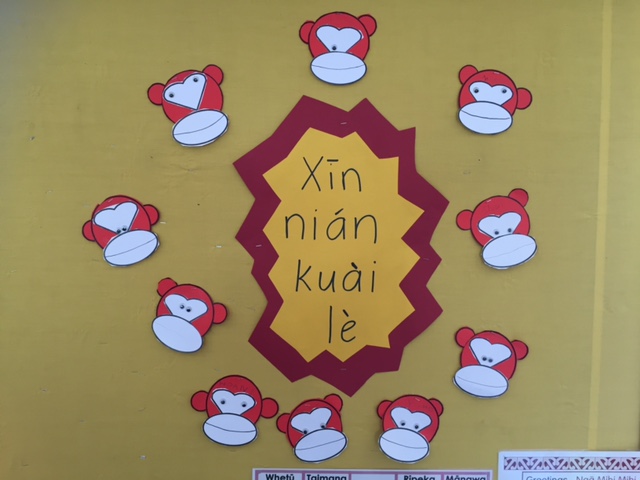
I also consciously learnt a new work. My new word was monkey. I thought about this and tried hard to remember the single sound of ‘hou’. This is because 2016 is the year of the Monkey and I wanted to share a little bit about the year of the monkey.


My first Lesson

I have agreed to teach the 5 year olds because I know from personal experience that if I am not prepared they will eat me alive. So I went into my lesson reasonably clear about the sequence of the lesson and my learning intention.


Everything was going really well. My first group were fabulous and I had support in the students with my pronunciation. They all made their monkeys and they all learnt basic sentences and could say this with support.


My next group involved two classes together and their two teachers. The lesson was a little more challenging because of the larger number. But that is OK because I know I will adjust from my peers feedback. I also know that the teachers are further along in Mandarin than me because they have had access to weekly lesson with the Mandarin Language Assistant so I am relying on them to support the lessons.


In the second class I have identified 7 fluent speakers who need much more than what I can deliver but that is OK too because I will use this piece of information to challenge my pedagogy. I do not want to teach whole class but want to structure the learning so my lessons caters for all levels of the language. Being a linguist I really want the children to be speaking in phrases rather than in single words as has been the previous few years learning.


I kept my eye on the short time and packed the children up. As they were leaving one little poppet, who was not a mandarin speaker called back to me,

再见猴子 Zàijiàn hóuzi. I responded with Zàijiàn. When he started giggling I realised what he had said and my first thought was, ‘just you wait until tomorrow.’


But then I thought about the linguistic implications. He had made a connection with two words, and he had made a joke. I know that to crack a joke in your second language takes quite a bit of thinking.


So do I feel pride or should I feel indignation? I will catch up with him about respect but will do so in a positive way. Unfortunately with 5 year olds, yesterday was a lifetime ago.


Personally, the parting comment made my afternoon and I was going around the staff telling anyone who would listen. However in this post I won’t respond what one staff member said. But it was really funny and you can probably make a smart guess.


My next steps

When I use SOLO to map my learning, extended abstract seems a lifetime away. But that is OK too. I have identified my starting level and I know what my next steps are.

My next steps will be carried out with Unitec with learning Mandarin and in the university paper on second language acquisition. I am looking forward to stretching my thinking by doing something new totally outside my comfort zone. I am really interested to learn about acquisition from a personal perspective and to apply it to a different way of learning.


Next week our group of schools will begin the ALLiS contract officially with an inauguration ceremony held at Epsom Girls Grammar. All of our staff will be present as we are committed to making this contract work.


For those of you wanting to know more about ALLiS you can join the online ALLiS Google+ community discussion group that has been set up.

But for now


再见

Zàijiàn


Three Level Guides

I am always up for a challenge and there is no one like my mentor to give me the push I need to reflect and think through pedagogy.

Just before the end of the year, I always go through the end of the year class data and identify my English Language Learners who could slide in reading over the summer period. Therefore over the summer period I give them a bag of books with the understanding that I will test them when they come back to school and I expect them to have either maintained their level or moved up one level depending on where they sit on the PM benchmark or using early probe levels.

This week from testing the children after the summer holidays I have several year 4 and 5 children at turquoise level on the PM Benchmark. So we are looking at level 17-18. Those of you who understand our system here in New Zealand will know that this is well below where they are expected to be by year 4 & 5.

But stop!

Have a think about this piece of information. Many of our ELL children came to us two years ago with no English. Therefore against our system that is the progress they have made within two years beginning with no English. If we look at our data and our school standards level 17 and 18 is the benchmark that we aim for for children after two years at school. In addition these children have achieved that benchmark and often began with no English. Therefore are they ‘failing’? Linguistically they have made accelerated progress because they have had to go through the silent, watching period and then learn basic interpersonal communication skills so they can communicate with peers and now they are beginning to gain cognitively applied language proficiency as we start the next process of developing inferential skills in reading. They have caught up over two years what a first language learner achieves after 7 years old. Pretty amazing and always makes me proud.

From the recent testing analysis I have identified that at the text level or the surface level of reading, their decoding skills have improved markedly from last year with a 95+ % result.  However the analysis identifies that they could do with help unpacking between the text and beyond the text comprehension strategies. Those comprehension questions continually trip them up at inferential level and stop them moving up to the next reading level.

Those of you who are ESOL teachers will probably know the work of Herber (1978)  who devised a comprehension strategy known as ‘The three level guide’. This comprehension strategy is a pre/post reading activity that gives students the opportunity to evaluate information at the literal, interpretive and applied levels based on a reading selection. The comprehension strategy was developed further by Morris and Stewart-Dore (1984) to help students think through the information in texts.

Myself I have trawled our fabulous TKI ESOL site to revisit ESOL comprehension strategies that I learnt about during my Diploma of TESSOL with Sue Gray and team. Furthermore this time I have used my SOLO Taxonomy hat to unpack the information using an information transfer chart. I have created 3 level guides in the past and have used them with great success.. However over the past few years I have been focussing on writing with my English Language Learners as this is another area that continually needs support.

Three level guides means just that 3 levels of comprehension. The comprehension strategy has teacher created statements that occur with searching for information at surface level of text, then has between the text statements that the reader applies the information from the text to real life contexts and explains reasons for this in paired or group discussion and then finally it has beyond the limits of the text statements that the reader critically evaluates the information and relates it to what is already known and justify their answers and their views.

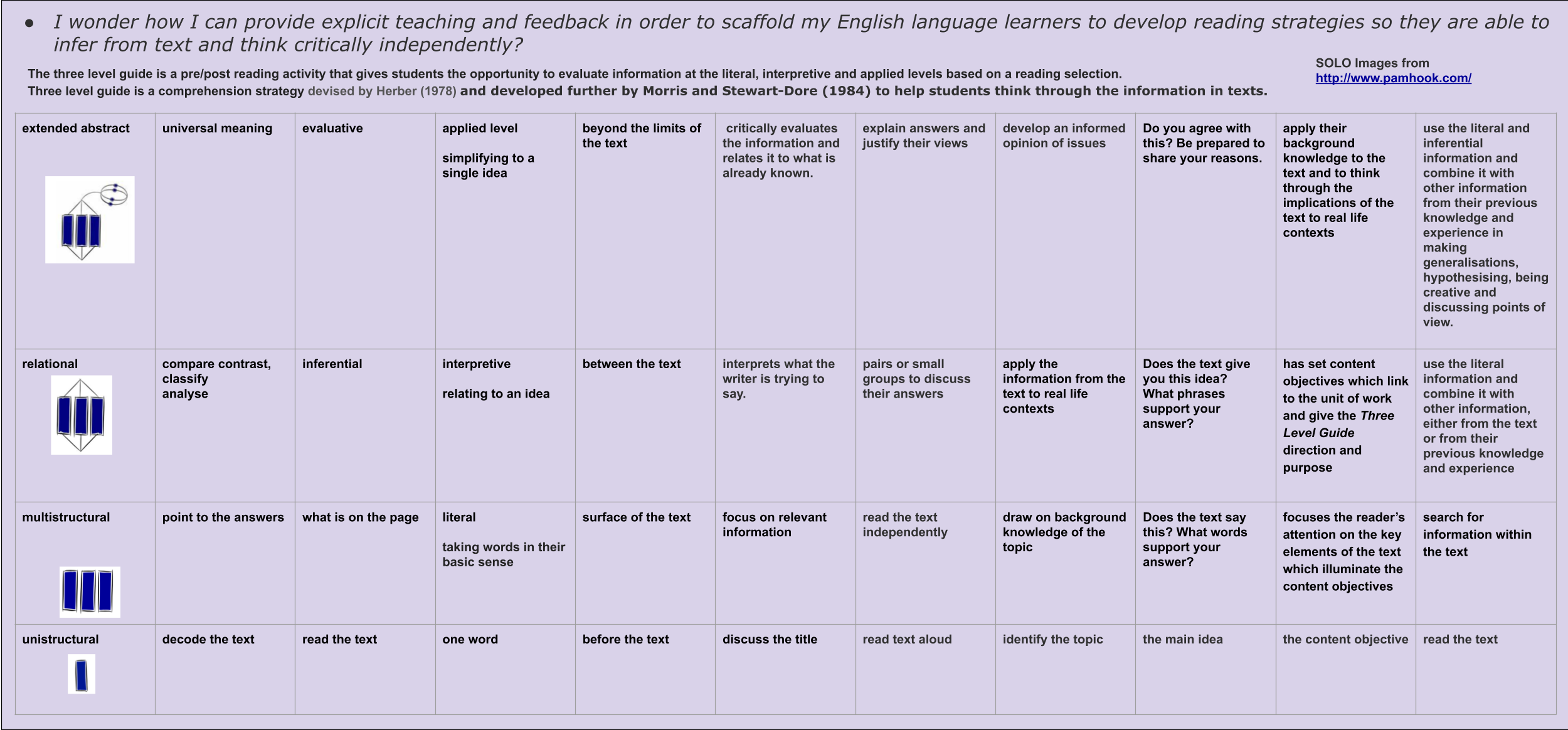
Using SOLO I have identified exactly where each level sits and why but from the writing research I have recently carried out I know that unistructural level in SOLO Taxonomy is also a really important level to go through and this does not feature in three level guides.

The three level guide sits comfortably at multistructural, relational and extended abstract. I now know that is why I have alway found them extremely effective in teaching inferential skills. Therefore as I have unpacked the guides against SOLO I have identified the unistructural part. That is reading or decoding the text. Our ELL are fabulous at that. Decoding is especially noticeable when they are literate in their first language. They fly through the PMs and then when inferential really kicks in at level 17 and 18 they plateau. Often I observe the data and see them sitting at this level for far too long. Several ELL can sit there in class for a year. Personally I believe this is not good enough and we are undervaluing what can be done to push them forward and especially if they are to match their peers after 6 years at school in New Zealand.

Therefore for this first term I will provide explicit teaching and feedback using three level guides in order to scaffold my English language learners to develop reading strategies. I want them to be able to infer from text and think critically independently. By doing this I expect a shift up of one level over this term. Personally I will aim for two levels but I know from past experience if I push too hard then they sit at the next level for three terms.

I have begun the first step by identifying the gap in their learning. I have gathered my data through carrying out reading analysis using running records. I have looked at their historic data and have identified that they have been sitting at level 17-18 for longer than they should have. I have identified that decoding skills are strong so can move straight to multistructural discussion by looking for information in the text. They can retell the story as this is another early indicator of understanding. In SOLO Taxonomy retell is at relational thinking as this demonstrates an understanding of sequencing and progression. For the clarity of this intervention I will look at sequence from a unistructural perspective and think of it as listing progression in the text.

Prestructural

In SOLO before I even begin to teach comprehension I need to identify where the learners are at. One way of doing this is sharing with them their comprehension data or their latest running record. So with my support they can begin to define what comprehension is and list the difference it can make to their reading.

Unistructural

Once done, I begin the Three Level guide strategy. So the students are using one comprehension strategy. The learner can decode the text and retell the text simply by listing the order of events.

Multistructural

At the surface level the learner finds the answer to literal questions on the page and point to them. This is looking at surface level of comprehension. At this level the learner can decode the text, retell what they read and find literal answers on the page by pointing to them.

Relational

At between the text, the learners will be paired into similar levels and they will interpret what the writer is saying by discussing their answers of what is between the text. They will do this by interpreting and applying the information from the text to real life contexts. They could use a variety of relational thinking such as compare and contrast, analysing, part whole thinking, classifying, cause and effect or even analogy.

Extended Abstract

At beyond the text  the learner critically evaluates the information and relates it to what is already known.They will explain their answers and justify their views and come up with a single overall statement. I like the I wonder statements and so will begin with these ones.

At the end of each article the children will identify their next steps by using SOLO Taxonomy rubric to reflect on their growing understanding of inferencing.

Using a follow up test I will see the difference that this intervention makes.

I am really lucky at Newmarket School because the teachers who have these children are into their second year of researching and teaching using innovative learning pedagogy. we also have teachers who are enthusiastic at what I achieve with the children and regularly query my methods therefore I have been able to articulate clearly what I do in a visible way.

In addition I have a mentor who gives me clear feedback and regularly prods my thinking so that I am always ready with research and data. If I am not then I say so. By having these regular minor learning discussions I have grown confidently in my pedagogy.

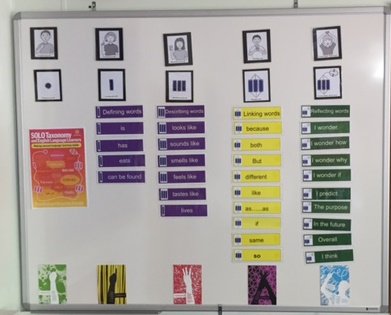
I have also been thinking about February’s #EdBlogNZ challenge of creating a photo of my learning space. I have begun by setting up my SOLO Taxonomy writing wall. If you want a copy of the words then look out for SOLO Taxonomy and English Language Learners available very soon from Educational Resources. Pam and I are very proud of our collaborative book. If you want the SOLO Taxonomy postcards then these are available from http://shop.pamhook.com/

writing

My ongoing goal is to make learning visible and SOLO Taxonomy is fabulous for doing this. I usually create ‘messy’ walls because they help me think and reflect on my pedagogy. I will complete my reading wall now that I am really clear on what it looks like.

My challenge to you, ‘How do you make learning visible for your learners?’

For all things SOLO, visit http://www.pamhook.com/

Update: My mentor mentioned I had omitted prestructural in my thinking. Therefore I have added that. (that is me thinking I do not really need to be adding that.) However presrtuctural is also an important part of thinking.


References

Herber, H. (1978). Teaching Reading in the Content Areas. New Jersey: Prentice Hall.

Hook, P., and Van Schaijik, S. (in press). SOLO Taxonomy and English Language Learners. Making second language learning visible. Essential Resources Educational Publishers Limited. New Zealand.

Morris, A. and Stewart-Dore, N. (1984). Learning to Learn from Text: Effective Reading in Content Areas. New South Wales: Addison-Wesley.



Visual Thinking

I have been following the work of @EduWells, @langwitches, @sylviaduckworth and others for several years now. I have always admired people who can draw. But I think the turning point in regards to visual thinking came to me when I picked up an old gift from @arti_choke. She gave me a Moleskine notebook a few years back and reminded me that once in a while I needed to use a pencil and paper. So this year I took the notebook to Tiritirimatangi with me and started doodling. (Hah what a hoot and I am not yet ready to share my scribbles.)

Those of you who know me well know that the only use I have for pens and pencils is to collect them, Totally unintentionally of course. So a warning to you, don’t lend me a pen.

Richard designs most of his graphics digitally using photos and designs he himself has created and Sylvia Duckworth seems to do hers with an iPad. Often drawing the images. As for Sylvia Tolisano hers also seems to be with ipads.

As I investigated people and built a twitter list of people who design visually the hashtag #sketchnote kept surfacing.

Some create better images than others. As is usual with me I often sleep and awake with amazing lightbulb moments. Today was no exception. When I awoke I realised that the better designed graphics have layout as the key.

Yes some include imagery, varying typography and even colour. But the key I believe is in the layout.

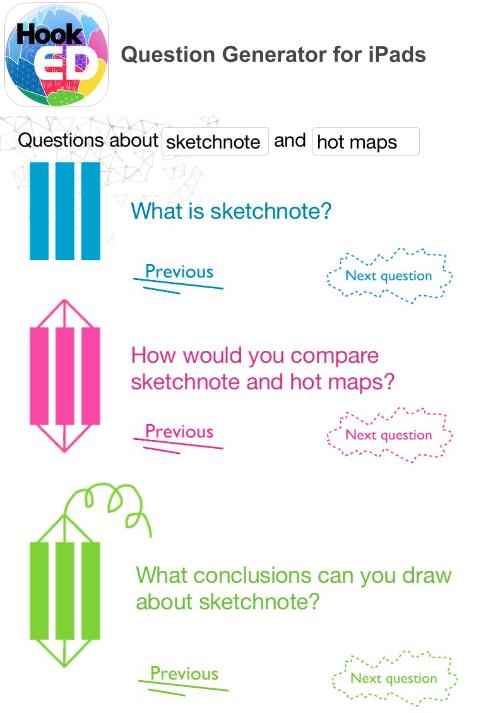
Over the past few months I have been using the SOLOTaxonomy question generator app to help clarify the sorts of questions I need to be asking. Via the app these are the three questions that guided me this morning.

question


Define Sketchnote

So  defines sketchnote as visual notetaking. It has layout, typography, colour, imagery. People who sketchnote basically actively interpret an idea. They identify the essence and visually present those meta ideas. The great ones have strong layout.

Compare Sketchnote and HOTMaps

Now if I compare Sketchnote and  SOLOtaxonomy HOTmaps, the difference is that the HOTmaps help identify what the layout could be. Sketchnote is about creating whereas I think HOTmaps is about layout design. I believe that someone with an understanding of SOLOTaxonomy HOTmaps could create even better sketchnotes because the design layout is already part of that process.

Conclusions regarding sketchnote

The conclusion I draw about sketchnoting is it is SOLOTaxonomy relational thinking because it is about making links with what we know in a visual way. Yes I know it could be extended abstract because new knowledge is being created. However the true function of sketchnoting is to link up ideas. It is to make sense of what we hear or read.

Where to next

I am desperately trying to use that pencil and Moleskine because I love the idea of creating my own images. This year I am aiming to use google draw a lot more in my teaching and learning. The difference  being that I will try to draw my own images. Maybe I might use it to help plan my SOLOTaxonomy HOTmaps and then physically draw from that plan. I also need to come up with my own representation of people. Those of you who know Pam’s doodles know she has a style to her people. 

solo_conversations_resized

http://pamhook.com/


ToD

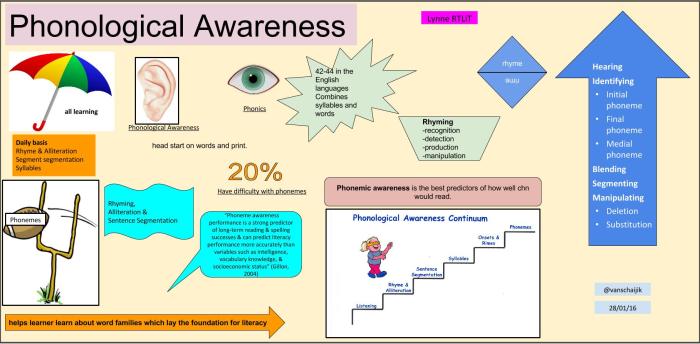
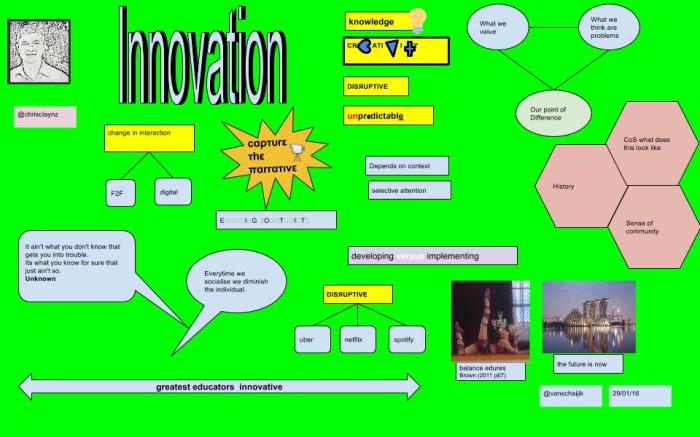
I had a go at visual notetaking on our Teacher Only Days. Below you can see what I captured from Lynne’s talk on Phonological awareness and Chris Clays session on Innovation. From what I learnt during the process, I have too much colour and too many shapes. I also need to work more on my layout and frame them using HOTMaps.

In addition, several staff microblogged via twitter using our school’s hashtag #NPSFab and this was curated using storify.

phonological awareness

Innovation

Lofty Goal Posts 2016

This piece of writing is to fulfil the #EdBlogNZ challenge that has been set.

Whanaungatanga (2)

A)Whānaungatanga is my #OneWord2016. I find it interesting how my efellow11 inquiry unpacked Hyperconnectivity. The space between the nodes.  The stuff that cannot be seen yet is vital for learning. Last year as part of EdBookNZ I undertook Team #Whānaungatanga. From the blog posts of my team the following list of words surfaced using Wordle. I added Va Fealofani as this also explains Whānaungatanga. I chose Whānaungatanga as my #OneWord2016 because I am the educator who connects, collaborates, co creates and supports others to be vocal digitally. I thrive in the digital environment so much so that my digital life blurs with my real life. By keeping a focus on Whānaungatanga I will recap the importance of hyperconnectivity. I will sit through meetings face to face, eye to eye, breath to breath to get a full understanding of the people I am working with. ( Me hui kanohi ki te kanohi kia rongo i te mauri o te tangata!’ ) 

  1. relationships
  2. people/tangata
  3. community
  4. respect
  5. whanau
  6. contributing
  7. learners/ ākonga
  8. va fealofani
  9. society
  10. working together

As my understanding of Whānaungatanga grows so does my understanding of sustainability. Therefore I will also be focusing more on Travelwise at Newmarket School and the part we play on Global Warming.


B)Aging Parents

IMG_8500

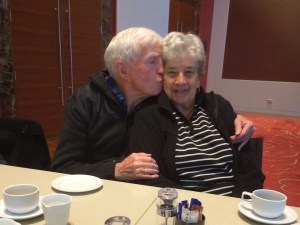
I look after my parents and so have added them to my goal as a focus that I had promised to make their golden years, just that, golden. I am writing both their stories starting with dad.

C) Learn Mandarin

mandarin

I have been accepted into the Language Teaching Consolidation Programme. One criteria is to learn and teach a new language. I have chosen Mandarin. At the same time this is Whānaungatanga because predominantly the children I work with are Mandarin speakers and one positive way of building relationships is speaking the language of the children I teach. I also know the challenges of learning a new language so that I may better emphasise with them. This year I am also the lead teacher for the ALLIS cluster for Newmarket School. This is a ministry initiative ‘Asian Language Learning in Schools.‘ Our school is part of the Epsom/Remuera group.

D)Community

Keep focusing on a community of learners. I now have several I am leading or involved with at administration levels.

  • #TeachMeetNZ,
  • #EdBookNZ,
  • #EdBlogNZ,
  • #SOLOTaxonomy,
  • #FlatConnections
  • #NPSFab

E) Health & Well Being

fitbit

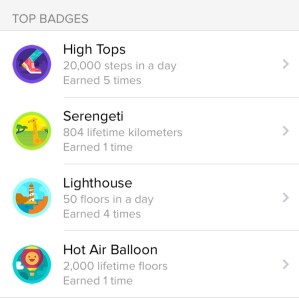
Keep my eye on my FitBit Dial and aim for a minimum of 10,000 steps per day. Keep walking to and from school.  At the moment I have recently shifted back home after having renovations and my steps are not where they were.

And you what will you keep as target practice for 2016?

Who’s voice is being silenced?

Who do we silence when we “collaborate” and “connect”?

Trust Pam Hook to ask this question.

I recently read a blog post where Pam commented and asked this question.

loudspeaker-clipart

Those of you who know me, connecting, collaborating, creating and sharing are my ongoing personal teacher inquiry. So much so that I have literally made an online name for myself with doing all this “connect” and “collaborate” online stuff..

Pam asked an interesting question and one that I am sure like me you had never really thought about or really cared about and you have been hell bent on gathering followers or creating virtual communities to have teachers work together because you realise how much of an impact this has on teachers learning.

But if we think about it, who are the teachers who are  being silenced by all this online learning ‘stuff.’  I remember in the early days of social media trying to convince teachers to ‘at least read emails’. or saying things like, ‘The information is on the server #DUH.’

And ‘Paper?? What’s that.  Give it to me digitally so I can have the option of repurposing what you have created.’

I know the internet is the main form of communication in this 21st Century and who does not have a cell phone? Correct? But it is still a valid question.

We are extremely lucky at my school because we have a strong school leader who has always been forward thinking in her approach. Such as giving the teachers the tools. So we all had an iPad 2 when they first came out and have since been updated and senior teachers were given an iphone with a school plan. She gave us all a chrome to play with because this was a tool we would be using with our children. We can even choose what kind of a TELA we want.

Yet I grew up in a 3rd world nation and I speak to other teachers who do not have the same access to technology or professional learning as what we have at Newmarket School.

I visited 13 countries in 11 weeks and spoke with teachers who many do not have the same opportunities and access that we have here in New Zealand. I visited many teachers whose classes do not have internet access.  For teachers in New Zealand I query their access because TELA has been available since 2003 and access to the internet really took off in 2004 when the first waves of schools were snupped. Name a new Zealand teacher who has not been part of an ICTPD contract in the past 10 years. Our Ministry of Education has poured millions of dollars into our digital learning.

So again whose voices are being silenced through connection and collaboration?

I am aware of the challenges that some outlying schools have to access. They do not yet have broadband and are still reliant on dial up. But I believe that if you want access bad enough somehow you can find a path. Even if you pay for access yourself. When I think back to schools that I have been at where I have had to pay for first of all for my own laptop and then my own lease or when when I was an early adopter of technology and bought dial up at phenomenal costs.

Online I notice that my twitter PLN are made up of mostly European educators. I find the Maori and Pasifika Educators appear to gravitate to Facebook. As for Asian educators I talk to them on WeChat. So I guess if I am looking for certain voices then as an educator I must move in the social media that has greater numbers.

When I have run online professional learning for educators I particularly target voices that are often very quiet. I am much more conscious of this then I have ever been because of my work with Pam.  Yes using digital communication can silence when we “collaborate” and “connect”.

The ones taking part in connecting and collaborating online can have their voices amplified like being the only ones holding a microphone at a face to face meeting. Yet what about our children who do not yet have access to home broadband because the extra cost is a luxury that is over and above feeding a family? That and even having a device to access communication with. Yes we still have those.

I also think about the work I do with my Samoan colleagues who insist on face to face meetings because, ‘This is the way we work best.’ I encourage digital communication but that is on ongoing journey I have always had. I also find that in the face to face meetings I am the voice being silent. I am used to having my voice amplified with media that sometimes I feel frustration in the noisy face to face meetings. I feel frustration at the speed of getting things done because I am so used to getting things done at super speed using online communication. I am the educator who amplifies our Samoan voices digitally and I do so willingly because I know some can be very quiet online.

My citizenship question to you is the same as Pam’s.

Who do you silence when you “collaborate” and “connect”?

Afterthought

I should have begun with this quote taken straight from Tahu’s Blog Post on Whānaungatanga.

Me hui kanohi ki te kanohi kia rongo i te mauri o te tangata!’ It is important to meet face to face, eye to eye, breath to breath to get a full understanding of the people we are working with.

A Week in the Life Global Project

SOLO Taxonomy

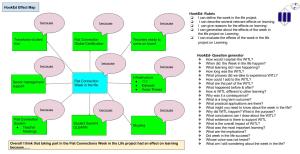
Those of you who work with me know that I frame everything I do using SOLO. Even as I worked with my student groups in the Week in the Life project, SOLO was there guiding my thinking all the way. This time for this blog post about the Week in the Life Global Project, I thought I would share with you how I use SOLO to guide my thinking and writing. Like the children I have been using Google Draw to create HOT Maps to guide my thinking. In addition I have used HookEd Rubrics to push me even further and in addition I used the HookEd Questioning Generator App to help frame ideas I might not have thought of. Here is my SOLO Describe Map that links to the original with links. ( I needed to adapt the map using slides because when publishing in draw, the links do not work.)

Effect


https://docs.google.com/presentation/d/1FRmIboflAmOgYutV_Ov8zyMCp3HwJIz4gv-tI6bG688/pub?start=true&loop=false&delayms=3000”>Describe Map


In October 2015 at Ulearn I presented Newmarket School’s involvement in online learning and collaboration leading up to the Flat Connections Global Projects and why I believe that teachers and schools should seriously become involved in global education. I shared a little about our involvement in the ‘Week in the Life’ student collaborative project that we were part of from July until December.

Flat Connection

Flat Connection

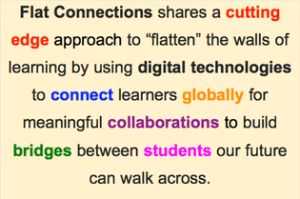
The purpose of Flat Connections is global learning for teachers and children. As I began to define what Flat Connections is I found this image that defines what the community of learners is all about. I have borrowed this straight off http://www.flatconnections.com

After becoming Flat Connection Global Educator Certified in 2014, this year from February until June, I trialled the ‘Week in the Life’ with a small group of student leaders. The outcome of that trial was as a school we embraced Edmodo to compliment our Google Apps for Education Tools.

Our year 5 and 6 classes and teachers used the Edmodo platform to communicate and share learning across three classes. I encouraged the rest of our staff to become involved as observers and most set up their own teacher Edmodo accounts. Magic can happen when teachers set up their own online accounts. Teachers must be actively involved online with their classes and using Edmodo across three classes enabled this.  As a further wall with our children three other administrators must also be inside that class account. With Flat Connections Edmodo was used for collaborative learning across 6 global schools. When you sign up for Flat Connections you must show evidence of police verification. That is why it is important to be part of a community that already has systems in place for our children’s safety.

A week in the Life

Meanwhile our trial group pushed through with learning and the outcome of the trial was so successful that in the second 2015 cohort of A week in the Life saw Newmarket school take part with 86 students and three class teachers. Because I had been involved I was able to support our teachers by attending most of the online teacher meetings and they attended whenever they were able to attend. The difference between cohort 2 and cohort 1 was that I was no longer attending teacher meetings at midnight on a Thursday. The benefit of having our classes take part was that a Week in the Life learning happened as part of their in class programme. My trial group had been doing their part during a 40 minute lunchtime once a week. Basically children are placed into groups with children from other schools across the globe. The goal is to produce an artefact that shows the outcome of the children working together.

Systems

I have learnt the importance of curating when I am learning online and I do this digitally using my wiki. So I curated the information that Julie @julielindsay fired at us such as who the teachers were who were involved, and I added links and curated meeting clips and slides because sometimes we needed to revisit them to keep up to date with schedules and deadlines.

We also had the google group emails coming at us. The challenge was that if teachers registered using their school email address then a lot of information would clog up their inboxes. I had learnt to deal with this by using an external email for Edmodo mail and Flat Connections. This allowed me to see at a glance where all the information was.

Teachers working together

When us four teachers from Newmarket school worked together on the online project I was really excited because I knew that a shift in learning had happened. More so than when I was by myself with the trial group of students. As much as I could, I supported our teachers during report writing by dealing with most of the communication.  In addition we had our cultural festival and end of year business looming.

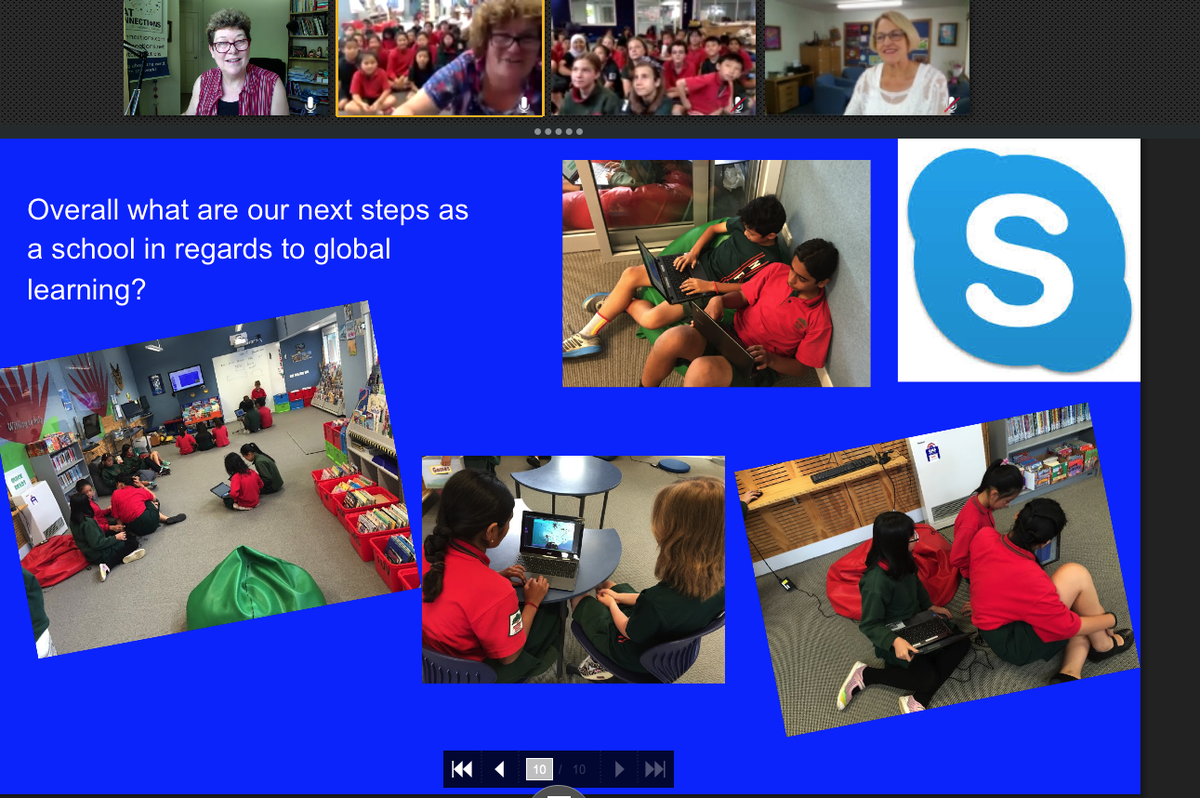
This time I was determined to have our students take part in the student summit. A student summit is when the children share their learning within a short time frame. I gave Julie a date for when we would be ready. I worked with the teachers and the teachers worked with the children and it all came together. I was really proud of Anna @MissSpeir, Belinda @BelindaHitchman and Veni @JamiesonVeni from Newmarket School. I know that taking part in the project stretched their thinking as learners themselves. We problem solved some of the technical issues and we connected with other educators and their classes via skype and Edmodo. They also helped monitor the online activities happening between student groups. I believe they were excited to see their children collaboratively learning with children from 6 other countries. When we met other educators via our Fuze meetings and via skype I think they were excited at the learning connections they made. They learnt about time zones and about everyone being responsible for our children, for each other and for other  for when we work collaboratively online.

Tools used

We used the following digital tools

  • Edmodo
  • Google Draw
  • Voice Thread
  • Fuze
  • Skype

As we navigated through a variety of tools we found that Google Draw was not that easy to use when on iPads yet is perfect for Chromes. So the schools using ipads used padlet. As a school I set up class accounts for Voice Thread, but my recommendation would be to have a school paid account and the children would have their own individual accounts. The class accounts worked to a point. but we found that only one user could use the account at a time. We had great excitement when we skyped Chipeta Elementary School in the United States of America and Wilderness School in Australia. The classes took part in the session like a skype in the classroom where they try and guess where the class in from using yes and no type questions. We also skyped in an air scientist to answer some of our questions. Fuze is like a google hangout but is more private. We used Fuze for teacher meetings and for the student summit. Edmodo continues to be a winner for us and all our children were really excited to talking to children from other parts of the world. I could see them trying to set up times for when they would all be online together. I love Edmodo too because I watched how our second language learners used translating tools to personalise and adapt learning to help them get their message across. They were so fast with flipping between two languages on their Chromes. The tools enabled their voices to be heard and often before they were ready to share orally in class.  During the Week in the Life Project I really liked observing our teachers giving feedback to student’s reflecting on their learning as part of the learning task. 

Student Summit.

The student summit happened in the final week of school as we raced towards the end of our school year. Out of our 86 children 30 children were selected to share their learning in the project. I basically gave them a single slide to build to accentuate their learning. Then narrowed down the selection group. We had one morning to prepare for the final sharing and so the presentation group had two shots at preparation before we went live. I invited our principal to watch and had some of our other classes watching too. Because of our time zone we did not get the global viewing from the other schools. So that would be something I would consider again for next time. At the same time with technology I know that the other schools could come back and rewind our session. I was really proud of our children. The final student summit is really the process of the learning.

Would I do http://aweekinthelife15-2.wikispaces.com/ again? Definitely. Learning is amazing when our teachers and children work with other schools. However something extraordinary happens when we cross oceans and time zones.

Difference to other learning.

The difference that The week in the life project has to other learning is the online collaboration that the children and teachers have with children from other countries. There is an ocean to cross and time zones to conquer. Together teachers and children create a shared artefact about their learning and this is usually to do with global issues. I think that this time children created their own artefact rather than contribute to a shared google doc and next time I would remind them about the importance of having everything in one space.

Visible Learning

As I observed the children working collaboratively, I could see teamwork happening as various members stepped up to ask and answer questions about their global topic. I saw examples of citizenship as members of our Travelwise Team took responsibility to run a school wide campaign to encourage our children to walk to school. The activity helped students to understand the impact of their actions and their role as citizens. Online and offline there were opportunities and examples of children speaking respectfully to each other as they learnt together. In Edmodo there was some discussion but probably the greatest evidence of teamwork was in co constructing information using Google Paint and in the dialogue happening on Voice Thread. I watched as my colleges helped students make connections across learning areas and to the wider world overcoming barriers of distance and time.

Julie helped us too by curating learning artefacts on a dedicated wiki. http://aweekinthelife15-2.wikispaces.com/.

 Overall impact of the WITL

The greatest impact is a glimmer of how far we can push learning through enabling students to join the Flat Connections community of learners. Learning does not have to just be within a physical space, or confined to a certain way of doing things, or even constrained by a language, distance or time. Learning extended well beyond the classroom using digital tools. Myself I learnt a lot too. I watched how the other teachers tackled problem solving and communication across time zones. I myself learnt about air quality from a student in Singapore and an air scientist somewhere in Auckland. Do visit the Flat Connections site to find out more about becoming involved.

Where to next?

As a school Newmarket has joined the ALLiS Cluster (Asian Language Learning in Schools).

I am the lead teacher for our school and I have proposed that we be involved in Connect with China project. This semester I have been an observer teacher in the project and have watched how teachers from America and Australia have made connections with Chinese education. The main tool we have used has been WeChat. I think that as a school we need to seriously consider using WeChat as a communication tool with our families as most of our families use WeChat in preference to Facebook. WeChat is a smartphone app that allows you communicate using text, photos, videos and funny stickers! You can even leave voice messages. WeChat is available across all mobile phones and it’s easy to use!

I have sent out the invite to our teachers at Newmarket School to join me in learning to use WeChat. I have been using WeChat for about three years now and I am slowly building an incredibly different PLN to what I have on twitter and facebook.

Download: http://www.wechat.com/en/

Add Me: ulimasao

Further information

If you are interested in Global Education and want to know more about flattening your walls, then join a Flat Connections group in 2016. Julie offers a range of projects that cover a range of age levels.

If you want to know more about SOLO Taxonomy then join Bridget Casse. Pam Hook and myself next year for a TeachMeetNZ Google Hangout where we will be sharing some stunning New Zealand Educators using SOLO in their teaching. Details are being finalised.

  • Date: Saturday 18th of April 2016
  • Time: 2.00pm

You can also visit Pam’s Site of incredible resources or get her into your school for professional learning. Personally I recommend her as an amazing educator who can help shift thinking within schools.

http://www.pamhook.com/