Not too hard or soft but just right

Goal Setting 

In  his book Visible Learning (p. 164) John Hattie summarises that the right kind of goal setting can have a positive affect on student learning.

This is the second reflection I have in regards to my 2016 personal inquiry. My first one is here. I stated that by the end of September I will have trialled the visible learning  interventions for ELL and then through data analysis ascertain the effect size of the interventions so that the most effective strategies can be applied to accelerate the progress of  targeted  ELL students.

In term 2 of this year I worked with Kahikatea year 5 and 6 students in class. I regularly came in as the third teacher and worked alongside the teachers as part of the class rotation. I found it such a joy to work with my English Language Learners as part of a normal class programme. I was delighted to see my targeted children part of a vertical grouping in maths, reading and in writing. They were not streamed but were placed in groups where problem solving was the main strategy for learning. For example in mathematics I might have been using https://www.youcubed.org as the focus for the lesson. Therefore it did not matter what level maths you were at, it was how the problem solving was carried out.

ILE

I worked too with writing and reading. I observed how my targeted children managed the tasks set in the innovative learning environment. I marvelled at the way they could structure their days of learning using google calendar. Each day needed to have an hour each of maths, reading and writing. At the beginning of term two I gathered all their reading and writing data. I will compare the new data with the initial gathering of data before the end of term three . This will help determine if having me work in class alongside the teachers made much of a difference. There are a variety of variables to this being successful. Some of these include using google classroom to curate learning, or by using peer feedback to critique work. Other variables could include accountability with how much learning evidence was collected or the challenge of completing all must dos in order to take part in passion projects as part of Discovery Friday.

Goal Setting

I supported the children in setting learning goals. In order for this to be successful they were given their reading and writing data and then their maths data. From these pieces of evidence and mapping these to the learning progression, the children identified where they were at against their National Standards peer group. The children then highlighted any gaps and these became the basis for their next steps. In addition the children set learning goals that were achievable. Hattie speaks about learning goals being not too hard, not too soft but just right. I look forward to the new data and how the students will evaluate these against their learning goals set last term.

Year 4 writing 

I had another group working on writing. They are a group of year 4 students achieving just below national standards for year 4. Their reading levels were much higher. Again I worked in class with this group and began with goal setting for writing. This group of students were not all ESOL funded students because I added two children who were not eligible but yet needed similar support. I have always tried to adjust what I do so that the learning is the most effective. One way of doing this is by me working with one group and the teacher works with another. For this group I chose to make learning authentic and used real learning to motivate their writing For example one part focussed on slaters. The class were investigating a variety of mini beasts. At the end of the writing the children created a video artifact for their class.  I am also particularly interested to see  if the goals that they set at the beginning of term two are achieved by the end of this term.

I believe that by unpacking the data with the learner, they are able to identify what they need to work on. I am developing in my own understandings of the learning progressions and I believe I am fairly accurate in judging a piece of writing. That is where my knowledge of SOLO taxonomy has been invaluable. The work I undertook last year as part of the book I developed with Pam Hook has enabled me to see at a glance the gaps in writing. Here is the link if want to know more about SOLO Taxonomy and English Language Learners

Where to next

I have been interested in seeing the latest development in the Visible Learning project. A key message is limiting teacher talk. This ties in nicely with my next piece of writing which is about my inquiry around teaching and learning of Mandarin. Through the termly observations I can see how much teacher talk takes place.

Reference

Hattie, John (2008). Visible Learning: A Synthesis of Over 800 Meta-Analyses Relating to Achievement. NY: Routledge.

Mid Autumn Festival

Background

This year I have been learning Chinese as part of my Teacher Professional Development Languages (TPDL) learning. TPDL is an in-service year-long professional development programme for teachers at all New Zealand schools.

I chose to take on the challenge of learning Mandarin as part of being the ALLiS teacher for Newmarket School. I also took on the challenge as I wanted to foster closer relationships with the children that I work with at Newmarket School. Nearly one third of our school is made up of children who speak Chinese. I have visited China twice already but with limited vocabulary and my second visit happened during their Chinese New Year.

chang e Chang e -drawn by Seroung

Mid Autumn Festival 中秋節

Soon in China it is the Mid Autumn Festival 中秋節, also known as the Moon Festival. One key idea I have learnt is the importance of festivals and celebrations to bring families back together. My first visit to Chine was just before the time of the Mid Autumn festival. During this visit I was introduced to moon cakes. Again I had very little knowledge of the importance of sharing moon cakes.

The Mid Autumn Festival  falls on the 15th day of the 8th month in the Chinese lunar year. Myself I naively thought this meant the 15th of August. However had omitted the phrase Chinese lunar year in my first round of information. I know now that Mid Autumn Festival takes place in September because Chinese New Year happens in February when we compare the dates to the Gregorian calendar or the calendar which the western countries use. This year the date for celebration is the 15th of September.

The Mid-Autumn Festival has its own special food. People eat moon cakes for celebration. The moon cake is a kind of pastry with various fillings and the surface is printed with different artistic patterns.  Mid-Autumn Festival is also a time for family reunions. As the moon cake is round in shape, it symbolises the reunion of a family.
So for this Mid-Autumn Festival our children at Newmarket School will enjoy a delicious moon cake at school and at home they will probably also enjoy a Moon Cake shared with family.

nzclw

New Zealand Chinese Language and Culture Week

Last year New Zealand celebrated Chinese Language week around this period. The first I heard about it was after the event. I have been watching for this years dates and checking the internet for the confirmed week. This year there is now a site for this event.

This year I was determined that at Newmarket School we would celebrate this new national event. So at Newmarket School I am working with a group of senior students to coordinate a week long list of activities. I have just finished a paper on Intercultural Language Teaching which clarified the need to communicate in the first place and seek to teach culture in a way which develops intercultural communicative skills at the same time as developing language skills. Intwined with cultural activities is the opportunity to develop language. As a Mandarin teacher I have been focussed predominantly on language. Partly because of my own focus of learning Mandarin. 

NZCLW at Newmarket School

With my senior students we have developed a list of activities that they have chosen to lead over this week. The activities planned include:

  • Elastics
  • Long skipping rope activities
  • Pong pong
  • Chopsticks activities
  • Diabolo spinning
  • Jianzi- hacky sack-  Shuttle Cock kicking

One key activity is a language activity as I really want our children who learn Mandarin to have the opportunity to celebrate their learning. I will also give the children the chance to practice a formulaic speech and for this activity I will use our fluent speakers as judges to help me judge this. The second part is to identify our fluent speakers because next year I will prepare them for the oral Mandarin speeches.

In addition I am keen to develop literacy skills for our Mandarin speaking children. So I have set the challenge of writing a book in English to retell the story of Chang-e. The lady in the moon. Our children who are literate in Mandarin will help me with translating. Also we have our parent community who will help me with the final draft. I have a group of artists who have chosen to develop the images that will be used.

In class activities that teachers and classes can choose to include in their programme are:

  • Dumpling making
  • Calligraphy
  • Painting cherry blossoms
  • Painting Panda
  • Decorate a tea tin
  • Make and fly fish shaped kites
  • Mask painting
  • Paper cutting
  • Making lanterns from recycled materials

Health and Well Being

One of our school wide goals for 2016 is ‘Heath and Well Being’. So by incorporating mindfulness into the weeks programme through exercise, physical activities and meditation I am proactive in developing a positive health awareness culture in our workplace. I am conscious too that by sharing moon cakes during this week I must take into account the children in our school who have allergies to egg and nuts. Again it is about being prepared and identifying those children for their safety and well being. My next step is to work with my student organising committee and identify any hazards in their physical activities so that injuries for participating children will be minimised. I also need to reconnect with our National Chinese advisor as I wish to strengthen our working relationship. I also still need to reestablish connections with a past pupil of our school by inviting her to our events.During my research for the types of activities to run I have made connections with Confucius, Asia New Zealand, our local secondary school, several parents in our school community, our after school Chinese teachers and of course our children who are running several morning tea activities.

WeChat

Those of you who work with Chinese children and are not yet aware of Wechat, then use your phone and locate the app. Wechat is an amazing social media tool to use to create connections with our Asian neighbours. I use Wechat for communication in the Connect with China Flat Connections initiative. I use Wechat to build communications with some of our parents. I use Wechat to maintain connections with our previous Mandarin Language Assistants and to communicate with New Zealand teachers who have shifted to China. I use Wechat to develop closer relationships with our sister school in Ningbo. I have used Wechat to make connections with a kindergarten who will communicate with our junior school during the upcoming week of celebration. 

The week long celebration is now just two weeks away. I have let our parent community know that it is happening via our newsletter. I have alerted teachers to the dates and to be aware of their contribution in class. I have met with the student leadership team to design the activities that will be run. So now it is down to the finer details.

Those of you who are in an ALLiS cluster, what kinds of events have you hosted to raise awareness and to celebrate our children?

Collective Teacher Efficacy

The power of connections is vital for collaboration. When a group of teachers come together to work together  magic happens. When they come together for their students, and learning is the focus, then we have collective teacher efficacy.

Teacher Efficacy

So what exactly does teacher efficacy mean? Hattie says it is the way you think about your role as a leader or a teacher that defines the way you work and the impact you will have.

So as a teacher how do we measure our impact?

Keep our eyes on the game

When working with our school I like to make visible our school’s ethnicity data. I have been tracking ours for seven years and am amazed at how much movement I have seen in the seven years since I have been at Newmarket. We have a fabulous makeup of an amazing group of students who are predominantly Asian. Recently I have seen another surge of new migrants, when I have finalised our application for ESOL funding. I have begun with this because the makeup of our school affects our data. At the same time I stress the importance of watching the data. The aim long term is not to get caught up in the six month gains or the short term achievements that we can sometimes become excited over. I have faith that our bilingual learners will exceed our expectations when they get to secondary school because I have faith in our teachers and in my school.

The importance of data to help drive learning

My first query is, ‘Do our children want to come to school?‘ So by focussing on attendance data I look at our children who have attendance gaps and determine why this happens. We have an amazing person who watches the trends carefully and catches up with families if there is a drop in attendance.

We can also measure academic data and decide on the impact we expect to see. We have a range of assessment tools that give us this information and we are getting better at analysing them to target where our teaching gaps are and the effect we are having. We have a robust student management system that is able to aggregate the data and our teachers are developing in their skills to access and analyse the information.

When measuring our impact I believe that understanding what a year’s progress looks like is more important than measuring where our learners sit against national standards.  I also believe that it takes six to seven years to measure the learning journey to see that progress. I state this because of my training in bilingual education and am influenced by the work of Thomas and Collier who have also conducted longitudinal studies on language learners progress and have researched that it takes six to eight years to see the impact of bilingual education. We are not a bilingual school but we do celebrate the languages that our children bring with them.

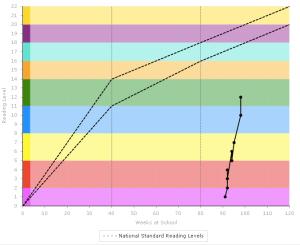
Every teacher needs to be tracking the children’s progress, but we really need to move faster as there is a sense of urgency for our bilingual children who are catching up. For them I expect to see greater than a years progress.We can track this by analysing reading graphs initially. When I look at reading data I love seeing something like this (Fig 1)and bearing in mind that orange to turquoise plateau when inferencing becomes even more important rather than at the text understanding. These graphs were borrowed from our student management system ‘EDGE’ and was part of what I shared with our Board of Trustees recently. Against National Standards this student is well below. Using the data I can share accelerated progress.

Fig 1

sample1

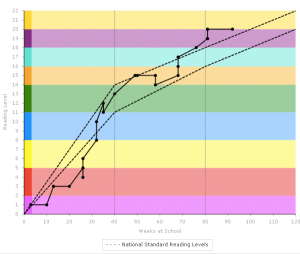
When I look at our writing data using asTTle as one tool, I check the scores because they tell me more about student’s progress than the curriculum levels. I align them to the reading and see where everything sits. I look for something like this (Fig 2). This is a three year reading graph and writing data. Remember many of our children are migrant and often come with literacy in their first language. The reading always shifts first and the writing can lag behind. Note the highlighted number, and I am seeing less of the inflated score that can happen at the end of the year. From my own learning I see a correlation between the scores and the colour wheel. This is not yet proven, but I am seeing a trend. For example a 1B writing score shifting into the 1000s usually happens from green level in reading. 

Fig 2

sample2 sample1a

I also scrutinise historic data and identify drops. I look for the classic year 3-4 drop when Cognitive Academic Language Proficiency (CALPs) becomes much more important than Basic Interpersonal Communication (BICs) for assessing progress. (Cummins). I am excited to say that after several years of across school moderation, we are no longer seeing that drop at year 3 & 4 so I believe we have nailed that. One key question here is ‘How long have the children been sitting at or above before we know that this data is stable?’ Check out your own school data at the Education Counts site.  If your school data is stable then there should not be that year 7 drop that also happens when children go to intermediate. I can also see from our historic graph the last time when our year 2 data was still too high. The graph shows the last of the trending drop happening in year 3. (Refer 2013, Year 2.)

NSD

Oral Language

As teachers we do tend to focus on reading and writing because these can be measured. However  take into account Paul Nations research into academic vocabulary and unpack what is required to achieve at this level of learning and remember how long it takes to learn a language. This can be broken down further using Academic Word List (AWL) devices by Averil Coxhead.

Students need to be acquiring 2000 new words per year to make a years progress. When this is broken down further, that is approximately 40 new words per week that should be actively taught. Breaking it down further, this is 10 words per day because we take into account holidays.  I recommend seriously looking at Jane Van der Zeydens book Essential Oral Language Toolkit. I love Jane’s work because it is research based and from a recent classroom teacher’s perspective. Jane also understands the sense of urgency for our English Language Learners.

Goal Setting

Recently I had a discussion with a colleague about the importance of goal setting. But not from a teacher perspective as was her understanding but from the learner’s perspective. I asked why the children were not setting their own goals looking at their own data. I shared with her John Hattie’s effect size on goal setting and suggested using the ‘Three Bear’s’ analogy also used by John. ‘Not too hard, not too soft but just right.’ The following was taken from one of our previous student projects. SOLO Taxonomy framework helped me unpack my understanding of goal setting but that is another blog post. 

NPS3 bears

Sharing data

As a school we have worked hard to have a shared understanding of data. We have looked at all our data in teams and set goals. We have shared our impact with each other and recently in teams we shared our impact with our Board of Trustees. We are gaining an understanding about the sense of urgency and about looking for a minimum impact of a years progress for a years learning. We are developing in our understanding about what the learning progression looks like at each year level as we moderate across the school. 

Updatehttps://lpf.education.govt.nz/ The Learning progression framework has just become public. Do register to increase understanding for the work we do.

Where to next?

Well I have recently joined our Auckland Central Community of Schools as an in school teacher but with a focus on building the across school community. Those of you who follow my work will understand my excitement at this new development.  I can hardly believe my enthusiasm because I have the chance to see longitudinal data being shared across our 11 schools. I have the chance to work with over 70 educators as we come together to make a difference to 7,963 children and their families. I have a chance to see if what we begin at primary school feeds through to our intermediate and then our secondary school. I can check to see how we are doing against the Thomas and Collier chart. We are all on the same journey and that is giving our best to our children. I have a chance to see and be part of a collective teacher group and the chance to see teacher efficacy in action across several schools.

Intercultural communicative language learning

Part 2 of my reading log for EDPROFST 360 

Course Director and Lecturer: Dr. Constanza Tolosa

Liddicoat, A. & Scarino, A. (2013). Intercultural language teaching and learning. New York, NY: Wiley Blackwell. [Chapter 2: Languages, Cultures, and the Intercultural. pp 11-30]

Key concepts relevant to intercultural communicative language learning

Intercultural language teaching places the need to communicate in the first place and seeks to teach culture in a way which develops intercultural communicative skills at the same time as developing language skills. This is an approach to the teaching of culture which sees language and culture as intimately linked and which recognises that culture is always present when we use language.

Intercultural Language Learning Learners engage in developing cultural competence from the beginning of their language learning. Learners engage in understanding their own languages and cultures in relation to the additional language and culture. iCLT is more than just learning the culture and compare to one’s own. Learners must make choices when engaging in meaningful communication in another language

Intercultural competence involves at least the following key concepts:

  • accepting that one’s practices are influenced by the cultures in which one participates and so are those of one’s interlocutors;
  • accepting that there is no one right way to do things;
  • valuing one’s own culture and other cultures;
  • using language to explore culture;
  • finding personal ways of engaging in intercultural interaction;
  • using one’s existing knowledge of cultures as a resource for learning about new cultures;
  • finding a personal intercultural style and identity.

Ideas about iCLT that are new to me

In taking an intercultural perspective in language teaching and learning, the term is new to me but the ideas are not.  Such as the central focus for culture learning involves more than developing knowledge of other people and places.

Or, iCLT is about raising an awareness of the pervasive presence of culture in language. Even,  iCLT uses learning processes such as interacting, exploring, comparing, and experiencing languages and cultures to develop in learners the competencies that allow them to communicate effectively across cultural boundaries; that is, to display intercultural communicative competence. Therefore iCLT reflects a social and dialogic perspective on learning. These ideas are already in my schema. However to activate them I need to unpack them further.

  • Learners involves purposeful engagement in interpreting  in interaction with others.
  • Learners continually make connections between language and culture and learning.
  • They continually make connections between first language and target language.
  • The learners continuously learn and build from interacting experience.
  • The learners continuously reflect on how we think, know and learn about language, culture, and their relationships.
  • Learners learning depends on learners’ attitudes, dispositions and values.

The ability to learn beyond the classroom is probably more important than any particular information that students may learn about another culture during their school year.

My personal response and reaction

The goal of iCLT learning is to develop an intercultural identity as a result of an engagement with an additional culture.

  • The move from static to dynamic
  • The nature of content: artefact-practice
  • The nature of learning: fact- process
  • The nature of the educational effect: cultural – intercultural

In approaching language education from an intercultural perspective, it is important that the view of intercultural Language Teaching and Learning culture be broad but also that it be seen as directly centered in the lived experiences of people.

The aim of intercultural language teaching and learning is not to displace language as the core focus of language education but to ensure that language is integrated with culture in conceptualizing language learning.

Learning another language can be like placing a mirror up to one’s culture and to one’s assumptions about how communication happens, what particular messages mean, and what assumptions one makes in daily life.

Intercultural Language Teaching and Learning culture can be broad but also that it be seen as directly centered in the lived experiences of people.

To sum it up I believe intercultural communicative language learning is whanaungatanga in Maori and va fealofani in Samoan.  iCLT is about building relationships with others so it is more than just language learning and more than learning about culture. iCLT is about people learning and the space that happens between that cannot be seen. I really like the use of the mirror analogy to help me as a learner understand my own culture.

Applying what I read to my language classroom

When I teach iCLT in my Mandarin language classroom the focus needs to shift from language to include culture. The focus needs to be on my learners making connections with the target language and culture.

The learners are:

  • actively involved in constructing knowledge through exploring cultural practices
  • making connections between cultures, and between existing knowledge of culture and language, and new learning
  • involved in social interactions that involve communicating across cultural boundaries
  • reflecting ‘critically and constructively on linguistic and cultural differences and similarities
  • taking responsibility for their intercultural growth, assisted by teachers who, for example, foster engagement with difference and awareness of stereotypes.

Opportunities need to happen for my learners to  participate in social exchanges and the most effective for iCLT is role playing by seeking explicit comparisons between the two cultures to develop empathy. Activities that develop noticing of cultural similarities and differences are also suggested for iCLT.

The following are examples of this:

  • Comparing what one has noticed about another language and culture with one already knows
  • Reflecting on what one’s experience of linguistic and cultural diversity means for oneself
  • Interacting on the basis of one’s learning and experiences of diversity in order to create personal meanings about one’s experiences

Overall iCLT is more than just learning the culture and compare to one’s own. It is more than a body of knowledge but rather a framework in which people live their lives and communicate shared meanings with each other. Learners must make choices when engaging in meaningful communication in another language through activities rather than just discussion.


July School Holidays

I have an exciting fortnight coming up. Soon it is the New Zealand school holidays. We have two weeks and it is the middle of winter. However at Newmarket School you would not believe what an amazing day we have. I am back at school on a beautiful Saturday to work on my upcoming presentations and to finalise ELL data for term three distribution of our in class support. Those of you who know me know I look after my aging parents and this past six months have been full on as they require more of my time.

So these two weeks coming up means I get a chance to have a break as my sisters step in to support me. They know how much I enjoy sharing our learning so have agreed to take over the care of my parents while I am away. My sisters support me daily with them but during this time they will be the primary support team.

Meanwhile I will be in Nelson, then Hamilton, Auckland for two days and finally I will visit Christchurch to make up for two days missed on the TPDL course that I am involved in this year.

Part of the NZALT preparation has included gathering artifacts to share. I have been working with my Thursday student Mandarin tutors who are helping me prepare my personal introduction in Mandarin. Yes it is really hard and they are tough on my pronunciation. On Monday our Mandarin dance group have agreed to perform for the school’s leadership assembly so I will have an example of that too. Of course SOLO Taxonomy continues to drive what I do and I am especially excited to be sharing SOLO Taxonomy and English Language Learners at CLESOL and at the PPTA Pasifika Fono.

As we race towards the end of the term our school has reporting to parents and of course the leadership week.

However I know that as crazy as it seems all my colleagues are in similar situations and are hanging out for some sleep ins, the chance to do some PD in their PJ’s and the chance to catch up with each other as we share what we do in our schools.

Do share what you are doing in that fortnight. I am particularly interested in those of you taking some time for mindfullness  and well being activities. This non contact time might also be a perfect opportunity to update that blog you have been meaning to do. Remember to use the #EdBlogNZ hashtag.


Defining Task-based language teaching


Part 1 of my reading log for EDPROFST 360 

Course Director and Lecturer: Dr. Constanza Tolosa

Write answers to the following questions after you have read the reading you have chosen.

  1. According to the author, what is a task-based approach to language teaching?
  2. In what ways does the author claim that task-based language teaching is superior to more traditional ways of language learning? What are the benefits of this approach to language teaching for language learning?
  3. Write a personal response to the author’s claims where you give your reaction to the ideas presented.
  4. Suggest ways in which the content of what you have read could be applied in your language classroom.

Reading Chosen

Ellis, R. (2009). Task-based language teaching: Sorting out the misunderstandings. International Journal of Applied Linguistics 19 (3), 221-246.

Defining Task Based language teaching (TBLT)

Task Based language teaching (TBLT) is an approach to teaching a second/foreign language that seeks to engage learners in interactionally authentic language using the target language by having them perform a series of tasks. TBLT aims to both enable learners (1) to acquire new linguistic knowledge and (2) to proceduralize their existing knowledge.  Teachers need to understand that TBLT involves input-providing as well as out-put prompting tasks and that it is possible to build up proficiency initially through a series of simple input-based tasks.

Task

Central to TBLT is that word task, and teachers must have a clear understanding about task by providing opportunities for communication. There is is no single ‘task-based teaching’ approach. Task can be focused or unfocused and can be identified by the following four key precepts of Task.

First the primary focus for TBLT should be on ‘meaning’ by which is meant that learners should be mainly concerned with processing the semantic and pragmatic meaning of utterances.

Then there should be some kind of ‘gap’ with a need to convey information and to express an opinion or to infer meaning.

Next learners should largely rely on their own resources whether it is linguistic and or non-linguistic in order to complete the activity.

After that there should be a defined outcome other than the use of language because the language serves as the means for achieving the outcome, not as an end in its own right.

These key precepts of tasks central to TBLT is superior to more traditional ways of language learning because TBLT is capable of providing much greater exposure to the target language than traditional language teaching. Task allows the students to communicate for a real purpose to achieve success criteria. The tasks need to be trialled to ensure that they result in appropriate L2 use and revised in the light of experience. Therefore in practice attention is drawn to as the name suggests, the Task.

Advantages of TBLT

Task-based learning is advantageous to the student because it is more student-centered, allows for more meaningful communication, often provides for practical extra-linguistic skill building and are likely to be familiar to the students such as visiting the doctor.

  1. Task-based language teaching offers the opportunity for ‘natural’ learning inside the classroom.
  2. TBLT emphasizes meaning over form but can also cater for learning form.
  3. TBLT is intrinsically motivating therefore students are more likely to be engaged, which may further motivate them in their language learning.
  4. TBLT is compatible with a learner-centred educational philosophy but also allows for teacher input and direction by allowing the learner to pick out the language to use for the task.
  5. TBLT caters to the development of communicative fluency while not neglecting accuracy.
  6. TBLT depends on the purpose of the activity and can be used alongside a more traditional approach.
  7. TBLT develops communicative abilities.

The role of the teacher for TBLT

Teachers need to be clear in their understanding of what a task is and to be aware of the purpose and rationale for performing tasks. Developing task materials allows teachers to tailor the task to the proficiency levels of their students.

Applying the principles of TBLT In my current practice of teaching Mandarin.

In my current practice of teaching Mandarin I am already using several principles of TBLT. However I had not unpacked it to the depth that I am currently doing. I am a new learner of Mandarin and I use songs and simple children’s poems when focussing on form. My current class has a large proportion of Mandarin speakers and I use them to help with extensive L2 input. Initially they supported me with form and L2 input with the other children. I am already taking into account the individual differences of my learners by grouping the students according to ability. From other readings would like to trial grouping mixed ability children so that more experienced speakers can help emergent speakers.

Where to next

I will develop language teaching activities with a primary focus on meaning as I have been focusing only on form. I will aim to provide more opportunities for group and paired activities that enable my learners to pick out the language for the task.

When I highlight the 10 principles I can see that I have taken formulaic expressions to mean my learning of the expressions but have omitted my students learning them too. In order to understand what a task is and understand what is required of the learner to understand communicative messages I have begun the process of providing tasks and activities to focus on output. I have identified that I need to examine free use of language as well as controlled production because activities have shown that such tasks are effective both for practising managing and facilitating students’ performance of tasks in TBLT.  For my new task I have made decisions around both design and methodology. I have sequenced the tasks using the three phases of pre task phase, task phase and post task phase. For the pre task phase my learners sing the Mandarin colour song that has already been taught. We recap on the colours by holding up a colour block as the colours are called out. For the task phase I have developed a resource using the images from the simple PM reader called Sally’s leaves.  I have added a question and answer component to the story using formulaic phrases of  asking the question, ‘Where is the red leaf?’ Then responding with, ‘Here is the red leaf.’ My learners will group in threes to discuss and practice the patterns that they can see and hear. For the final two slides, I will leave out the formulaic expressions but will leave in the colours of the leaves. For the post task phase I have created another resource that has the coloured leaves with the words. Included are the two formulaic phrases. My learners will work in pairs to practice asking and answering the questions. The task I have created for learning has an element of natural language use.


10,000 is the magic number.


1742ab90415d01300e80001dd8b71c47

http://dilbert.com/strip/2013-02-07 By Scott Adams 

I had been reading around  the 10,000 hour rule that was shared by Gladwell. You can read all about the research and also how and why it was recently criticised. 

At the same time I have been analysing our student data against national standards. At this time of the year I usually have a look at how we are doing and particularly how my ELL students are doing. I have written about this process before. 

I looked at our writing data and wondered about the hours that we put into daily writing. A 40 hour work week multiplied by 5 years equates to an estimated 10,000 hours.

Children should be having approximately 1/6 of that or about 6,000 hours worth of school learning by the time they leave primary school. I am taking into account the 40 week school year. So 25 weekly hours face to face multiplied by the 40 week year.

If we want to see a shift in our school’s writing data then we have to be targeting that number. However the realities of school life indicates that writing happens more like 200 hours per year. I thought about the usual class timetable that schedules an hour a day for writing. I haven’t carried out any research into this claim but am just putting it out there. In order to fulfil a daily writing schedule as educators we have to be focusing on writing across the curriculum. I have been working in the senior part of the school this term for an hour a day and have the fabulous opportunity of being part of an experiential timetable. One way I see around this dilemma of practice is encouraging students to write at home in the same way that we encourage them to keep a reading log. 

I wonder too if a 2P in writing equates to 600 hours worth of crafting. The article mentioned a direct statistical relationship between hours of practice and achievement. No shortcuts. No naturals. So I wonder too if we can fast forward a 2P to a 3B if that requires another two years years or another 200 hours of writing practice.

Personally I also believe that teachers too should be writing. They should be crafting their own work and working on their own skills. I believe it is not enough to teach writing but should be happening as part of teacher’s own learning.

One way of gaining motivation to undertake writing is to create a reflective journal. I read with interest some of the comments teachers on the New Zealand Primary School Teacher’s Facebook Page gave in regarding to keeping a digital portfolio. I believe that part of my portfolio includes me reflecting on what I do in a visible way and I do that by blogging. I wonder how these same teachers evidence their professional teacher criteria. Surely if you teach writing you should be working on your own skills.

If you want to find other New Zealand teachers who reflect in visible ways and who practice the craft of writing then look no further than

http://www.edblognz.blogspot.com

I wonder what are your thoughts on educators teaching writing. Is it enough to teach writing or do you also believe that teacher writing and teaching writing go hand in hand?

I look forward to the dialogue.


Road Safety Week

This week is National Road Safety Week. This is a week of events to end devastating road casualties by making communities safer. The week is also run by Brake, the road safety charity of Aotearoa New Zealand to help raise awareness of the terrible carnage on NZ roads. 

As lead teacher of Newmarket School’s Travelwise team, I oversee the weeks activities.

Road Safety Week

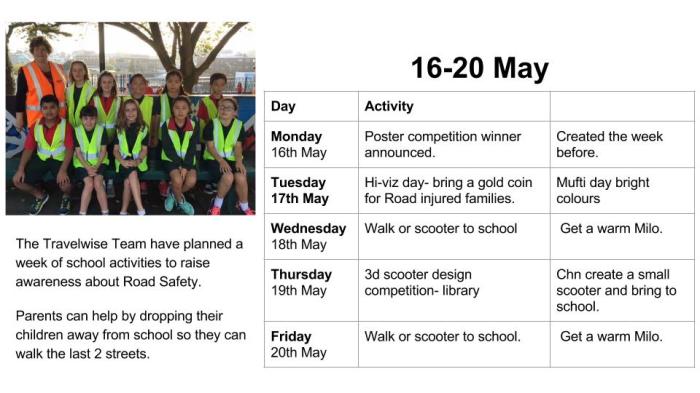
Road Safety event student leader coordinator is Stella and with her were 4x other student leaders who offered to plan for and implement one of daily school wide activities.

Over the past fortnight the team met to discuss and finalise details for their activity. Part of this preparation included creating a slide to back map ideas, scheduling and meeting the principal for event approval, broadcasting the week before at our school assembly, and approaching peers and extra adults for support in running activities. 

You can see that there are a lot of events happening to highlight this very important week on our Travelwise calendar.

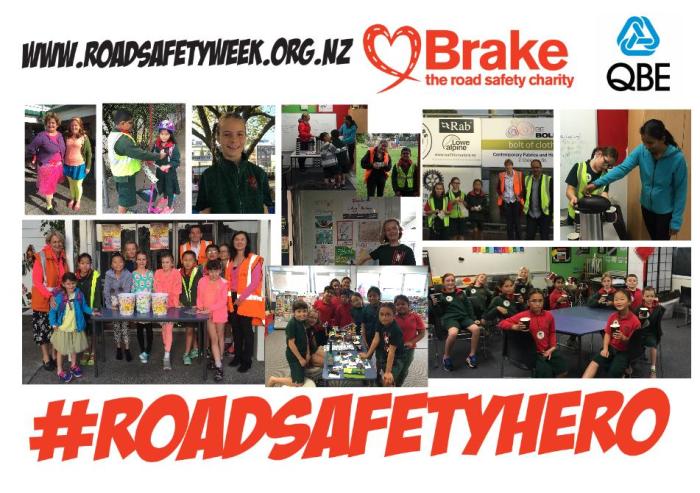
Safety Hero

Here are some of our statistics for the week.

  • We raised $168.00 for Bright day and had David Seymour our local minister of parliament join us.
  • We had 86 children take part in the Milo mornings as encouragement to walk or scooter to school. We guestimated 60 students to take part from our previous surveys and activities.
  • We counted 46 scooters on our scooter rack, an increase from 9.
  • We had heaps of posters for the Step up for Road Safety Competition because we are keen to win a Big Foot Adventure for our school.
  • We had 21 3D scooters handed in and they were fabulous.

On Friday we have our final activity which is walk or scooter to school and get another free Milo.Over the week lots of fabulous highlights surfaced and I commend the way the student leaders dedicated and carried out their part to ensure the smooth running for the week.

Overall, I believe the Road Safety Events held at Newmarket School raised awareness about being safe on our roads. Even more important was standing back and observing our student leaders plan, work together and create activities that involved the whole school.

Already I have had other students approach to be part of the Travelwise team and the student leaders have asked what the next event is. Tomorrow at our weekly meeting we will evaluate the week and identify areas for improvement as we will definitely run it again next year.

Update

On Friday we gave out 114 Milo. We had 36 scooters lined up on the rack with 18 helmets.

Giving out stickers we noticed the amount of children not wearing a helmet and the number of secondary students jay walking. At our next Travelwise student meeting results will be discussed and evaluated and our next steps identified.


píng guǒ shuō- Apples talk

If you use google translate and listen to the first two words on this chart, maybe you will be like me and find them quite similar.

朋友 péng yǒu friend
苹果 píng guǒ apple
shuō talk
中 文 zhōng wén Mandarin
请 帮 我 qǐng bāng wǒ Help me

Goals

On Monday, I asked Virginia, our Deputy Principal, to come and observe me teaching Mandarin. My two goals were to use the Mandarin language 100% in instruction and for the children to be using the language as much as possible.

Linguistically the strategy is known as ‘forced output’. Me I call it Flippin’ hard.

My lesson focus was to recap on term ones learning and to find out how much had been retained and to extend our native Mandarin speakers in using numbers.

Anyway, I began with some songs because the teachers I work with have asked me for more songs to help them and the children learn vocabulary and also phrases.

I also included the songs we were practicing for our team’s turn for the upcoming school assembly. Then I had some children come up and share their learning and was proud to see our non native speakers stand up and share their growing vocabulary.

After this introduction the class was split into three groups and I sent the teachers off with their group to practice some previous lesson’s activities. One group worked on questions and answers. The third group worked on colours.

I took the extension group to extend their number knowledge and also for me to learn numbers in isolation. For example I can count to ten but ask me ‘What is 9 Sonya?’ I count on my fingers and then tell you what 9 is. I need to know my numbers because I am desperately learning how to tell the time in my own Mandarin learning. When my tutor asks me the time, I need to use my fingers and need a long processing wait time before responding. I really want to be able to flip back the answer straight away without translating and or using my fingers.

My group lesson

So I took some playing cards and I set up a line of numbers and through hand signals, modelling and the white board was able to get across that the children were to add two numbers together and give me the full response in Mandarin.

Then I asked the children to turn to their 苹果 (Píng guǒ) and 说 (shuō) in 中 文 (zhōngwén) ….. Meaning: turn to your friend and talk using Mandarin.

By this stage, Ginny my observer was nearly rolling on the floor with laughter. I knew straight away what I had said because I know how similar 苹果 (Píng guǒ) is to 朋友(Péngyǒu) But for the life of me I could not remember which was correct. So I turned to one of my little teachers and said 请 帮 我 (qǐng bāng wǒ) -help me. He corrected me and we continued the lesson. Ginny speaks Cantonese and knows some Mandarin and yes we know each other really well and have a history of mutual respect.

After the session Ginny gave me some fabulous feedback. She always knows how hard to stretch my learning. The first thing I wanted to know was, did I full fill my two goals? She said yes pretty much. I would have had my lesson in 97% Mandarin. Yes too, to the children sharing their learning and on me limiting teacher talk.

From my feedback these are my next steps.

I need to increase the font size of my resources. Because even digitally, they are too small. I need a few more formulaic expressions to add to my growing list. These are

  • Make a circle
  • Talk to your friend in Mandarin.

I am really lucky because I have access to our parent community and they are willing to help. My next step is to bring them into my lessons to help me teach it. 

Mindset

On Thursday I had the ALLiS Lead teachers come to Newmarket for our monthly meeting. My principal was present at the meeting and the first thing she said was ‘Share your apple story.’ So I did. I know that sometimes the funny incidents help break the ice for a new group coming together and getting to know each other. 

I shared my lesson resource blog with our ALLiS Cluster teachers. This space is where I am placing anything I use in one space so that other teachers who are willing to have a go at teaching Mandarin can do this. The space currently has videos I have used from youtube, however as our children learn, I will go back and replace the originals with what they do. I have to acknowledge too the huge work that our Mandarin Language Assistance did when they were with us. All their resources are available too to our teachers and have helped me immensely in what I am doing.

The bonus of having a blog, which I had not considered was I can place a homelink on the student iPads and they can come back and go over the lessons too. I know, the students should have been my first consideration when making the resource. However I was creating something and I love to tinker around learning. Already my mind is racing with possibilities. I am also using the site to curate some of my own language learning lessons. So when I have a moment, I can quickly pull it up and recap on any device. 

Assembly

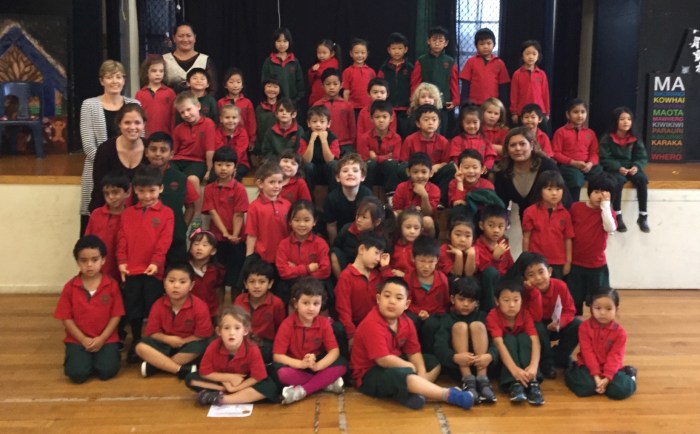
On Friday our little ones stood up and shared their Mandarin learning with the whole school. I was so proud I could pop. At the same time I am incredibly proud of the teachers that I am working with in Te Ako Kowhai because they are also learning with me and are willing to learn too with the children. I thank them for practicing the songs and poems every day as this helps me tremendously in growing our children’s vocabulary.

kowhai.JPG

At our school our children learn Te Reo as well as Mandarin so most of our children will exit Newmarket School as Qualinguals. You read correctly,  four languages because most of our children are already fluent orally in two languages when they arrive. I really like too how learning TeReo and Mandarin gives our learners a chance to shine because once you learn another language, then learning a third and fourth is a lot easier.

Me as a learner

The children take great delight in making me practice my Mandarin so love coming up and asking me basic questions. The parents have even taken part too and greet me in Mandarin and ask me how I am. I now  know three differing ways of greeting them back and have learnt how to respond when I am asked ‘Ni Hao Ma? (How are you? I used to always say 我饿了(wǒ è le) – I am hungry. But I can now say 我 很 好 (wǒ hěn hǎo) as well as a few others.

Coming up as part of my learning another language.

I have another observation coming up this week as part of my TPDL course and I am looking forward to that happening on Wednesday.

Next week I have two sessions at Auckland university around pedagogy as part of my TPDL course. I have finally completed my registration for that. I just need to finish the Ellis booklet.

I have had my abstract accepted for the New Zealand Association of Language Teachers (NZALT) conference. http://www.eenz.com/nzalt16/.

I am still attending my Wednesday Mandarin course at Unitec which takes four hours out of my day. I enjoy the train ride and the walk time as I use this quiet time for reflection. This week I created some vocabulary slides to help me memorise seasons, weather and days of the week. 

I have investigated sitting the Hànyǔ Shuǐpíng Kǎoshì (HSK) Level 1 test. The test is designed for learners who can understand and use some simple Chinese characters and sentences to communicate. In New Zealand the test is offered by Confucius twice a year. I aim to sit this first level in November.  I have found this fabulous app that helps me memorise Chinese characters using flashcards. The app is called Find a pair. It is free and I really like it. I have gone on and bought the next level but at this stage that is too difficult for me.

I can now read 11 characters.


#eTwion

etwion.png

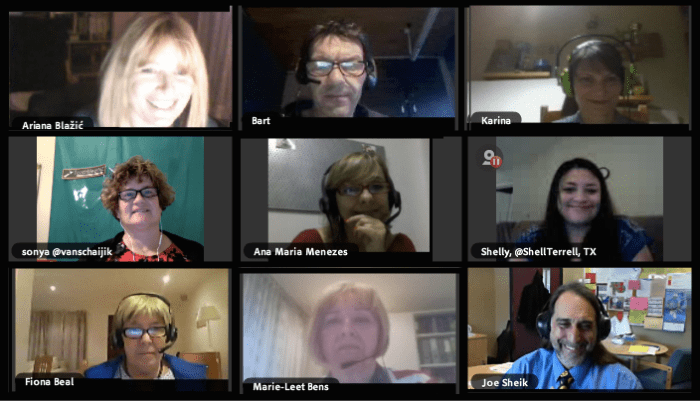
My ongoing personal inquiry is teachers and how they share their learning. I was really excited to  join Arjana and Bart @abfromz @BartVerswijvel and six other global educators on Tuesday 26th of April for a global networking seminar as part of their programme for European teachers called The Networked Teacher. When Shelly opened the session, we had both Arjana and Bart on screen and I was reminded about our history of connections through the TeachMeetINT virtual sessions that we took part in a few years ago. Bart had this cow bell that he used as a timer. That bell was an awesome timekeeper and we tried hard not to hear it.

I shared parts of my ongoing personal inquiry but from my perspective of how I built my professional learning network. I was asked to focus on my New Zealand connections so was extra excited to share about our part of the world to European educators in the eTwinning programme. The hashtag they use is #etwion. The session took place at 5.00am in our New Zealand time zone. You can check out the hashtag and see what the attendees are learning.

I built the slides over a few days. An event like this allows me to reflect on where I am as a learner and from listening to other global educator stories inspires me to set new digital learning goals. I was interested in hearing their stories from their parts of the world. Happening in the chat window was a lot of questions. I am not the best at multitasking so quickly captured the questions asked of me so I could respond to them later. The ones that caught my attention involved teachers of heritage languages wanting to make contact with our Te Reo teachers. So I suggested contacting me via social media and I hope to help them make connections here. I learnt the splot trick from @MissSpeir. So sprinkled purple splots as hyperlinked breadcrumbs throughout my presentation.

I have to mention here how Arjana was an inspiration for the #TeachMeetNZ project which is where New Zealand teachers share their passions and learning in 3 minute video clips. In a way too she plays a part in #Edblognz because it was by tagging me in a #Meme that the list of New Zealand educator blogs was curated by @HelenOfTroy01. I took that over and expanded that to include all other New Zealand blogs which was then added to the #EdblogNZ curated site of New Zealand educator blogs which I now help curate with @nlouwrens and @ariaporo22.

Thank you Arjana and Bart for inviting me to share our New Zealand teachers learning. To Joe from Canada @Joe_Sheik, Fiona from South Africa @fibeal, Shelly from Texas, USA  @ShellTerrell, Karina from Israel @karinam60, Marie-Leet from Belgium @BensBel, and Annamaria from Brazil @anamariacult, fabulous to meet you all. Hearing your stories was inspirational. To all the attendees of the webinair great to meet you all and I look forward to adding you on twitter.