My name is Sonya and I am a teacher at Newmarket School.
https://www.youtube-nocookie.com/embed/RvecGdyWRgo?list=PLzH5saR6I_oHHd0u6CLk0cT7qlB3Bv7zn
One of the strengths of SOLO taxonomy is being able to identify where I am with my learning and what my next steps are. @arti_choke. often reminds me to think about the process and not the finished product. When using ICT I often get caught up with the tools I use and focus on the finished product. However reflecting on the process of my journey is important for abstract thinking.


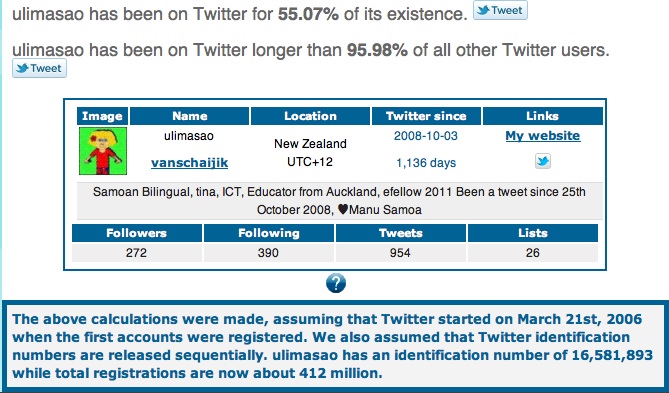
http://twopcharts.com I have been investigating my twitter history and came up with some interesting memories.
My first tweet was sent on 25 Oct 2008. Therefore I have been using twitter for 1,136 days.
The first account I followed was @nzcurriculum. I do not remember why I chose them first. The first account to follow me back was @CherylDoig and it was through her that I began to build up my followers. So far I have not quite broken sending 1000 tweets but I know I have read more than that as I regularly pop on to follow the breadcrumbs of other educators.
When I first began using twitter just over 3 years ago, I was number 16,581893 user. My stats say that I have been on Twitter for 55.07% of its existence. I began by following television stars like @Oprah and also a few preachers as I was interested in how they used this medium to communicate with their followers. I used to follow a few singers. I won’t name them here but you know who I mean. I soon became irritated by the hogging of communication. So now I dump twitters who hog the timeline. Every so often I have a clean out and find out who is not using twitter regularly and they get filed. Sometimes I check out who is following me and usually look for ‘julia’ type profiles that do not fit my educator profile.
I do not know who introduced me to twitter, but I think it was at the time of @BarackObama and his presidential campaign. So it might have been the hype around his use. I witnessed his campaign using twitter and from then on I was hooked. Barack introduced me to the concept of real time technology as I watched the twitter timeline and the live video streaming of his win.
For the first year using twitter was a lonely existence on the ground and yet really exciting up in the twitter cloud. I did not find discussing my use easy, as other educators around me were not ready for this social medium. But what I now find is that I have made some great connection. One of these was hooking up with the efellows. The list of 2011 efellows twitters can be viewed here on https://twitter.com/#!/dragonsinger57/core-efellows-2011.
Great excitement happened when our principal took her initial twitter steps @newmarketschool. The URL had been booked for over a year and then last year she began to follow and then start post and respond to posts. However the greatest enjoyment I have had this year was when three of our teachers began to use twitter. @oprubyslippers, @MissNWalden and @Kyliegeddes.
At this stage I use twitter to amplify some of the exciting learning that happens at Newmarket School. I do this by retweeting and adding users who I know will retweet the message. Every so often I might use it for advertising or to share a link.
But it is the following of breadcrumbs that I enjoy the most. I have learnt so much using twitter and my wikispace http://www.ulimasao.wikispaces.com is the evidence of what I learn.
Where to next, I really need to sort out my list and I will use @justadandak idea of sorting his followers into lists. I already have one list of Pacific Islanders on twitter and I set that up in the early days. What I find is that some of my favourite tweetchers are being buried in the online noise. I hardly see @arti_choke anymore unless I really go searching for her. I am getting better at using @ and # to amplify my tweets. I use my tweets for microblogging and when I am ready, I write a blog entry.
So share with me your twitter history so that I may make links with my own learning about my twitter history.

One of the changes in my thinking that has taken place over the past few weeks is about online work. I have so many learning sites that it is a challenge to keep track of them all.
One way I do this is to create a list using my wikispace. I do have a delicious account for keeping track of websites however my online spaces have a different purpose. I have two different personas. One persona is as a teacher and online school administrator and the other persona is for personal learning. Sometimes my spaces merge between the two personalities and sometimes I feel that they need to be kept separate. I also want a third online personality for keeping my digital photos and videos tidy and out of my computer. I am struggling not to create another space.
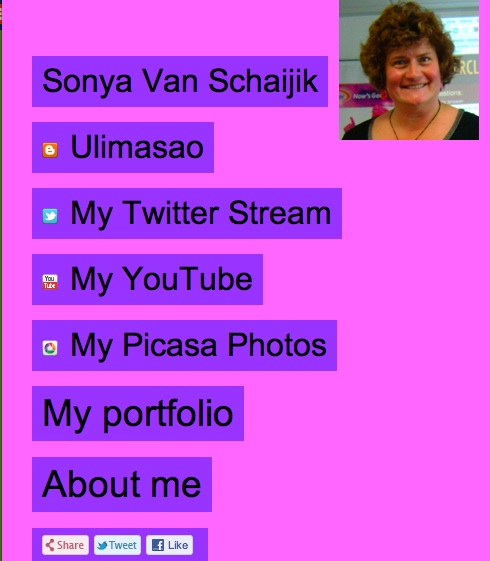
So here is one way I have chosen to show my learning self and that is using http://flavors.me/ulimasao.
I place this link onto twitter. Initially, I added my personal youtube video space and picassa photo folders. However when I was checking out information, I realized that the sites chosen did not match my twitter persona. So I adapted and merged my teacher sites with my personal blog. Even that does not feel correct as I have been channeling our teachers learning onto our school youtube account. A few of the videos are not ones I have created.
The second change in thinking is regarding online writing. Initially I wrote for an audience and was hesitant about publishing. But realize that writing for myself is a more powerful tool This came about with myportfolio work with teachers who do not want anyone reading their work or seeing what they have been doing. I teased them and said good luck getting anyone coming to read your work. Because I know that unless teachers live on social broadcasting sites like twitter or blogger how are they ever going to channel traffic to read their work.
I use blogger and myportfolio for my reflections. Personally I enjoy myportfolio as this is my teacher self shining through. At the same time I like using blogger because the site looks better.
When I reflect using SOLO Taxonomy I know that making connections is relational thinking. Therefore I think my blog writing often sits at relational thinking because I use my writing to make connections with my own learning. In order to shift my writing to extended abstract I need to shift to the next level and give feedback on other peoples writing. So in relation to what I have been doing this term with teachers my next steps include encouraging them to blog about their learning and give them written feedback on what they are doing. I also can write about my new learning.
Date: Monday 15th of August 2011
Venue: National Library of New Zealand
Purpose: To connect online schools face to face. For teachers and children to work collaboratively, for invited guests to network, to launch a New Zealand author on Superclubsplus and to raise global awareness about the International year of forest and birds.
On Monday the 15th of August 5 Auckland schools who have been using Superclubsplus for teaching and learning gathered together to meet face to face. One school joined the session via skype. The five Auckland schools were St Ignatius, Rosebank School, Blockhouse Bay Intermediate and Newmarket School. Raumati came in via skype. Each school has a very different background. Our school Newmarket is an inner city small school.
The children and teachers in these schools have been using Superclubsplus for teaching and learning and how to be safe and respectful online.
Most of the teachers and invited guests involved used twitter to communicate about the upcoming event. The Hot tags chosen were #scplushotseat We also used Titanpad to share information and wikipages to coordinate timetables and a place to keep information together.
For the Hot Seat project, schools were chosen who proved that they have been actively working with their children about using the internet safely. So the teachers and children who came are already active users of Superclubsplus.
The school came together to be involved in an author Hot seat project where we launched a New Zealand illustrator and author onto Superclubsplus. Sandra Morris was in the Hot seat. We chose Sandra as this is the UNESCO International year of Forest and Birds. Sandra’s specialty is New Zealand birds. We used real time technology for learning such as skype, email and forum. We took lots of photos and the children are writing an online article about their experiences.
This link will give you highlights about the schools, teachers and invited quests involved. http://newmarketenviro.wikispaces.com/scp_highlights
Each teacher was given a designated task to do to help ensure the smooth running of the event.
After the event a picassa folder was set up to put in any photos. We look forward to the children’s articles.
(Cross posted on myportfolio.)
In New Zealand 18 years old is the ages to enter into a legal contract
Here you can read the legal age in New Zealand for a variety of activities.http://www.newzealandatoz.com/index.php/page/display/653/
Youth is classed as 14- 18 and parents can sign a legal contract on their behalf. But what happens if the children are younger?
http://galesburgcusd205.schools.officelive.com/Documents/6%20Guidelines%20for%20Safe%20Use%20of%20Internet%20Resources.pdfI have been reading around the legalities for nearly a year. The above document highlights the importance of monitoring all online activity when children are involved.
I have been using Superclubsplus with children for 18 months now and am continuously astounded at the amount of activity taking place. I like Superclubsplus because as an educator I like knowing that I am not alone in monitoring my children online. Someone else is there too and the system monitoring activity is continuously evolving and adapting with our online users.
In New Zealand the secondary schools are advised to have robust systems in place when using the internet for teaching and learning.
WebsafetyNZ writes about the morals of children under 13 lying to use social media tools. Yet we teach children not to share too much personal information about themselves.
http://blog.websafety.co.nz/2011/02/underage-facebook-users.html
From ACMA Australia, this clip has a section regarding cyberbullying and also has data about Social Media under age users. The numbers are challenging in that we underestimate what under 13 year olds do online with or without parental permission.
http://www.youtube.com/watch?v=JHj0gKGYzfY&feature=youtu.be
http://www.inspiration.com/blog/2011/02/web-safety-comes-first-when-teaching-media-literacy/
I use this statement as a framework for working with teachers and children. Web safety comes first when using the internet for teaching and learning.
USA has COPPA for under 13 year olds. COPPA stands for ‘The Children’s Online Privacy Protection Act.’ Read all about what that means when working with children online.
In New Zealand – we do not yet have anything like COPPA in place.
Until this changes then New Zealand follows the legal binding contract between 2 parties or a signed parental agreement for youth. 14-18.
Under 14- the area is still grey.
Hence how can it stand up in court if anything goes wrong?
One statement I continually make is just because we can – does it mean we should? I read with interest the changes that have taken place even in Googles Terms of Agreement regarding Google APPS for Education. This agreement is outside their Terms of Agreement with the general public. Therfore schools would be signing a separate agreement with google, and their parents signing a separate agreement allowing their children to use the APPS available for education.
Those of us teaching in the under 13 age group when do you think is a good age for children to have their own email account and how much freedom do you think they should have? That is a question I still cannot answer. Our children have a locked down email on SCP. It is so locked down that they are not allowed to use it to contact parents as most parents have not been police vetted. They can only use it in a walled environment to communicate with children or teachers from their own schools.
Finally, we continuously focus on what we do with our children. But how many of us are in schools where all teachers know what google docs and apps are and even more exciting – how many of them use docs and apps for teaching and learning? How many schools run teacher cybersafety training alongside their other professional learning?
Reflecting using SOLO taxonomy, my thinking is still at multistructural as my learning in this area is still new and most of what I have is a list of websites as I have been reading around the subject of children and the internet. I am just starting to make links with other educators in my ideas.
I welcome any comments and any further information that other educators have on the subject about teachers and children using the internet for teaching and learning.

Using elluminate http://www.elluminate.com
Be aware of time difference <a href="http://www.timeanddate.com/
“>http://www.timeanddate.com/
I had the most interesting experience on the weekend. @CliveSir on twitter called for people who could help answer some elluminate questions. I put my hand up and before I knew it I was asked to be a moderator for http://reformsymposium.com/
I was co-moderator for @krivett1 as she presented ‘Literacy in the Digital Age’. @mrsdkrebs was the main moderator and I learnt from watching her.
I had been a participant several times during elluminate sessions but when the message came via twitter for helpers for rncons3, I agreed to help to see what it would be like and to find out more about the global free conference. Now the conference itself would be another whole blog. This time I just want to focus on the tool because it was one of my personal goals this year to find out more about elluminate.
Some of the things I learnt about elluminate was:
How do I set up a poll? I still have to work on that.
2x Elluminate windows should not be open- so look at the bottom of the screen. This causes echoing. As a moderator- sign on early and set up your profile so that participants can learn more about you. Add a picture. Communicating on line requires a personal touch.
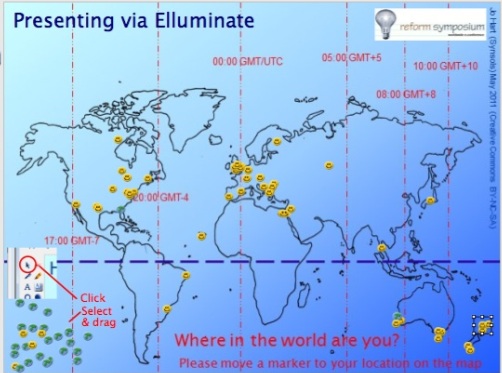
Always have a map for participants available as it is interesting to see where everyone comes from. It took me a while to figure out how to add a map. One neat idea was having little smiley faces that people could plot onto the map. Get the participants to test that you can be heard. Use the smile to indicate whether you can hear the presenter. Then have participants use chat to inform what the time is, and what the weather is like.
Have a video start to introduce yourself and then switch it off to save bandwidth.
As a mediator, I noticed that more tools show up. I have set up my own room and here is the link. Unfortunately you can have a look and if I am not there nothing will be happening.
https://sas.elluminate.com/m.jnlp?sid=2011061&password=M.0082D0676989571ACCF2B8F57DA4D3
When you sign on as a participant to an Elluminate session use your twitter name like @vanschaijik. That little gem took me a while to figure out.
When presenting- get the audience to add a smiley, or a hand clap to give a sign of participation. The chat can be quite distracting so if you are presenting focus on sharing. The mediator will be interacting with the participants for you.
Use images and simple phrases- do not use lines of text. Because the audience is hearing only a voice, reading the screen- becomes death by powerpoint. Think of how Lessig presents. Single words and images. I am going to have to redo some presentations. The computer screen can be shared if you want to have a look at some websites, but again band width can be an issue. So upload your presentation to the system and try and have links available on a word document to copy and paste into chat. You can copy and paste URLs onto a working sheet. Hyperlinks and animations do not work.
Remember to thank the moderators after the event.
Get on early and test everything before participants arrive and do not leave. When you exit the room you loose all your slides and have to start again. Room settings cannot be saved.
I have been involved in a few elluminate sessions but tonights by @shellterrell was one of the best. She obviously had presented via Elluminate several times and I learnt heaps from just listening. She spoke about setting 30 goals.
If you want to read about other moderators experiences with elluminate then have a look at Jo Harts blog. http://johart1.edublogs.org/2011/07/17/reform-symposium-presenter-training-overview/
She writes about some of the challenges that can be encountered when being a moderator.
#RSCON3 set up a google doc and had presenters ask questions and Chiew @aClilToClimb proved to be a mine of information. Here is the list of questions and answers that were helpful. https://docs.google.com/document/d/11ysUifJoANnf1ELq9UeFPeEZ6QYJM3XHoNpcTEpoKeo/edit?hl=en_GB&pli=1
Chiew took the questions and answers and created this self help document. https://docs.google.com/document/d/1hREOuQBdusNamC0_pR2vq_TpUNL7_KSbDGWeUKM4bos/edit?hl=en_US&pli=1
Finally if you want to have a play and create your own space. Then here is the link to create your room with 3 participants and no recording facilities. You can pay for the upgraded version and more participants. http://www.learncentral.org/
![]() |
| vakatele |
Click to go to photos taken when the vaka tele left Auckland.
These link to videos on youtube of the vaka tele leaving Auckland
Gaualofa on Deck
Uto Ni Yalo Leaving Auckland
Gaualofa Leaving Auckland
Haunui Leaving Auckland
Te Matau a Maui Karanga
Te Matau a Maui Leaving Auckland
Gaualofa
https://picasaweb.google.com/s/c/bin/slideshow.swf
Today I had the most amazing experience.
I took my parents down to the viaduct to see if the va’a tele were there, as I knew that they had returned to the harbor awaiting better sailing weather.
We arrived and saw the wooden masts above the modern boats. The masts stood out distinct as two straight thick poles.
As I approached the Floating Pavilion I saw to my delight the Gaualofa, the Samoan va’a.
She looked absolutely beautiful and my heart swelled with pride just looking at her. My parents and I waved to the crew and I called out to them in Samoan and asked if there was there a chance that I could bring my parents down for a look. Not only did they let us on but invited me to be with them when they took her out for an afternoon sail.
Wow a bucket list opportunity. Never say no. Of course I said yes. I waved my parents off and settled on board getting to know all the crewmembers.
I met Lole, Fialelei, Fani, Kalolo, Koleni, Brynne, Marc, Bruce and Malua
Marc skippered us out onto the Waitemata Harbor where we learnt about reading the winds and how to raise and stretch out the boom to guide the mainsails when needed.
As I looked around the va’a tele. I could see the double hull shaped like a catamaran. The outside was painted in traditional Samoan mamanu or patterns. The sails or ‘la’ were triangular shaped and also featured traditional Samoan mamanu but when they were hoisted and shifted to catch the wind, the boom was lifted and stretched out. The decks covered the flat of the va’a. The rear end housed the gigantic ‘fue’ or paddle which was used to steer the va’a. Above the fue were solar panels to harness the sun’s energy. Around the edge of the va’a I observed the lashings had been carried out using ‘afa’ or woven coconut sinnet.
Marc directed us when to gybe which is a sailing maneuver when the va’a is sailing in the same direction as the wind. When he called out ‘gybe’ we would loosen the la and some of the crew would tighten other ropes. The la or mainsails were pulled into the mast and would cross the centre of the boat, then flicked out under the other guide ropes. We would then rush to retighten them. He would call out if they were not flapping to leave them alone.
We also tacked into the wind. This is a maneuver that would turn the va’a into the wind. Again we would shift the la so that they were sailing in the same direction as the wind.
Marc read the current and stated at one stage that the current was swift. I looked over the side but did not know how he was reading the current. I would have liked to have asked heaps more questions but was conscious that I was there observing and helping without getting in the way of the afternoon.
As I helped Koleni with the fue I learnt that the paddle worked in reverse of a car. You turn right the wheels right. But with a fue, we would push it left to turn the boat right.
Sailing along, Lole was busy preparing the evening meal and it smelt delicious.
We raced along catching the wind and headed towards the Auckland Harbour Bridge. Suddenly disaster struck. A windsurfer appeared out of our left and sailed straight into our path. Marc called out we tried to avoid him and he continued straight into us. Straight up the middle of the va’a and under the hull. Marc called out and we released the sails and pulled them in. There was a sickening crunch. The crew opened hatches and the wind surfer appeared. He was yanked up safely onto the deck but was calling out for his wind surf. I was thinking of the crew on board whose lives were endangered. The surfer, who could have been killed, but was luckily unscathed. Thank goodness for the experience of Marc and the crew.
We tacked back and picked up his small vessel and hauled that onboard too. The motors were checked and one was damaged so that might affect the departure date.
Then we were instructed to pull down the main sails and to motor back to berth in the Viaduct.
So we did. The mood going back was somber and quiet. As an observer I thought how patient the skipper and the crew had been in regard to the event of the afternoon. However the positive sign was the seeing of a double rainbow appear in front of us. The ‘nuanua’ was a beautiful sight and the mood lifted.
Everyone helped prepared the va’a for berthing by tidying the deck, putting away the sails and coiling all the ropes. We pulled up beside the Tovuto Ni Yalo. The Fijian crew helped us berth the Gaualofa.
I was content and excited at being part of something so big. I am aware I was privileged to be part of this amazing sailing team if only for a few glorious hours. They will leave Auckland and sail for Tahiti. This is the first leg of their epic journey. The voyage is used to raise awareness for the Ocean. They want us to think about the growing noise pollution in the ocean, acidification of the ocean and about anoxic waters and how this is changing the balance of the ecosystems within the ocean. They seek the wisdom of our ancestors and the knowledge of scientists to keep the Pacific healthy and give our grandchildren a future. More information can be found by visiting their website http://www.pacificvoyagers.org and helping them spread the message globally.
Soon after we were tied up securely Te Matau A Maui motored in beside and I made contact with Cecile who had sailed with her Maori whanau and was seeing off her sister who is part of this epic journey. She agree to give me a lift back home. The crew of the Gaualofa kindly asked me to stay and share a meal with them which I would have loved to have done. However family responsibilities were calling. I bade all my new friends soifua ma manuia i le latou malaga and left with Cecile. When I return to school next term I will make use of this personal experience. We are studying Tangaroa as a focus for Matariki.