Now that the session is over I still need to clip videos and add them to the wikipages. Then I will add the pages to the Pinterest list. If you were a presenter and are visiting thank you again for taking part.
I give a shout out here to Monika Kern who did a fabulous job with broadcasting. We trended on twitter so that was really exciting and I give a shout out here to all the teachers who joined in on the session virtually. Thank you because having an active audience really helps make the session. Monika created a storify of the session.
I also acknowledge Virginia Kung from Newmarket School. She is our assistant principal and for this session she agreed to be timekeeper. She gave feedback and covered for me when I stepped away at the start of the session to collect the team.
Where to next for TeachMeetNZ, well we will be steaming live from Ulearn and I will have Matt Esterman from TMSydney with me as co-host. We will run a combined Australia and New Zealand TeachMeet virtually.
Finally, I was not all nervous this time. The changes I have made included creating slides and broadcasting them before each practice session. We also had questions happening on the Hangout and I will push this more next time.
Now if you are interested in taking part, please do not hesitate to contact me on twitter. If there is space I do bring in educators from outside New Zealand however the time difference for you does suck.
These ‘kinds’ of students I love and can relate to. Because I am one of them.
At the moment, I have tidied my desk and one staff member jokingly said, we should have sweepstakes to see how long that lasts. My staff know me well. My modelling books are a highlight and I am always the first to share them. I often look back and think, oh my goodness how did I let that page slip through with my learners? But what I do is effective, because I would never judge my learners on what I see immediately but what I see over time and with evidence. I also say, ‘If my handwriting, spelling and desk looked ‘normal’ then I would not be doing what I do.’ Those of you who know me, know exactly what I mean. I am creative and inventive. I can problem solve most technical problems both hardware and software. I can bring a group of learners to work together and I get results.
Technology was invented for a learner like me. Suddenly spelling, and handwriting are no longer as important and modern learning environments have taken away desks for creating nests. So I am almost normal. But I like being different and I embrace being different.
I am the teacher who loves wiggle woggle chairs, and reminds children to tidy their desks, when I tidy mine. Tidying desks would be a class activity or someone ends up doing it out of total eyesore. I am an early technology adopter and was the child who took apart the family radio, stereo, iron and computers to see how they work. And I still like to do this.
I often say, I am not the one with the problem with my untidy desk or my spelling. Yes I can be judged on what can be seen, often an untidy desk, but I can close the door and receive visitors elsewhere. Who do they often come to see but some one like me? I go to my editor to proof read any writing that will be published or could be read by our school community.
The point of all this, embrace your challenging learners. One day they will grow up and surprise you. They might even be the ones employing learners who are different.
The bird that consumes the berry his is the forest. The bird that consumes knowledge his is the world.
“E fafaga tama a manu i fuga o la’au, ‘ae fafaga tama a tagata i upu ma tala”
Language and Culture are sustenance for our children”.
In the early 1980s, I trained as a Māori language teacher under the guidance of Wiremu Hohepa. When I attended Christchurch Teacher’s college I met someone who was like me with a passion for language. Her name was Aroha and she was a member of the Māori Woman’s welfare league. So those early years of my education journey to become a teacher, I was immersed in Māori language and tikana.
I am fluent in Samoan so I took to Māori language like duck to water. I was the Kapahaka leader because I had excellent pronunciation and under Aroha’s skilled leadership, she brought me up to speed with waiata and dance.
I always believed that I would teach Māori and over the years Te Reo has always been part of my classroom programme.
When I graduated from teacher’s college I joined a Catholic school and Māori is part of the special character teaching. Therefore teaching Māori has always been part of whom I am. Later as my own understanding of bilingualism developed I taught Samoan and even in my bilingual unit we worked closely with our Māori whanau as between us we had a similar goal and that was academic success for our tamaiti.
In my ongoing research to better understand the registered teacher criteria I have been reading around Tātaiako and have been learning more about the meaning of Tangata Whenuatanga which is the affirming of Māori learners as Māori, providing contexts for learning where the language, identity, and culture of Māori learners and their whānau is affirmed.
At Newmarket school we already have a lead teacher for Māori and that is our deputy principal, Eilleen. However for me, I am also a resource person for pronounciation and also for our local stories. Since I have been at this school I have made it a mission to find out as much as I can about our local iwi and history. Matariki allows me the luxury of paying closer attention to the natural environment and each year I add to the ongoing research I have been gathering in regards to who we are and where we come from as a school.
Because this is the month for Matariki, it is also the time to learn a new skill and to revisit Māori language. It is a time of achnowledging those who have come before us and to pave the way for those coming after us.
I have always believed in leaving a legacy both for school and as an educator. As July fast approaches I will soon be working extensively with educators from around New Zealand as part of Connected Educator Month. This year my focus is on the registered teachers criteria and this year the outcome is Tangata Whenuatanga. I have taken the document, Tātaiako: Cultural Competencies for Teachers of Māori and have used this to underpin the registered teachers criteria. I have built the leadership coordinators and soon will be calling for other educators to take part. By undertaking this project, I want to raise awareness of several values that underpin the document and by understanding these values our educators will be better able to affirmMāori learners as Māori through providing contexts for learning where the language, identity, and culture of Māori learners and their whānau is affirmed.
Relevant RTC
Kupu
Meaning
RTC5, RTC11,
Wānanga
participating with learners and communities in robust dialogue for the benefit of Māori learners’ achievement
RTC1,
Whānaungatanga
actively engaging in respectful working relationships with Māori learners, parents, whānau, hapū, and iwi
RTC2, RTC7,
Manaakitanga
showing integrity, sincerity, and respect towards Māori beliefs, language, and culture
RTC3, RTC9, RTC10,
Tangata Whenuatanga
affirming Māori learners as Māori, providing contexts for learning where the language, identity, and culture of Māori learners and their whānau is affirmed
RTC4, RTC6, RTC8, RTC12
Ako
taking responsibility for their own learning and that of Māori learners.
If you would like to join us in the edbooknz 2015 project, I will be calling for interested participants in July. Here are my confirmed team coordinators, Stephanie @StephKitto1, Lavinia @lrobyns, Hazel @HazelAbraham1, Alyx @chasingalyx confirmed Team coordinators for #edbooknz 2015 project.
I wonder how the collaborative project will evolve. I have an idea but implementing it will require a team effort.
The language is the life force of the mana Māori.’ Sir James Henare, 1985.
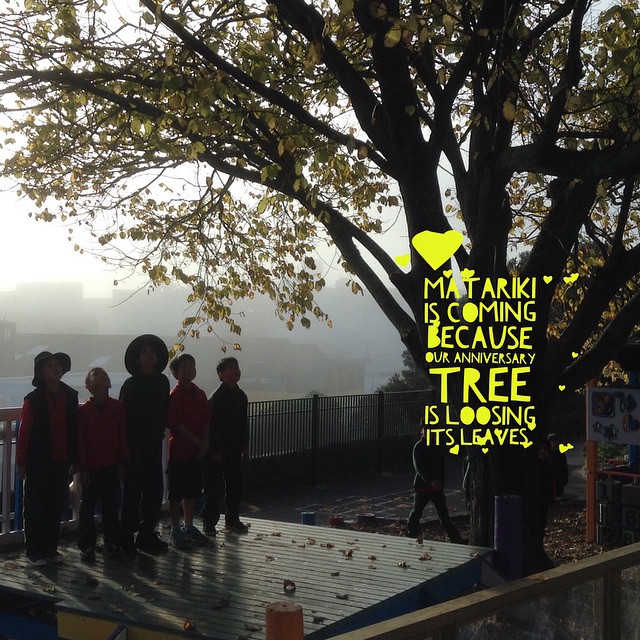
Matariki signals the dawn of the Maori New Year and this year begins 20 June and ends on the 19th of July. Matariki is a time for reflection and where we are up to on our learning journey. Matariki is about whanaungatanga and the chance for our school community to come together to plan, collaborate and celebrate this important event. Matariki is a time to retell stories and to revisit traditional games and crafts. Matariki is a time to set new goals and make new connections. Matariki is a time to focus on Te Reo and the upcoming Maori Language week that begins on the 29th of June. I can tell Matariki is close in season when our school centenary tree loses its leaves. I see Tui making a regular appearance around school. They come for the black whauwhaupaku berries and for the the ripe Puriri fruit. At our school the rainbow is a regular sight and we get the torrential rains just like when it rains in Samoa. Often the mornings are misty and our grounds become soggy so we have to look for alternative lunchtime activities for the children. Our school gardens are in the last stages of harvest and the gardening club plan for the next cycle of planting. The children are usually excited because it is also at this time that they prepare for our annual Matariki disco.
Sometimes events can suddenly happen to make you sit up and take notice.
Friday was no exception. We had an interesting day as a flow of speakers came through our school as part of early Matariki celebrations.
While the school was at assembly the first groups arrived and were greeted by our principal and deputy principal in a whakatau because our speakers and workshop presenters were immediate and extended family members of our school and local community.
Eilleen our deputy principal and of Te Rarawa descent organised the day as part of the Te Whanau Kotahitanga Maori enrichment programme and we were given a shared doc to choose activities that we could take some of our children to. Two relievers were brought in to tag teachers in and out of class so that they could take part and they could take some children from their class to attend the planned sessions.
During this same time our senior school had their Friday Discovery day where several children were part of the planned Masterchef cook off and today was their semifinals. At lunch time I had my usual Travelwise lunchtime group meeting where I had aimed to complete work for an upcoming global sharing celebration that my group are involved in as part of the ‘Week in the Life Project.’ We have worked towards this event for nearly two terms as part of preparation for an experience for learning student project I have planned to launch in terms 3 & 4.
The challenge I had is that several of my Travelwise children were involved in all three events. Sometimes events like this can throw all planning out the window. So after speaking with the children in the morning I readjusted on the day and worked with only one Travelwise student instead of my ten to get a model up for the rest of my group. Over the next week I will find time to support the others as they complete their part to share with our global audience via skype over the next few week.
As I worked with my usual English Language groups to complete work the computer system played up. I wanted to complete a piece of digital art with a few children but did not finish this. In between children I attended a few sections of the Matariki activities. I attended three activities in the middle block. In the afternoon, I had agreed to share my journey about receiving my malu and missed seeing the other Matariki activities then too. I made sure that I finished a little earlier so that guests who had come to hear me would be back in time for the whaikōrero with Eilleen.
Our Maori students and teacher need acknowledgement of who they are and under the Treaty of Waitangi, they have the right to come together to celebrate their uniqueness with role models and senior members of their community. Friday was no exception because at our school we had a range of powerful role models join us for the day to mentor, guide and share their gifts with some of our students. On Friday our Maori teacher and students took charge of the day. They had their voices heard and had the opportunity to influence others.
So on reflection Matariki is about whanaungatanga and the chance for the whole school to come together to plan, collaborate and celebrate this important event on the Maori calendar. We have focussed on whanaungatanga in the past with great success as can be seen shared on our school Matariki wiki. I also believe that an event like this allows us to reflect where we are up to on our commitment to the Treaty of Waitangi.
Its that time of the year when most of our data has been entered into our Learning management system and I have a chance to look at the total picture of my children who are eligible for ESOL funding.
These are some of my heart stopping moments.
I have a year 4 student with a 3P in reading and a 2P in writing. She has been in New Zealand for 3 full years and came to us with no English but is fluent at speaking in her first language. She had no literacy in her first language. In three years she has surpassed a year 6 in reading and can match a year 5 in writing. That is what the data tells me. As I have a quiet chuckle. I hope that the teacher makes a teacher judgement and adjusts these marks for feeding back to parents because I know for a fact that these scores are not realistically possible, YET.
I have another student who is a year 4 and has a 2A for reading and a 1B for writing. His probe score matches the reading asttle, so does this mean he is above for reading? Again I don’t think so. The scores do not align. How can he be reading at a year 5 level and writing at a year 1 level? I remind our teachers to lay out the scores and see how they align. Personally either the writing has not been pushed or the reading is far too high.
I have another student. She is year 6. Her scores indicate that she is reading as well as a year 9 student with comprehension. But she her written work shows that she is writing at an early year 5 level. Sooo? What do you think? She came to us as a five year old with no English and had no schooling in her first language.
I know that by year 6 if we have worked really hard, our English Language Learning children will be beginning to meet national standard data.
When I see them surpassing national standard data in the earlier years I know from my vast experience that these same children will fall dramatically by year 4. The teachers have to work really hard to continue to meet the earlier year’s gathering of data and this takes time.
If you are an junior school teacher and have never taught in any other area of the school, then this would be my recommendation to you. Spend some time teaching in other levels so that you have a more realistic grasp of what data should look like.
Myself, I always work in class as much as I can so that my understanding of data remains realistic. I really like teams who come together to moderate their data and even better if this can be spread across schools so that moderation between schools gives us a clearer picture of what we should be expecting and looking for in our data. I wonder what our intermediate teachers would say when they see our student’s data being levelled and benchmarked the same as theirs. These questions I continually have with our teachers as they write their reports.
As for the rest of New Zealand, what do your data tables read? How do the scores align across curriculum areas and across year levels? I have a staff meeting coming up where I will be sharing some of what I see with our staff. I ask them these same questions and ask them to justify their teacher judgements when levelling our students against National Standards. Scoring our children academically is a small part of the total child and I ask them how well do they know the children. Our parents want to know how their children are aligned with the rest of their peers. However the most important question they usually ask is, ‘Is my child happy at school and do they have any friends?’
I also hope that there are no surprises for our parents because I know that most of our teachers communicate regularly through out the year as to how the children are doing in class.
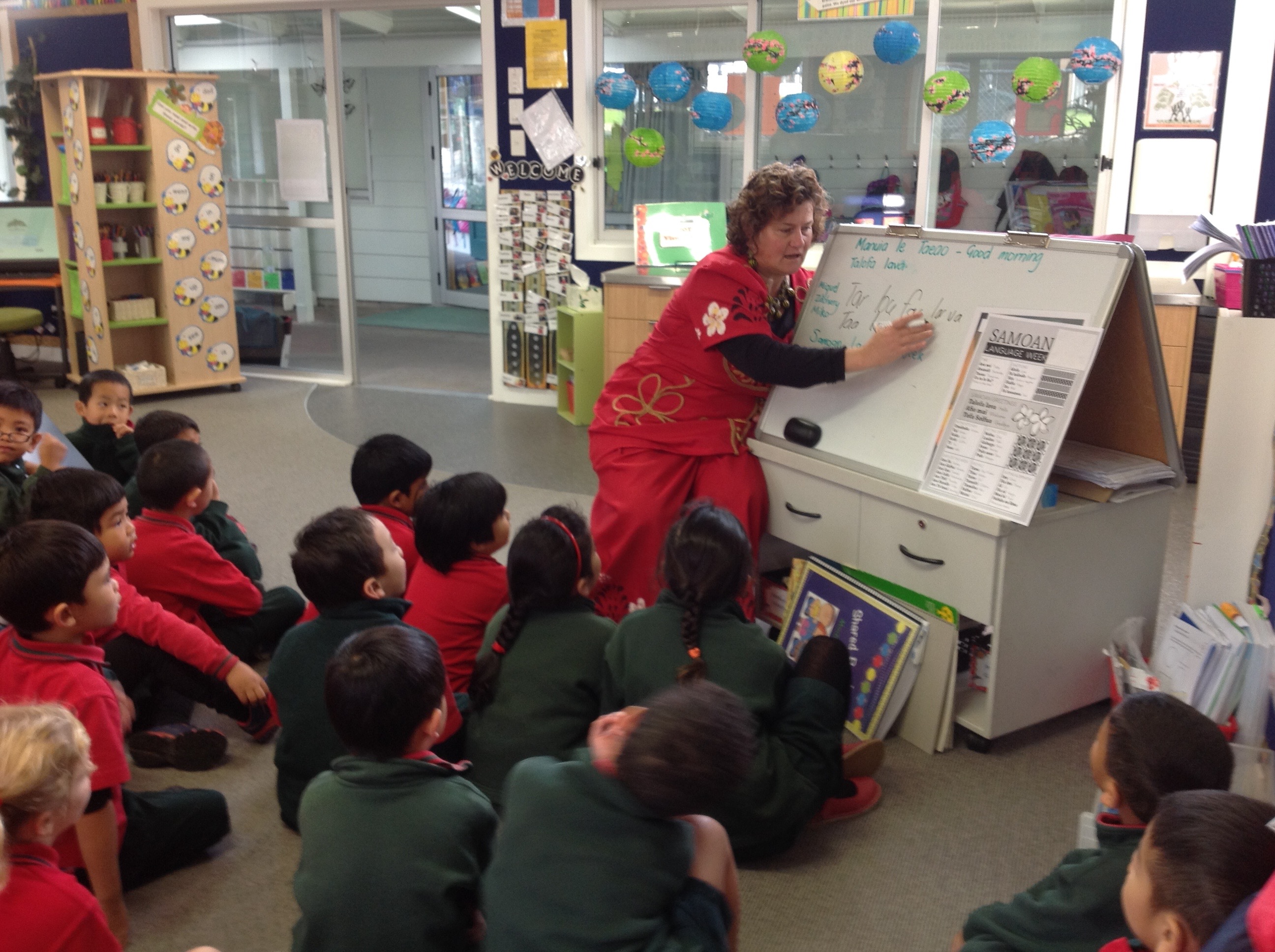
First of all it was Samoan Language week and to celebrate I highlighted the event at my school.
Andrea took this photo
The theme for ‘Le Gagana Samoa’ was “Tautua nei mo sou manuia a taeao” -“Serve now for a better tomorrow.” The theme also aligns with Newmarket School’s Historic Motto of ‘ Not self but service and with my favourite Samoan saying, ‘O le ala o le pule o le Tautua’ meaning ‘The path to leadership is through service.’ I loved the theme because it aligns well with my personal inquiry. That is growing Teacher Leadership. One way I know that teachers can grow leadership is by sharing their learning. The term ‘professional learning community’ is one that implies a commitment of teacher sharing and also the expectation of collaboration and I will share more on collaboration in this post.
On the first day I wore my puletasi and many children commented on how beautiful I looked and asked why was I wearing my dress. An event like ‘Samoan Language Week’ opens dialogue so I explained why I was wearing my national costume. In Samoa though I would not have worn my long johns underneath but the day in Auckland was freezing. Te Ako Kowhai invited me to share how to say ‘Hello’ in Samoan and so I did and for the rest of the week the children would come up and greet me in Samoan. Online I shared a little about my culture and my language and made connections with other Samoans too virtually.
I give a shoutout here to @AndreaDesForges. She put together the fab video on her teams site about Samoan Language Week. I would love to take credit for the song. However it is all the effort from Te Ako Kowhai.
Taku Tāmaki
On this first day too I was invited to attend the celebration of Taku Tāmaki or Auckland Stories where several of our children had taken part in the display for Auckland Museum to celebrate 175 years. I went along with Belinda from school because two of her students had been selected from 134 children throughout Auckland to have their story created into a movie. While we were looking at the displays, I saw many of our other children who had taken part in a variety of ways and were featured in the overall display too. I had gone with Belinda as a support person because she is an amazing teacher and because she has been visibly stepping out of her comfort zone and trialling many new innovative ideas in her teaching this year and reflecting on them with her usual critical thinking.
On Tuesday Wendy, Waveney and I attended the Auckland Rotary get together at AUT to view their 3Dprinter and to have a look around the engineering department. We were asked by Rotary Newmarket to share our journey and Waveney and I co-presented a Pecha Kucha that you can view here. I have been working with Waveney and guiding her as she learns how to use the 3Dprinter with her class. I have been particularly excited at the way she has been using Edmodo as a reflective writing tool with her children. The children learn how to use the 3Dprinter and as they move through the process from design to creation, they have been reflecting on the process. Waveney has also been building an online community and learning how to harness the power of collaborative learning to guide her. I know that one big learning for her has been co-construction and she has taken this on board with great enthusiasm and was able to transfer this knowledge to her class because they are co-constructing designs for 3D printing. I am particularly excited by this shift and can’t wait to see the designs in reality.
Family night making Dumplings
I agreed to attend our PTFA fundraiser where tickets had been sold and one of our parents showed us how to make dumplings. I love these events as it gives me a chance to chat with our parents and make connections. This nights event also gave me the chance to eat home made Chinese dumplings which I love. Mrs Li, one of our grandmothers, gave instructions on how to make the dumpling and of course I had a try at making dumplings and had her grand daughter show me how. Virginia and several other staff members were there too. I watched Virginia help with the cooking and Mrs Li chatted to her in Mandarin. Virginia is a fluent Cantonese speaker and understands some Mandarin so it was great to watch her make connections with the parents running the event. Virginia is another teacher who has been embracing technology to reflect on her learning in a visible way through her blog. You can read what she had to say here about the community evening.
I give a shout out to Davina who has a flower shop called Vida Flores. Its parents like her who are incredibly supportive to us as a school and the event was hosted there.
Flat Connection
My Travelwise team met and finalised their contribution for our Global Project. I was really excited to see how the project was finally coming together. You can read a little more about the project here. The children took a screen dump and they will write a summary as they prepare to share their learning via voice thread. I have loved being part of ‘The week in the life project’spearheaded by Julie Lindsay as I have been working collaboratively with teachers and children globally. My biggest learning has been using Edmodo and how to use this tool for reflection with the children. From my own learning, our teachers have benefitted too as I have introduced them to Edmodo and have watched in delight and amazement at the way they have used the tool like a reflection forum.
Te Ako Kahikatea
On Friday I was in and out of Te Ako Kahikatea as they worked on their discovery learning. I love the way the teachers have worked collaboratively to create Discovery Friday. They have set up the system so that the children are guided to direct their own learning. The teachers have moved cautiously, innovatively and creatively with input from the children. They have conducted research about the process and then adapted it to their own learning and skills. The teachers have front loaded a variety of ideas to give the children a taste of the process and are now at the stage where the children will take a passion and use it to frame their learning.
The day I watched, I saw Belinda have the students create a soundscape to go with an image. She used Garageband. Anna has been pushing her own learning with the children and they are exploring google sites because she quickly discovered that slides does not have enough space to share a full curation of the children’s learning. Veni has been exploring slides and created an artefact to support the children’s learning. As these teachers have a few technical hitches I am called to offer guidance and support them with just in time learning. This is the learning I know is the most effective. ‘Don’t tell me what I don’t need but be there when I have a question.’ If our Newmarket School teacher’s read this, just a reminder about blogging about the process of learning.
I watch Discovery Friday learning space with great interest.
Using Blogger
One teacher who has taken blogger on board to curate learning has been Eilleen. She oversees our Maori learners and our Maori Learning. She also oversees our Student Leadership project. I have been excited to see her implement the many lessons I have had with her in regards to blogging, youtube and twitter. Together we have worked collaboratively to co-construct both learning sites. She has taken on board suggestions and I have been thrilled with the results. I am able to see at a glance where all our children are at in the different activities and even more exciting is seeing the learning artefacts developing. In addition the children have been reflecting on Edmodo and their teachers are giving them feedback. Eilleen often sits with me for a korero about what she has been up on the sites and we chat about some ideas about where to next.
Where to next?
I believe that with the teachers embracing technology and in particular to provide opportunities for collaboration, co-construction and for reflection our children’s learning benefits. I have watched our teacher’s progress in making their own learning visible. When they talk to me about creating a site with the children, I say, ‘Show me your site’. When they talk about creating a video with the children I say, ‘Show me your video.’ When they talk about using Edmodo for reflection and feedback I say, ‘Show me your reflection and feedback.’ This year, I have stood back much more and watched and prodded where I can. When they come to me for just in time learning I ask, ‘Who have you asked before me?’ Probably the biggest change I have made is to make all their learning as visible as I can. This can be seen on our teacher blogsite which has RSS feeds from all their blogs and online activity. I have just added a twitter feed too. I think this has enabled the greatest shift in our growth mindset than anything I have previously undertaken. I linked the teacher blog to our staff site that has all planning visible across the school. Both sites are developing and evolving and proving to be highly successful at making our learning, as a staff, visible.
SOLO taxonomy
I continually use SOLO to frame my understanding and I can see our teachers shifting from making connections online to begin to collaborate for their learning. Last year I encouraged them to create accounts in online spaces and made this visible. From those connections I have seen a shift from lurking and observing to online discussion happening in visible ways. If you follow our twitter stream of #NPSfab you can see this happening. I have also seen a gradual uptake of visible reflections both from their personal blogs and from their team blogs. By monitoring the RSS feeds I can pop in and give feedback and feedforward on their reflections. I also send an email out to all staff when the site updates with staff presenting their learning. As much as I am able I support learning by creating and maintaining the hidden infrastructure that enables learning to take place for staff and students. I mentor them in building their own learning communities by encouraging and celebrating each step that they take. I am their biggest voice and their biggest fan.
How do you grow Teacher Leadership? How far are you in your own journey to make your own learning visible? Have you tried any co-constructed online activities with educators outside your school bubble? Do share and tag me on twitter.
I have to share this piece of writing from one of my students. For this post, I will call him Jimmy. That is not his real name.
Jimmy is a 7 year old who has been with us since he began school. He has had several interventions including reading recovery but continues to lag in national data.
I chose to work with him this year because he has finished the other intervention and currently is not having any other form of withdrawal. He is also one of my ESOL funded students and my inquiry this year was to reflect on strategies I use for writing and to try something different. I know when I work with students I can accelerate their progress. I use SOLO taxonomy to frame the learning and I won’t change this strategy because I know how effective SOLO is for making learning visible for the students that I work with.
However it is what I chose to do with the students that is different. Whenever ever I withdraw my students I shudder at what is happening. I know from international research that withdrawal is the least effective strategy for my bilingual students. They are already on the back foot by trying to catch the moving target of National Standard Data. So withdrawal continues to put them on the back foot. If I do withdraw students it is because the numbers are spread across classes, As much as I can I try and work in class alongside the classroom teacher. This is the most effective strategy for working with bilingual children. I have seen this in action too first hand in Finland and we all know about the Finns and their NSD.
So for my current target group they are spread across two classes. They are all boys who have had reading recovery but are not maintaining their levels and that is an ongoing critcism I have had with reading recovery withdrawing bilingual children with no English. If I had my way with the system I would have them begin after being at school for two years and not when they turn six.
For this intervention I wanted to switch my boys onto writing. Usually, I would align my programme with what the children are doing in class so they are not missing out on learning by just doing language based activities. If the class are writing, then we are writing too. If the class are writing about ANZAC then we are writing about ANZAC too.
However for these boys I have chosen to try a different method.
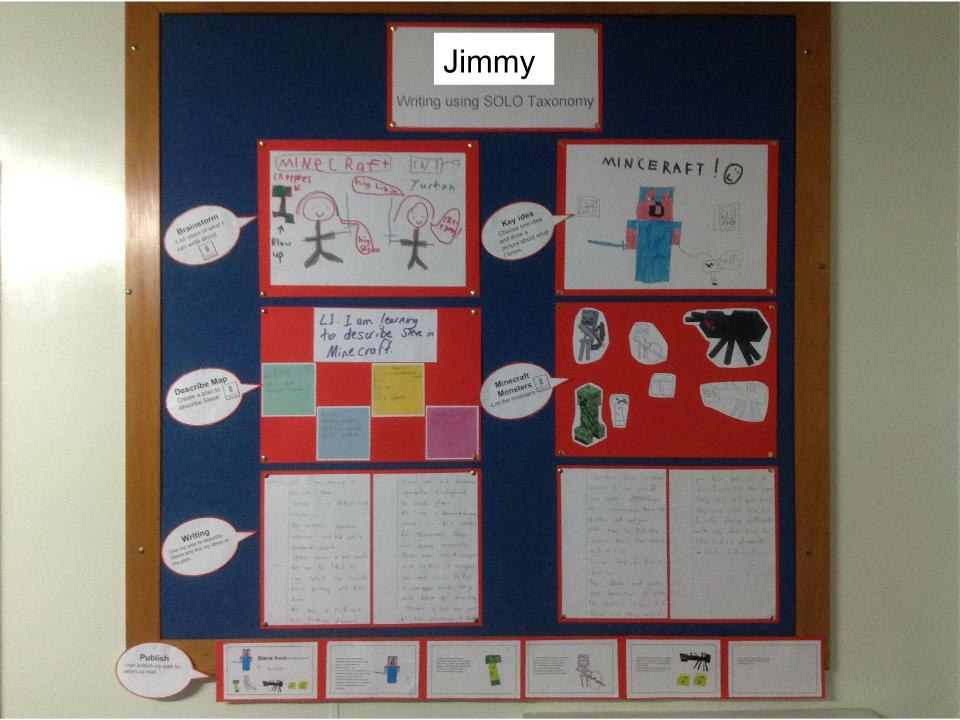
First I had them list all the things they were interested in. I believed I would find a common theme between them. Well that did not happen. I uncovered a different passion in each student and found out that they all like drawing. For ‘Jimmy’ it was Minecraft. To clarify how much he knew, I asked him to draw the main character from Minecraft. With my own beginning knowledge I knew it was Steve. So Jimmy drew Steve.
I told him that we would describe Steve and to do this we needed to list our ideas.
I then asked him to list everything he knew about Steve and I would help him. Using SOLO I knew listing is a multistructural out outcome and from my initial observation I knew this was not a difficult task to do. I gave him a piece of paper and asked him to list all he knew about Steve. When he was ready I gave him another colour and asked him to list all the tools that Steve used in Minecraft. Then he was given another piece of paper and asked to list all the monsters in Minecraft that he knew. Then a final piece to list why he liked Minecraft. Keep in mind I am not a Minecraft player. I have an account and have played the night time version only once.
In the follow up lesson Jimmy was given the task of writing up his first piece of paper. I changed the usual strategy for this too. I have often worked in our junior class and could see how challenging it was for the children to have their describe map stuck into their books and then they have to flick back and forth with their writing. So for my group I gave them a separate book for writing and used a different book for planning. This was to keep all the artifacts together and also so they can visually see their plan all the time. It is in front of them. A major challenge I know with children learning how to write in English is keeping the thought in their head. It is hard enough that we are asking them to write in another language but we are also asking them to think and keep the thought in their head long enough to get this down. I understood the importance of this strategy from the work we did last year with Anne Girven.
As Jimmy wrote down his thoughts, I could barely keep up with him. He wrote quickly. As he wrote I reminded him about the importance of ticking off his ideas. Again the writing professional development learning from last year. In two 30 minute lessons Jimmy wrote 4x pages.When it was time to come to me he would run to be the first into my session. He told me he loved writing. His draft was so raw and delightful I did not want to touch it and so I have not made any teacher edits. Unfortunately he became sick and so missed the next two sessions for editing. So his writing has remained untampered with teacher support. How often do we correct because that is how it is done? We don’t do it to their drawings so why do we do it to their writing? Correcting writers work has also been a real issue with me as a teacher. I am informed it is modelling but I know too from my own experience that until I am ready to make my own spelling changes then it isn’t going to happen. I am empathetic with emergent writers because my own writing is an ongoing challenge for me.
Afterwards in the next session I had him draw the monsters. Then I scanned this into the computer, imported the lined drawings into paint and he dumped colour into them. I learned this little trick from our work with Ant Sang a graphic artist.
Jimmy wanted to come back at lunchtime to work with me. I had to turn down his kind offer because I had other student commitments. I did suggest that he return and work in my room while I worked with other students. This he did.
He missed the self publishing part so I typed up his story for him while he read it out. In the published story I corrected all his inventive spelling and left his initial draft in its current state. I used presentation to do this and then imported the graphics in.
Finally I printed off his home copy and I sent him to receive a principal’s sticker from Dr Kofoed.
Where to next?
For me as a teacher, I was surprised at the relational thinking coming through strongly in his writing. I was aiming for a multistructural outcome but this piece of writing is definitely relational. I will get him to identify and highlight all the relational thinking words that he used to link his ideas.
Because the learning intention is to describe Steve, I will have him rephrase the last paragraph about why he liked Minecraft to what is special about Steve. At this stage of the intervention, I am uncertain if I can push extended abstract thinking but think I can start to develop the early sentence structure to include an I believe statement.
For my next session I will introduce the relational words and the describe rubric and explain how both will help them with their next piece of writing. The decision I have is do I continue to write about topics that interests the boys or shall I focus on the writing that is happening in class? I have identified a commonality with this group of boys and that is a love of cartoons. So maybe I should create a collaborative comic with them.
I spent the afternoon with my SOLO mentor who encouraged me to display the process. I am not the best at making things look pretty for the wall and usually just throw things up. As much as I can I like the children to see too that my own handwriting continues to develop and so they see my handwriting in its raw state. So if you see my writing, that is the writing that the children see too. What I do try and do is make it legible ad I even do this for my modelling books. Several of our children still write with a pencil so if they write with a pencil I also write with a pencil/felt.
Today we had our school assembly and this time it was led by our senior school students who are known as Te Ako Kahikatea. In the New Zealand native forest Kahikatea is the giant of the forest and with the status of being named after the giants of the forest there is also the expectation that our senior students will step up as Kaitiaki and spread their branches and leaves to lead and protect all the other seedlings growing beneath.
I was there in assembly as usual. I was excited and proud for our Travelwise team because today our principal Dr Wendy Kofoed was presenting us with our school’s silver Travelwise status from Auckland Transport. I am the teacher who works with the Travelwise team. This year the team have really stepped up activities and efforts for our school.
I sat in assembly and spotted my big sister and was feeling worried because I care for my aging parents and wondered if all was ok at my house. Assembly began and I focused back on the what was happening.
First Te Ako Kahikatea shared their learning and explained the process of their discovery Friday. As usual I thought I need to be recording this but have been trying to step back and let the team leaders take up more responsibility of sharing their team and their students learning via their team blogs and sites. The rest of assembly unfolded and we listened to achievements and notices.
Then it was time for our certificate to be presented and we all went up on stage. One of my Travelwise students had written a short explanation of why we were awarded our certificate. We received our certificate.
Next Te Ako Kahikatea received their principal’s award. I love this part of the assembly because its like mini celebrations of learning for students from the teams.
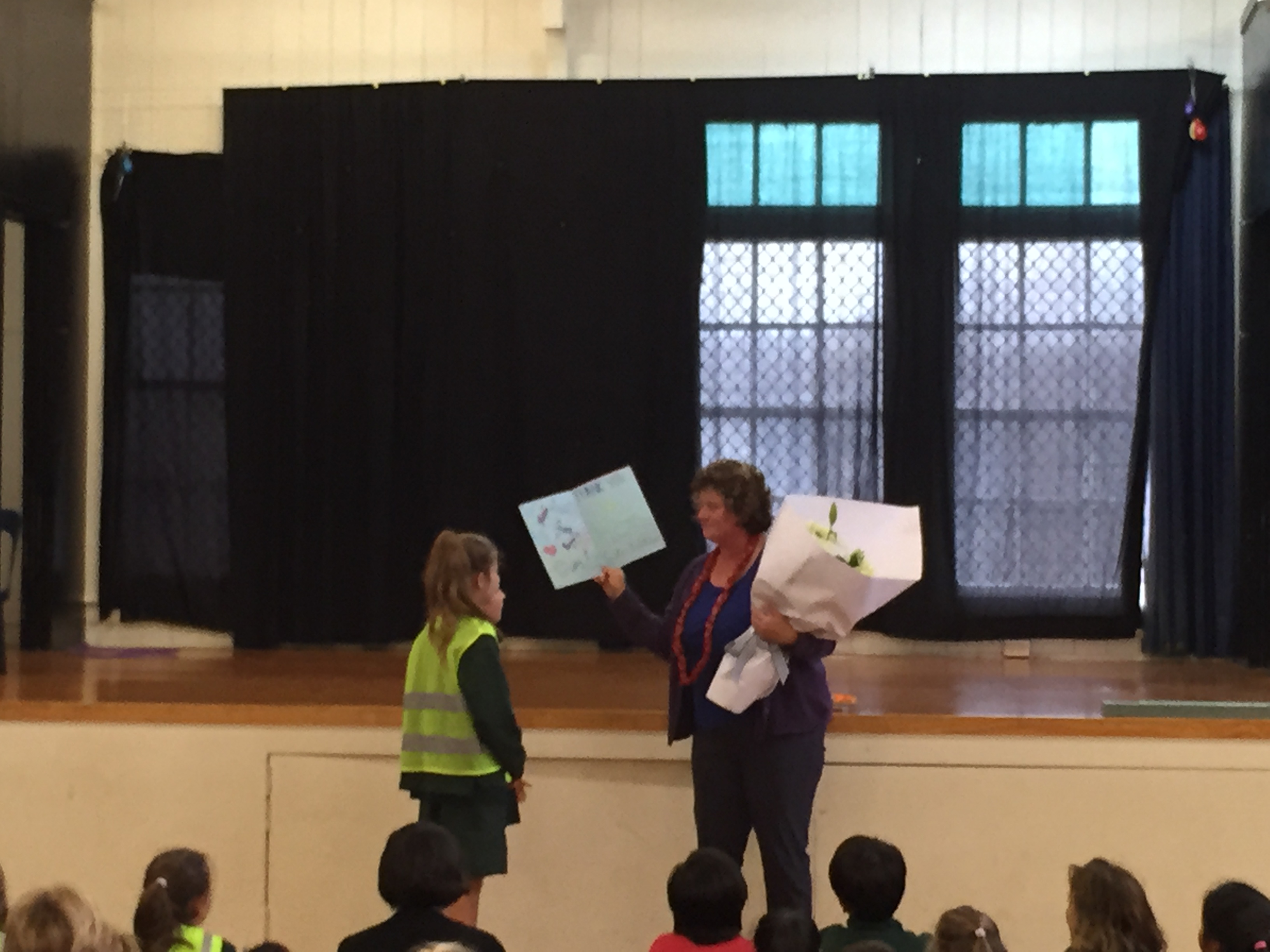
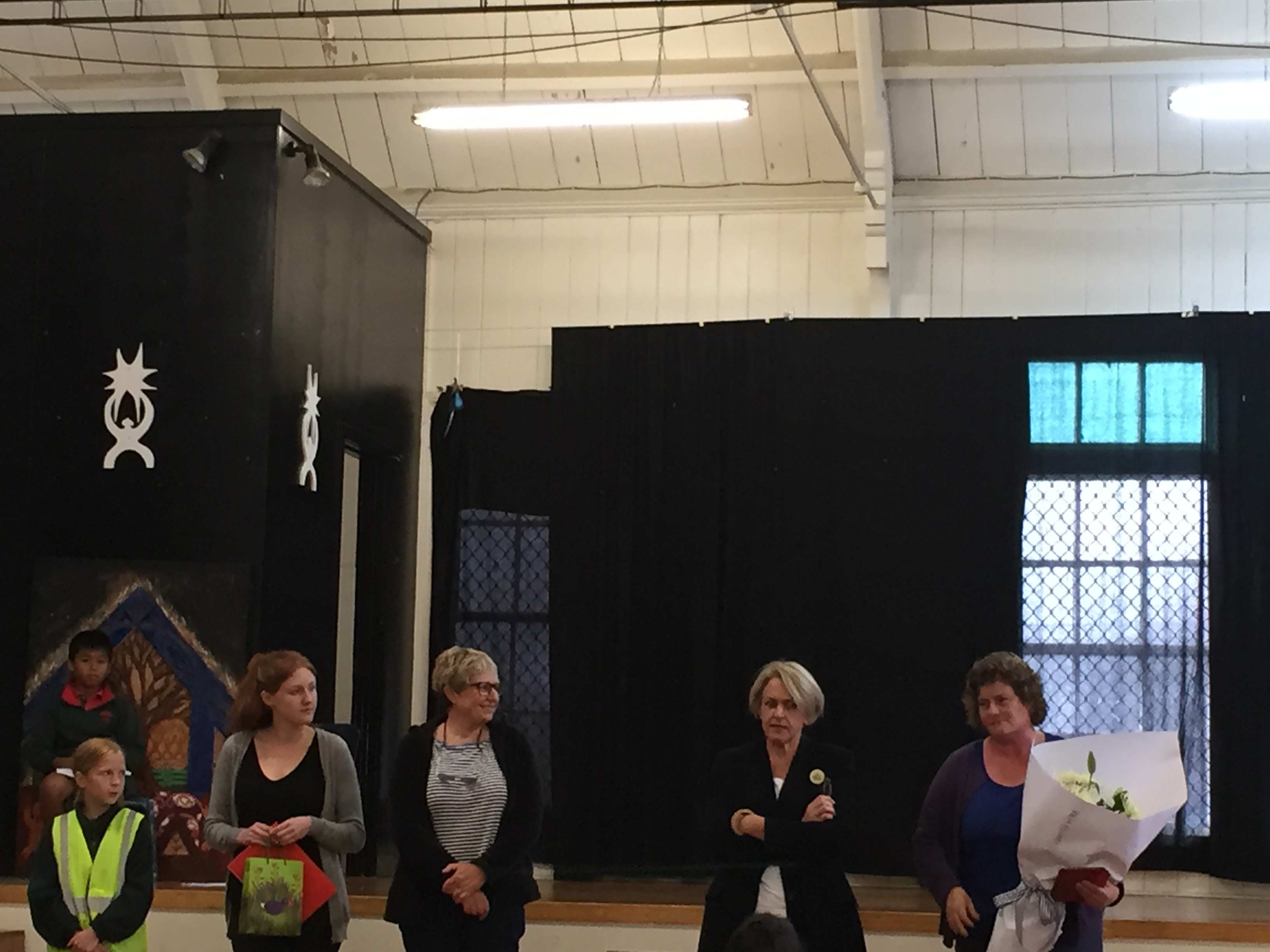
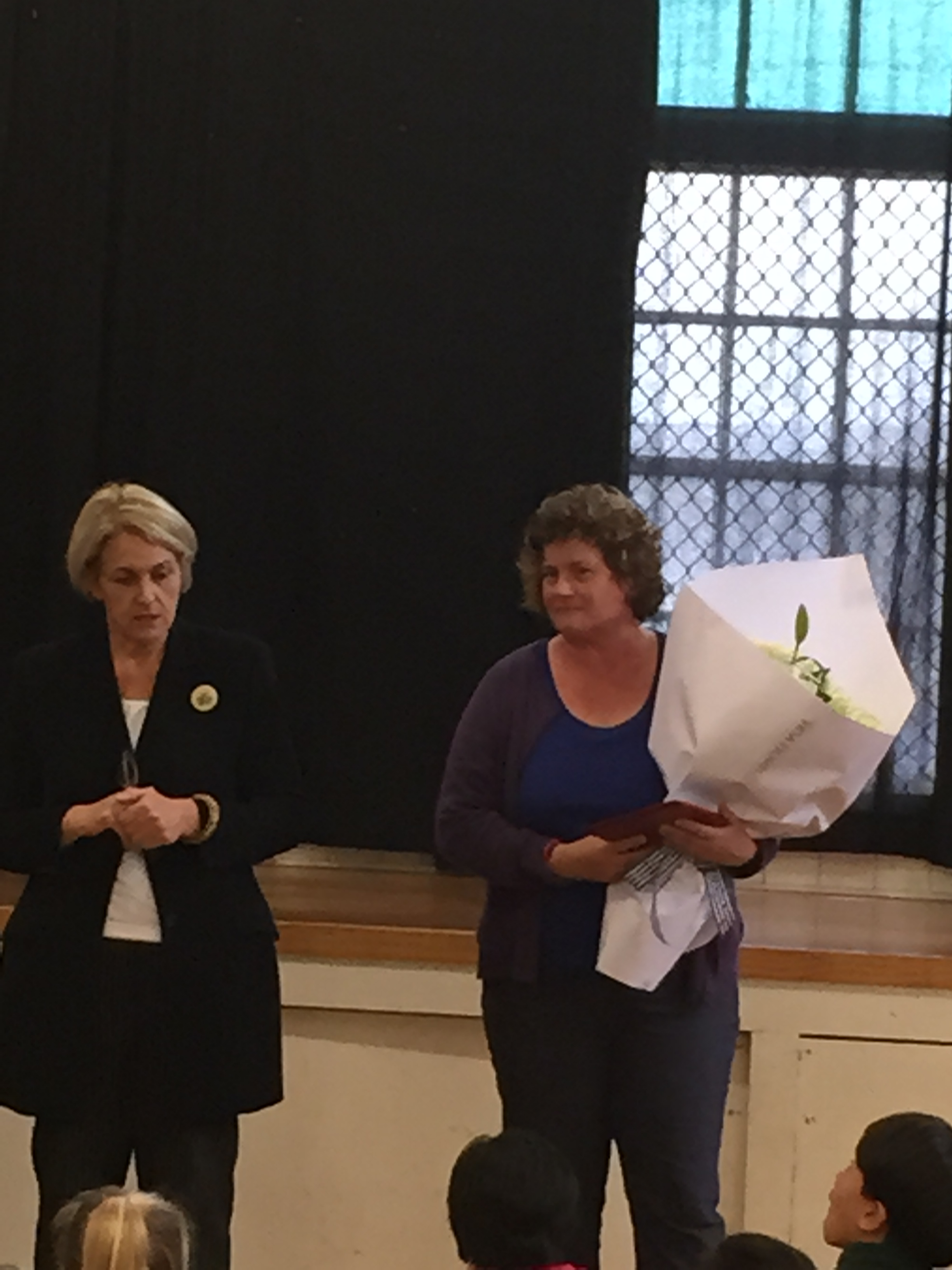
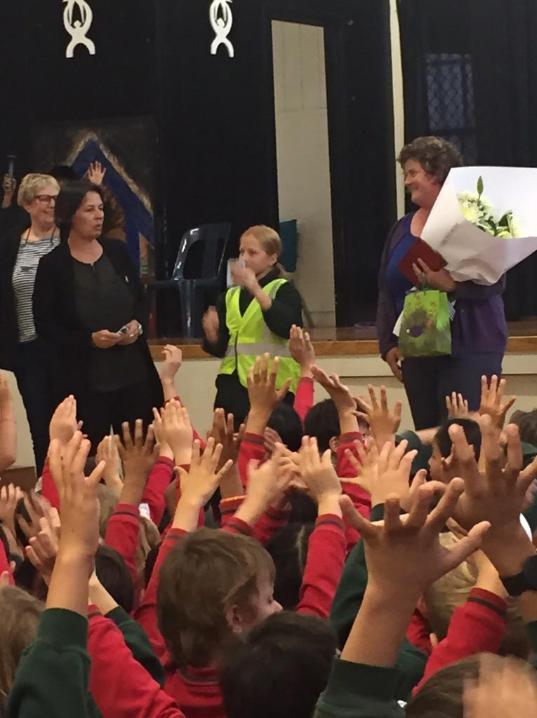
After that the assembly came to a conclusion but before then our lead student commentators said they wanted to call up an amazing teacher who deserved the honour of a mention for all that they do for our school. They played a video and it was me. Many children from the team that I taught, teach and work with shared little snippets about why they thought I deserved this recognition. This part was totally not part of our usual assembly.
I sat right up the front in shock and felt overwhelmed by emotions such as incredible pride at hearing them speak so clearly. Some of my bilingual students spoke and I wiped away tears of joy and was called up to receive a massive bunch of flowers and presented with a red pandanus necklace known as an ula fala which I associate with our Samoan leaders or matai. I was also given a leadership badge and gift that the students work towards and my Travelwsie team had created an amazing card for me.
I stood there listening as some of our teachers spoke too about how I have guided and supported them in their practice. Some from my Travelwise team led our school song and I joined them.
Finally I thanked everyone for the honour bestowed on me, made mention of my big sister and took the opportunity of highlighting our Samoan language week that is celebrated next week.
I believe it is important to be transparent as a teacher, thinker and learner so that children can see your progress. I thought about my Samoan culture and what my grandmother Matalaoa used to say to me, ‘E iloa le tagata i ana tu ma aga’ which means people know you by your actions. I am often asked what is my role at Newmarket School and I often reply jokingly, ‘You do not see what I do but if I was not here the school would fall down.’ At the same time I know that if I was not there and the school did fall down then I have not achieved my ongoing goal of growing others as teacher leaders.
So if you are visiting my reflective blog and were involved in today, thank you, thank you, thank you. I can’t wait to share the children’s video because it shows how awesome their collaborative skills are developing. I can’t believe how they were able to keep it such a secret from me.
Where to next, like Kahikatea we all need mentors and leaders who guide us. We all need feedback about what we do to help with the running of our schools. We must continue to take time to acknowledge each other whether its via words and actions or words on a blog post or tweet.
Faafetai tele lava mo lenei aso matagofie.
Update: my #WELS15 friend Jon wrote this fabulous piece and I have added the link here because he writes with clarity and has included references I have added his twitter here too. @jca_1975.
The intent of the NZ Curriculum vision (NZC 2007 p.8) is to enable connected learners who can support the well-being of New Zealand, can relate to others, participate and contribute to the world around them. This year Newmarket School students joined the Flat Connections Global project, ‘A week in the Life’. Learners are actively engaged in digital collaborative activities with 143 students and 13 teachers from 6 different countries.
This project helps Newmarket School students enact the NZ Curriculum vision by enabling global connections in ways that prepare young learners for their future. Students learn to question, investigate and act as global citizens using digital technologies and online learning environments – learning with and from students all over the world.
The students use SOLO Taxonomy as a model to to design the process of their own learning and to inquire into the impactof their actions as citizens on their communities and beyond. The digital literacies required to usefully and purposefully navigate the environment are a strong learning focus in the project. The information sharing, the creation process and the learning discussion is made visible to all with students using digital tools like Edmodo, Hapara, Google Apps, Popplet and Voice Thread and others.
Hellen Keller said, ‘The world is moved along, not only by the mighty shoves of its heroes but also by the aggregate of the tiny pushes of each honest worker.’
In Samoa we have a saying: “O Manu o le lauamanu e felelei mamao” meaning ‘Birds that fly together go far.’
Introduction
I have selected to evaluate distributed leadership. As I researched background information when I supported a principal friend of mine on his assignment, the works of Gronn, Splianne and Elmore confirmed my beliefs of leadership experience within my current and previous positions. Previously, I have held a variety of teacher leadership roles. These have included:
School Lead Teacher for the 2001 and 2010 Information and Communication Technology Professional Development (ICTPD) contracts
Director of Religious Studies in a Catholic school
Steering committee member for national conferences
Webmaster for two educational associations
Executive member for ULIMASAO Bilingual Teacher’s Association
Steering committee for the Edchatnz Conference
Member of the advisory board for the National Diploma of TESSOL
Led a Samoan Bilingual Team and run the school library.
Host a national virtual TeachMeetNZ each quarter and have had 80 educators share their story.
Develop and maintain the school’s hidden infrastructure for digital learning
With many of these positions, monetary gains, in terms of a Retention unit or a Management unit, are often and have been non-existent. However, the teacher leadership experience has enabled me to learn about distributed leadership. The lack of monetary recognition is minor compared to my vast ongoing personal growth, critical reflection with professional development, community experience, networking, mentoring and being mentored, and having access to a range of knowledge, skills, mentors and leadership practices which have been part of my learning journey.
With this reflection I intend to look at the leadership practices associated with the concept of distributed leadership. I will examine both the educational and the practical utility of this approach to leadership. The reason I have undertaken this task is to further my own understanding about developing leadership in teachers as I believe teachers also need support, guidance and encouragement to undertake many tasks that sit outside their normal classroom practice and yet is an indication of leadership. My personal inquiry is to continue to explore the greatest variance that makes a difference to student learning and that is the teacher. Leadership also plays a role in making a difference to student learning and in particular distributive leadership.
The concept of distributed leadership.
In my readings, I found varying concepts of what distributed leadership is. Key ideas associated with distributed leadership, such as sharing, growing leaders within an organisation, recognising skills and knowledge, mentoring, group responsibility, group accountability, critical reflection and self efficacy appealed to me. I found defining distributed leadership in a way that made sense to me, increasingly challenging.
Defining
Probably the closest term to describe what I believe distributed leadership to be, is an organism that grows and changes depending on the environment it is in. It is constantly changing, living and adapting. MacBeath (2003) defines distributed leadership as ‘something in the gift of a head teacher, allocating leadership roles magnanimously while holding on to power.’ Hence the term distributive which implies a holding, or taking initiative as a right, rather than it being bestowed as a gift. In other words, it is a value or ethic, residing in the organisational culture. Harris (2008) defines distributive leadership as leadership shared and extended within and between organisations.
He Tangata, He Tangata, He Tangata
I strongly believe that distributed leadership also has heroes. Bass (1997) describes them as ‘transformational leaders with highly developed moral and ethical values that reflect the culture and community that they work in’. However, they are far from the ‘super hero’ concept. They stand out because the decisions made within an organization are based around their ‘inner voice’ input. They have people at the heart of all decision making.
Elements of Distributive Leadership
Senge (1990) suggests designer leader, teacher leader and steward leader are essential in distributed leadership. I will discuss teacher leader and steward leader further on in the writing as I have had personal experiences with these concepts of leadership. However within my current growing understanding, I have hesitations with designer leader as I feel that this leadership concept does not align with the concept of distributed leadership. In further searching for a concept to clarify my understanding of distributed leadership, I came across the National College for School Leadership Spring Report, (Bennett, Wise, Woods and Harvey, 2003). The report elaborates on the elements of distributed leadership. These elements are:
1) An emergent property or network of interacting individuals.
2) Openness of the boundaries of leadership.
3) Varieties of expertise distributed across the many, not the few.
I intend to take these elements and explore them further under practices associated with the concept of distributed leadership.
The leadership practices associated with the concept of distributed leadership.
Using the above elements, I will clarify what they are in leadership practices and because I am a teacher, I will reflect back on practices I have observed.
Element 1) An emergent property or network of interacting individuals.
Teacher Leader
In the research I read, the term Teacher leadership appeared regularly. This first came to my attention with the work of Senge (1990). I thought that this term clarified the first element discussed. In describing practices associated with teacher leader, I found it exciting to use the word Teacher Leader as an acronym and to search for practices that describe each letter. The following is what I developed around the various researchers.
Teacher leaders are action researchers who regularly use qualitative data to guide their practice. They are action researchers, peer developers, mentors and decision makers.
Emotional intelligence is one of their traits as described further by Fullan (2001).
They have high ethics and moral values that reflect the culture and community with whom they work. Teacher leaders act and think sensitively to the school culture in which they work. They critically reflect on practice and are constantly changing, adapting and improving their practice. They are committed to self-review and actively encourage critical feedback from their peers and students. Teacher leaders have high student achievement and work with qualitative data. They seek out embedded professional development that focuses on pedagogical knowledge and subject knowledge. They are morally responsible for improving the quality of instruction- not just their own but also the peers with whom they work.
Teacher leaders learn to create and manage learning culture. They have ethical principles, which drive their decisions. They acknowledge all stakeholders and are active stewards in the role they lead. They are daily communicators and ensure that information is accessible to all with whom they work. Teacher Leaders are effective educators.
They see one of their roles in education as supporting leadership activities with resources.
“They equip students with the civic, moral, and personal skills and behaviours to live in a multicultural society.” (Cuban: 2001)
An example of teacher leader is the Sustained contract we were recently a part of. The delegated lead teachers and senior management pooled their ideas and expertise, and shared them around the schools within the cluster. At the same time, staff within the schools were part of the skills and expertise group. If any teacher showed signs of leadership within an area of digital learning or SOLO Taxonomy they usually contributed to the cluster, by sharing their skills and expertise. Everyone within a school was accountable and responsible for the success of the contract. Benchmarks were monitored, feedback was given and qualitative data gathered. This data was used to drive the next round of professional development. I became really skilled at curating evidence of our teacher’s learning and continue to do this even now.
2) Openness of the boundaries of leadership.
Leadership
Once again, I use the term leadership as an acronym to search for practices that describe each letter. A variety of leaderships are defined in Alphabet Soup. (MacBeath, 2003)
However, in this case when I focus on the practices of leadership, I am writing about leadership practices associated with the concept of distributed leadership.
‘The world is moved along, not only by the mighty shoves of its heroes but also by the aggregate of the tiny pushes of each honest worker.’ (Keller, H)
Leadership is about life long learning and is an inner drive about self-improvement in order to better interact with others. It is about empowerment. Empowering the learners, the peers, and the community that all are part of the community of learners. Leadership is guided by action research and can begin with a simple question. Leadership is distributed.
Elmore (2002:15) promotes distributed leadership in “which formal leaders widely distribute leadership responsibilities among various role groups in the organization while they work hard at. Leaders create a common culture, or set of values, symbols, and rituals.”
Leadership is about examining practice and using reflection to guide the practice. At Newmarket School nearly all our staff have taken this onboard and have developed their own reflective blogs.
LEadership is about shared decision-making. One of Lambert’s (2002) key assumptions about leadership is that ‘leading and learning must be shared because school change is a collective endeavour.’ We know the importance of this at our school. I always say to our staff show me your example of what you are asking the children to do. A classic example of this is creating videos or asking the children to write.
Leadership is holistic and supportive. It is about instructional improvement. One of Elmore’s (2002) principles states that ‘the purpose of leadership is the improvement of instructional practice and performance, regardless of role.’
Finally leadership is about a professional learning community. Sergiovanni (1992) discusses the importance of ‘building a learning community by reorganising educational values, beliefs, and practices’.
I have established a learning community outside of school with the work I carry out with teachers on the #TeachMeetNZ project. I have explored many digital communities with our staff and each year brings a new one. I have recently set up one in Edmodo because maybe this year is the year where I can get more than a few contributing in a visible way.
I think back to the work of ULIMASAO bilingual teachers association to raise student achievement for Pasifika students in South Auckland. This is leadership in action, the association worked with school principals, teachers and the community to raise awareness about the benefits of Pasifika Bilingual Education. They used Cummins’ (1996) research on community empowerment, and Colliers’ (1987) research, to drive best practice for student achievement. The community was very much a part of the process. All involved in the children’s learning are responsible and accountable for their achievement. Students’ results drove the work of Ulimasao. Pasifika Teachers came from all over Auckland to share best practice ideas, to support and nurture any new teachers, principals and community to Bilingual Education.
This was leadership in action.
Element 3) Varieties of expertise distributed across the many, not the few.
This element sums up the distributed leadership
Principles and Practices of Distributed Leadership
In order for varieties of expertise to be distributed across the many, not the few, the following leadership practices are necessary.
Daily quality communication takes place. Information is continuously fed through at all levels of the school. Murphy (2002) discusses stewardship. Stewardship is about “the willingness to be accountable for some larger body than ourselves – an organisation, a community“. ‘Stewardship is to do with our choice for service over self-interest, with being willing to be accountable without choosing to control the world around us.’
‘Transformational leadership provides the vision and inspiration that is intended to energise all members of the school community.’ (Leithwood and Jantzi, 1990.)
Distributed leadership is about actively taking responsible roles. Teacher leaders focus on instructional change. They have implicit and explicit goals.
Distributed leadership is about building sound relationships by strengthening webs of social relationships. It is about being a social architect. This concept is about understanding culture, symbols, rituals, ceremonies, and traditions. It is about knowing the community in which you work. This is telling our stories, and redefining our goals in educational concepts. From my previous experiences in Catholic Schools I believe that telling stories is particularly strong in Catholic School. My past schools celebrated and revisited their history each year. They created memories that were archived and shared with the community. I try and do that at Newmarket School with the wiki that was created for this very task. However because I often am the only person curating memories of our stories in a digital way that the work can be overwhelming.
Transferring control is another principle of distributed leadership. It is about sharing leadership even when the school leader makes limits explicit. It is about examining daily practice and embracing the daily macro and micro tasks and using them to critically reflect on daily practices. When all elements are aligned, the result is improved academic outcomes for all. Often the teacher thinks that this is a top down approach but as our understanding of accountability develops and our understanding that we are all on this journey together for the success of our children then this becomes ‘business as usual’.
I see stewardship as an integral part of this element. The Samoan Matai system in which I was brought up helps me relate to this element. A Matai is chosen to lead his village and to speak for the ideas and goals of his village to the council of chiefs. When a Matai is selected, he is selected as the steward of the village, the guardian of values and thoughts of the village he is representing. When Matai come together they represent more than individual villages, they present a presence, a concerted dynamic that moves the world along. In Samoan we say: ‘O le ala o le pule o le tautua.’ Translated this is ‘ The path to leadership is service.’ At my school of Newmarket this is also our historic motto, ‘Not self but service.’
Likewise, in a Catholic school, a similar process takes place. Leaders are appointed to be a steward of the school for which they are responsible. However, the role goes further than that. Leaders are responsible not just for their school, but also for the schools in their neighbourhood and all the surrounding community. When they come together, they become one group, one concertive dynamic which pushes the world along.
Te Hiringa i te Mahara, the Power of the Mind Project by the Ministry of Education uses this same concept – we are all responsible and accountable, for each other as teachers and for our children’s learning.
Educational significance of this approach to leadership.
The educational significance of this approach raises the following questions:
How practical is distributed leadership in education?’
How are we preparing for the future?
Taking the elements already discussed, I revisit them and view their significance to distributed leadership.
Element 1) An emergent property or network of interacting individuals.
Teacher Leadership
Schools cannot change teachers’ behaviour unless they discuss the teachers’ beliefs and values first. Fullan, Rolheiser, Mascall and Edge, 2001) argue that ‘Real change, occurs when teachers are fully engaged as active agents in the process of research and development and when it observes the three cardinal principles of responsibility, mutual accountability and collaboration.’ I have often used the term active agents of change and compared it to baking powder in baking. When baking powder is added the cake rises. At the same time, I use the term disruptive educator or the educator who asks the tough questions. The educator who questions the why of the system. Part of accountability is standing up and asking the tough questions of people leading our schools and leading the education system.
As we prepare our students for a future that is changing, it is not easy to prepare for a moving target. The work place of the future is continually changing and evolving. Teacher leaders recognise this paradigm and use it as a challenge for self-review. Teacher leaders must be life long learners. They must learn new ways of learning with the students that they teach.
Element 2) Openness of the boundaries of leadership.
Leadership
Elmore, (2000) links distributed leadership to the school’s fundamental task of helping students learn. He promotes ‘distributed leadership in which formal leaders widely distribute leadership responsibilities among various role groups in the organization while they work hard at creating a common culture, or set of values, symbols, and ritual.’
Leaders must forge closer links with external influences that help shape the system.
Sometimes, a true leader is able to be a led. They understand that by employing great people and know when it’s time to get out of the way.
Element 3) Varieties of expertise distributed across the many, not the few.
Distributed leadership
Johansson (2006) discusses distributed leadership in depth.
‘This is a values informed leadership a sophisticated, knowledge-based, and skilful approach to leadership. It is also a form of leadership that acknowledges and accommodates in an integrative way the legitimate needs of individuals, groups, organisations, communities and cultures – not just the organisational perspectives that are the usual preoccupation of much of the leadership literature.’
Leadership is about going beyond the four walls of the classroom and even including the students themselves. Leadership is about a professional learning community; it is about shared community knowledge and is organisations and people focussed. Prior knowledge is acknowledged. All members are empowered and are committed and accountable to the vision. There is trust between all stakeholders and normality is diversity.
An evaluation of the practical utility of distributed leadership to leadership.
When I refer back to the practices of distributed leadership, I have chosen to focus on five aspects to evaluate. There are: shared leadership, common vision, outside constraints, budget constraints and time constraints.
Shared leadership.
The leader must be open to shared leadership. Some leaders could feel threatened as they feel their leadership role is being eroded when they share the leader role. It can be equally frustrating for those who prefer to have someone lead him or her.
Having a common vision.
For distributed leadership to work, it helps if everyone in the school has bought into the school vision and goals. This works well in the New Zealand integrated school system, which allows only 5% to be a different faith. The Private Schools Conditional Integration Act 1975 dictates this.
However, in Australia, where Catholic schools, are private schools, not integrated, some schools can have as many as 40% of their students from other faith, or no faith traditions. Distributed leadership would also work in a Bilingual Unit, such as O le Taiala, in Findlayson Park School. Parents, students and teachers buy into the concept when they apply for their children to be included in the units. There are other examples of schools having a common focus. Examples include a schools with an elearning lense such as the schools in the Manaiakalani cluster, or a school based on Emilia Reggio principles. Difficulties can arise if not all stakeholders have bought into the concept. Such stakeholders must suppress their own views for the sake of the school’s common vision and goal, even if they are not in agreement.
Outside constraints
Outside constraints can affect the common vision, and these have implications on distributed leadership. Distributed leadership is about setting the communities’ educational goals. However sometimes outside agencies dictate the education goals. Examples of outside constraints include the Ministry of Education in their National Educational Goals, the Education Review Office in their school reviews, and the Proprietors of Special Character.
Budgets constraints.
Professional development is central to the idea of distributed leadership and the opportunity to critically reflect on one’s own self. However schools’ budgets are usually limited, therefore any money spent on professional development needs to be seriously considered, as in practice, the concept of distributed leadership takes a long time to implement and carry out.
Time constraint.
When leadership is distributed, more demands are placed on individual leaders. It takes time and commitment for school leaders to build a professional learning community. It takes dedication for a person to take on more responsibilities over and above an already heavy workload, and also to reflect on their learning while so doing. I know when I ask staff to do this I am asking a lot. When they reflect on their learning I make a special effort of acknowledging this and give them written feedback on their posts. I also give them a shout out on social media. A passionate belief in education is required to undertake leadership roles, which often comes with no extra monetary gains. I share this from personal experience over the thirty years that I have been teaching. Many times I am asked, ‘why do you run learning sessions for teachers?’ My response is ‘why not.’ I am an older teacher and it’s time to give back. I also take great pride in seeing their development. I take an even greater pride when I see this transfer to their classroom practice. Ultimately a learning teacher is learning children.
Conclusion.
Even with the challenges associated with the practical utility of distributed leadership, my current belief in this form of leadership is effective in sustaining lasting effective, learning environments. I identify with the Helen Keller quote, which I have rephrased to suit a school situation. ‘The tiny pushes from each stakeholders pushes the school towards a goal of long-term effective learning environment for all.’ My background has distributed leadership as a way of making decisions. From the Samoan Matai system, being taught and having teacher leadership modelled in the many of the Catholic schools that I have attended and taught in and having led a Samoan Bilingual Unit where as a team we had a common goal of student success. My current role is with second language learners and the teachers who teach them. We all have the common goal of student success.
Distributed leadership can be seen as a weakness in the current market of instant outcome based models, but I view the aligned elements of distributed leadership as a clear pathway to improved student achievement and the future for lifelong learning. Distributed leadership creates a professional learning community that continually reflects, grows and changes depending on the environment it is in.
Where to next
When I reflect on my understanding of distributive leadership using SOLO Taxonomy, I can define and list elements and practices and am beginning to make links with what is happening at our school. I can see that we are growing stronger as a staff in distributive leadership but still have a way to go. Analysis of data suggest that distributed leadership impacts positively upon student achievement. (Hallinger and Heck, 2009). But change takes time because the whole school needs to come on board with the concepts and share the same vision. At Newmarket School we have recently embraced Google Apps for education. I can see the visible learning of our teachers. Our teams have changed and teachers have new roles and responsibilities. I can see our professional learning community constantly changing, living and adapting as we move to a deeper level of learning cultures. I hear ‘Business as usual’ and for me that is the way we do things at Newmarket School and that is growing leadership capabilities in our teachers and our students.
Bennett, N., Wise, C., Woods, P. and Harvey, J. Distributed Leadership. National College for School Leadership, Spring 2003. Retrieved April, 2015 from
Cummins, J. (1996). Negotiating identities: Education for empowerment in a diverse society. Los Angeles: California Association for Bilingual Education.
Collier,V. (1987).Age and Rate Acquisition of Second Language for Academic Purposes. TESOL Quarterly, 21 (4). 617-641.
Elmore, R. (2000). Building a new structure for school leadership. Washington, DC: The Albert Shanker Institute. Retrieved March, 2015, from
Fullan, M. (2001). Leading in a Culture of Change. San Francisco: Jossey-Bass.
Fullan, M., Rolheiser, C., Mascall, B. and Edge, K. (2001) Accomplishing Large Scale Reform: A Tri-Level Proposition. Toronto: Ontario Institute for Studies in Education, University of Toronto.
Harris, A. (2008) Distributed leadership in schools: Developing the leaders of tomorrow. Routledge & Falmer Press.
Johansson, O. (2001) Swedish school leadership in transition: in search of a democratic, learning and communicative leadership?, Pedagogy, Culture & Society, 9:3, 387-406, Retrieved April 2015 from http://dx.doi.org/10.1080/14681360100200122
Leithwood, K. and Jantzi, D. (1990). Transformational Leadership: How Principals Can Help Reform School Cultures. School Effectiveness and School Improvement, Vol 1, No.3, pp 249-280.





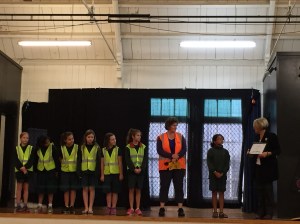
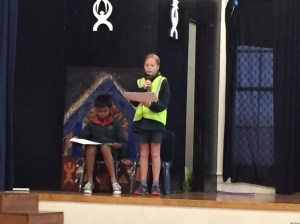
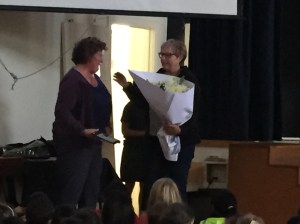 After that the assembly came to a conclusion but before then our lead student commentators said they wanted to call up an amazing teacher who deserved the honour of a mention for all that they do for our school. They played a video and it was me. Many children from the team that I taught, teach and work with shared little snippets about why they thought I deserved this recognition. This part was totally not part of our usual assembly.
 students spoke and I wiped away tears of joy and was called up to receive a massive bunch of flowers and presented with a red pandanus necklace known as an ula fala which I associate with our Samoan leaders or matai. I was also given a leadership badge and gift that the students work towards and my Travelwsie team had created an amazing card for me.
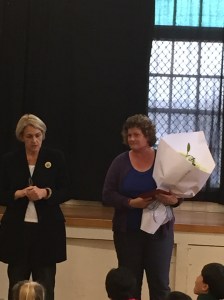 I stood there listening as some of our teachers spoke too about how I have guided and supported them in their practice. Some from my Travelwise team led our school song and I joined them.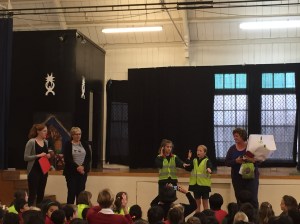
 ‘A week in the life.’
 Sonya @VanSchaijik